

OpenAI said on October 21 that ChatGPT Ads is expanding to 26 additional countries, which extends availability to 89 countries worldwide. The same day, two members of its technical staff published a long engineering post on how the ad system works. Read together, the two posts show where ChatGPT advertising is going and how OpenAI decides when an ad appears at all.
What changed today
According to OpenAI, more than 100,000 advertisers have run campaigns on ChatGPT since ads launched "just over eight months ago." The new markets include 14 more Latin American countries, among them Argentina, Chile, Colombia and Peru, following earlier launches in Mexico and Brazil. OpenAI also named new markets across Europe, the Middle East, Africa and Asia, including Nigeria, South Africa, Serbia, Ukraine, Cambodia, Bangladesh and Pakistan. The company said this builds on its recent expansions across Europe, Southeast Asia and Taiwan. We covered its expansion into 31 European countries in August.
Advertisers in these countries can buy through technology partners or use self-service access through Ads Manager. OpenAI points interested businesses to ads.openai.com.
Two rules stay the same:
- Ads appear only on the Free and Go plans. Plus, Pro and Enterprise subscriptions remain ad-free.
- OpenAI says it keeps conversations private from advertisers, does not sell customer data, labels ads clearly, keeps them separate from answers, and that advertising does not influence ChatGPT's answers.
OpenAI says its next phase will include "additional formats, objectives, buying options, and measurement capabilities." For the formats, bidding and measurement options that already exist, see our earlier ChatGPT Ads explainer.
The revenue figure
The engineering post adds a number the announcement does not. OpenAI writes that ChatGPT Ads "reached $1 billion in annualized revenue run rate less than 200 days after launch." That is OpenAI's own figure, given without a breakdown by country or ad type.
Why ChatGPT needed a new kind of ad system
A search ad system reacts to a clear event, such as a query or a page view. OpenAI's engineers, Ritendra Datta and Karthik Gopalratnam, argue that chat has no such single moment. A person might start by asking how to train for a race and only several turns later ask about shoes. An ad system that acted on the first message could pick the wrong intent.
OpenAI's answer rests on three design decisions described in the post:
- Stateful ads sessions. Information is remembered across turns of a conversation and across multiple conversations, so the system follows the exchange instead of treating each message as a new request.
- An LLM orchestrator. A custom, post-trained LLM reads the conversation and makes tool calls for retrieval, ranking, relevance checks and the auction. OpenAI calls this model "the orchestrator."
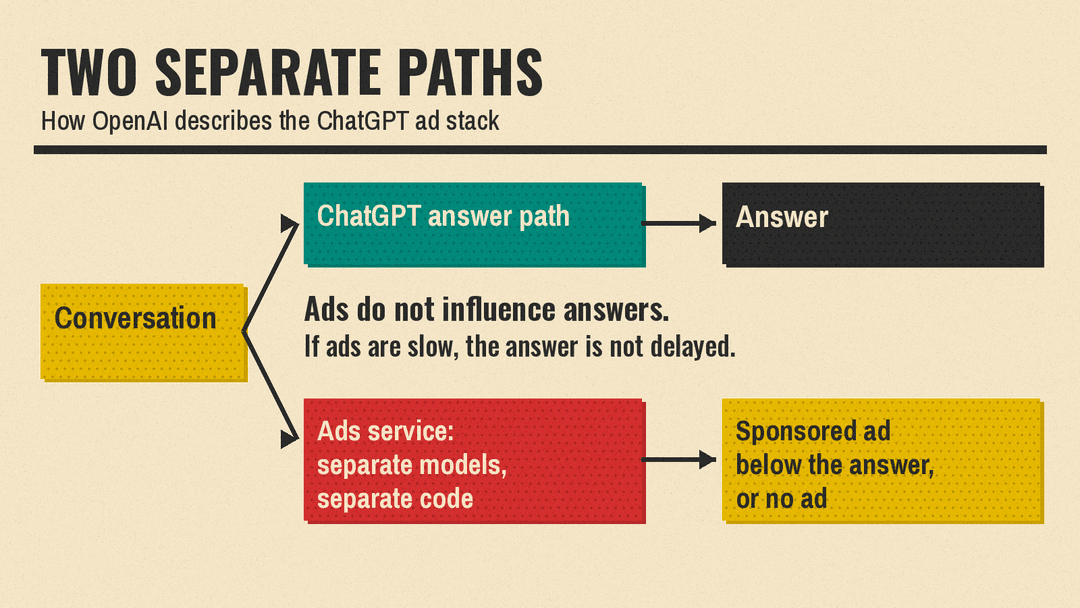
- A separate service. Ad selection runs alongside ChatGPT's answer generation, in its own service with separate models and separate code. If the ads system is slow or down, the answer is not affected.
How an ad gets picked, step by step
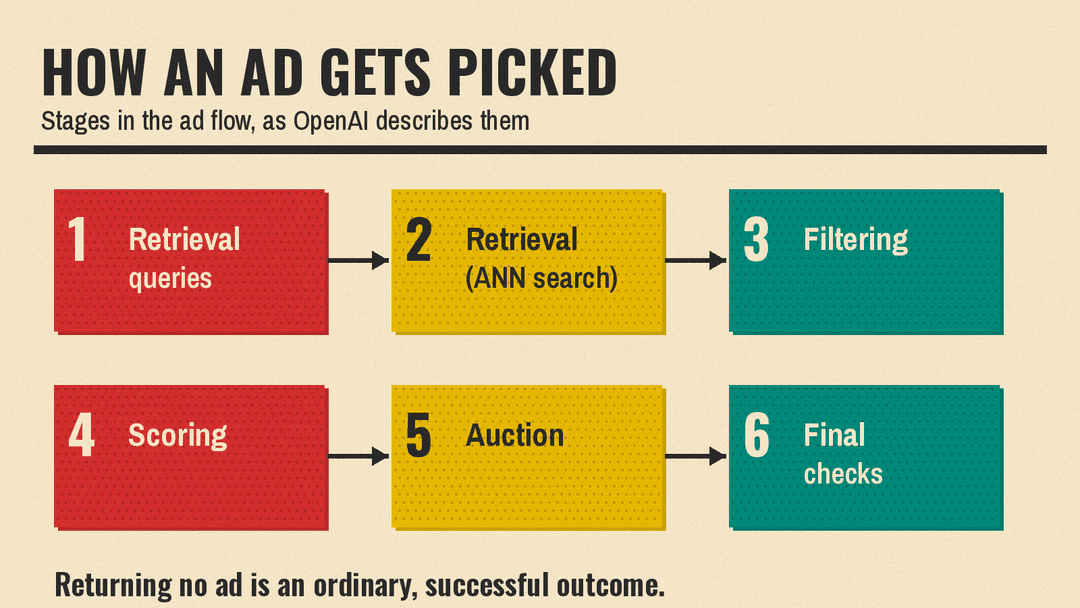
The post walks through the pipeline in order:
- Retrieval queries. The orchestrator turns the conversation into one or more short queries that capture commercial intent. A chat about a Yosemite trip and a shoe brand might become two queries, one for hiking shoes and one for the brand's travel products.
- Retrieval. Those queries become embeddings, and approximate-nearest-neighbor search pulls a deliberately broad pool of candidates from several indices.
- Filtering. Candidates are dropped for reasons such as inactive campaigns, locale targeting, policy restrictions, budget, pacing, placement compatibility and per-advertiser deduplication.
- Scoring. Scoring systems check semantic relevance, predicted engagement and historical performance.
- Auction. The orchestrator nominates candidates but does not choose the winner or set the price. A separate auction tool handles admission, pacing, quality-adjusted ranking, pricing and final selection.
- Final checks. The orchestrator can block an ad that feels wrong for the chat even if it passed policy. An ad that is not ready in time is dropped, because OpenAI says it does not delay answers to wait for ads.
If an ad survives, the frontend shows it below the response, labeled as sponsored, with a short model-written "preamble" explaining how the ad relates to the conversation. OpenAI stresses that returning no ad is "an ordinary, successful outcome."
What it means for users and advertisers
For people on Free and Go plans in the new countries, ads will start to appear below some answers. OpenAI says personalized matching uses "available nonsensitive information" about past conversations only if the user chooses to personalize ads.
For advertisers, matching works on the intent the orchestrator reads from a conversation, not on a single literal query, and some turns will show no ad at all. OpenAI also says it logs granular outcomes, such as a turn that was not eligible or retrieval that returned no candidates, and that advertisers can use the reporting data to improve their strategies. Relevance has been tested from the outside before: a Searchable study we covered in August found that 33% of more than 11,000 ChatGPT ads it reviewed had no discernible relevance to the conversation.
The engineering post also calls Codex a "fundamental force multiplier" in building the system, and that OpenAI's strongest models judge results and help train smaller models used for orchestration or retrieval. OpenAI frames this as a self-improving loop. It gives no figures on how much that loop has improved ad relevance.
What is not said
Neither post lists all 26 new countries, gives prices for the new markets, or names a date for the next formats. The $1 billion run-rate figure appears only in the engineering post and is not broken out. We will update this post if OpenAI publishes the full country list.
