
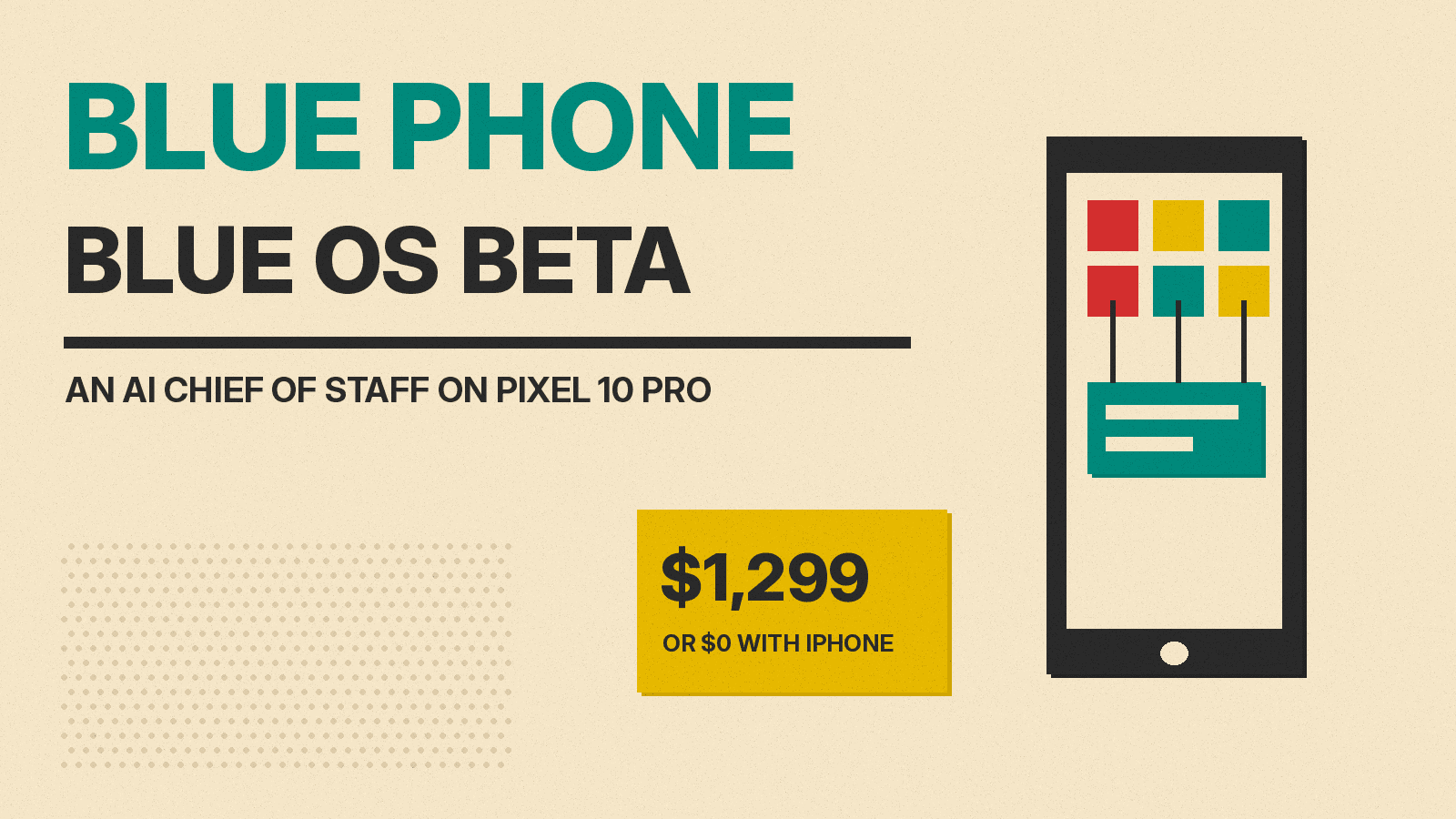
Blue, a startup backed by Y Combinator, opened the public beta of the Blue Phone on Nov 11, 2026. It is not new hardware. It is a Google Pixel 10 Pro or Pro XL running Blue OS, a heavily modified Android around an AI assistant the company calls a "chief of staff." The assistant is meant to work across apps.
What is the Blue Phone?
The beta is a Pixel device with Blue OS. Android Authority reports Blue launched it on Nov 11, 2026. The goal is an assistant that acts inside your apps, remembers the people and details in your life, and finishes tasks in the background while you do something else.
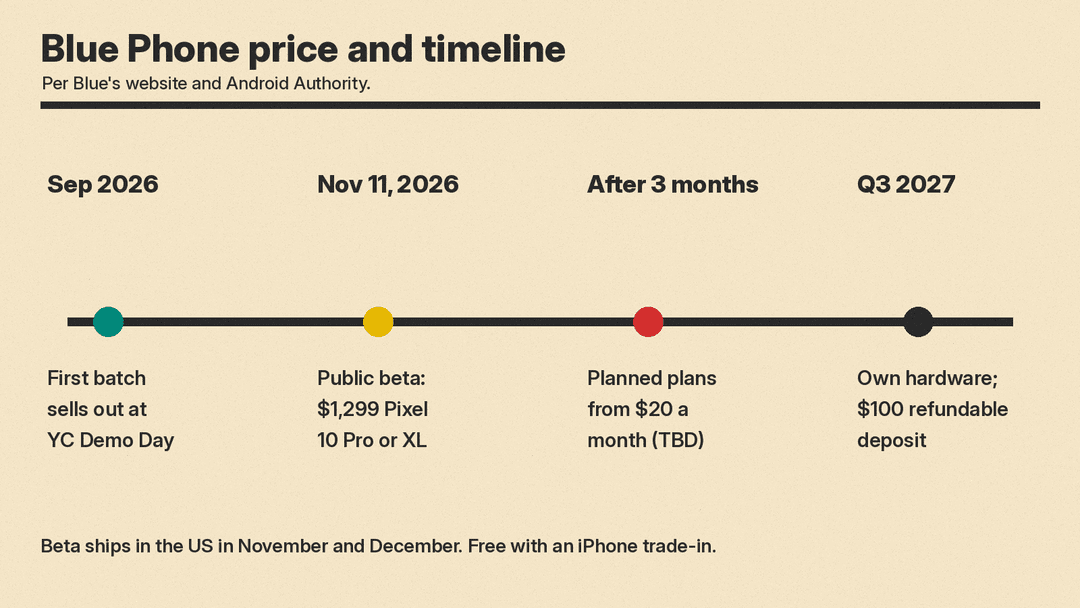
For now, Blue skips custom hardware and installs its software on Pixel 10 Pro and Pro XL phones. The company's own custom Blue Phone is planned for Q3 2027 and can be reserved with a $100 refundable deposit. Its site says, "Alpha sold out. Batch 2 shipping now through December."
What can the Blue assistant do?
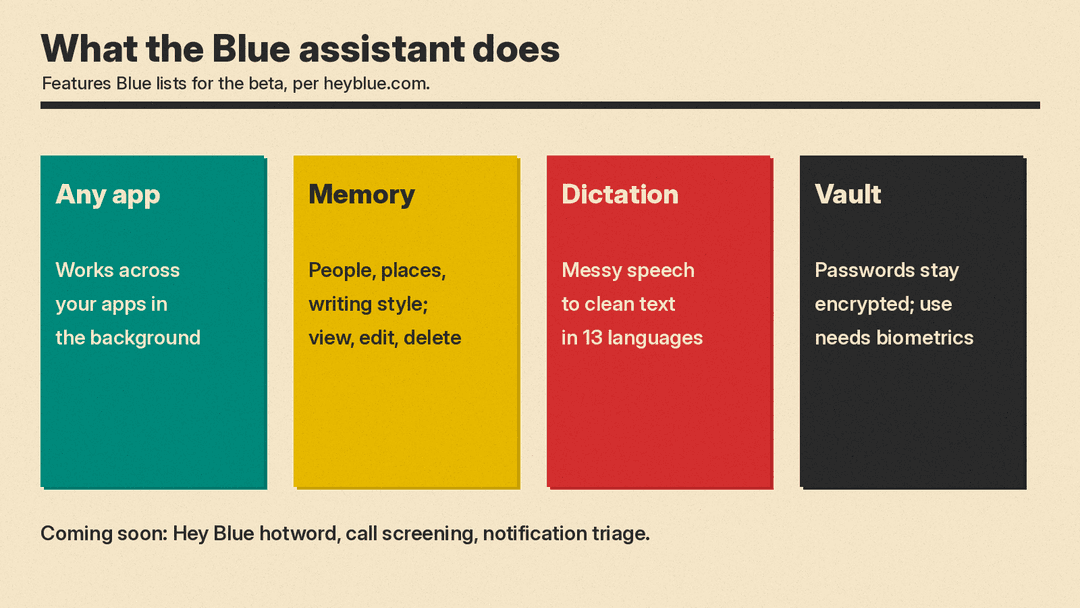
Blue says the beta can use any app in the background, handle multiple tasks, and turn rambling speech into written messages. Examples include finding a receipt from months ago, comparing prices, and disputing an unexpected charge.
Other beta features listed by Blue include remembering people, workflows, and writing style. It can recall anything the user has seen or done before. It supports time-based automations, instant voice actions, smart dictation in 13 languages, a secure vault, unlimited cloud storage, and memories that can be seen, edited, or deleted. Google offers a similar view for Gemini, called Memory summary. A sample request is, "Let Dad know we'll be there in 5".
The team has big-company roots. According to Blue's Y Combinator page, Omar Abdelaziz led Google Assistant's move to large language models, Peter Krogh was a design lead at Google DeepMind building actions for Gemini Live, and Muhammad Farhan Hossain helped ship Apple Vision Pro. Blue's earlier products were a voice assistant that could tap and type across apps and a dictation keyboard. The company says both taught it that on someone else's operating system, an assistant only sees one app at a time. So it built its own.
How much does the Blue Phone cost?
The beta price is $1,299. Blue's site says it can be $0 if you trade in your iPhone within 30 days. Its order form says you pay $1,299 plus tax up front, and you get a refund only if you send the iPhone you switched from, or return the Blue Phone, within 30 days of delivery. It includes 3 months of unlimited use, with fair use limits. After that, Blue plans subscriptions starting at $20 per month. Tiers and token limits are still TBD, and it may support bring your own API key.
Blue estimates delivery in November and December 2026, in the US only. Its order form also requires an iPhone 11 or newer and a Mac with an M chip. Android users are not supported yet.
What is missing in the beta?
Blue marks the "Hey Blue" wake word, full-duplex live mode, notification triage, call screening, calls for you, and Blue desktop as coming soon. Tap to pay with Google Wallet does not work on the beta yet. Blue's workarounds are a watch with Google Wallet (an Apple Watch also works on its own) or a MagSafe wallet.
Google is moving in a similar direction from the other side. Its November Pixel Drop added a feature where Gemini makes phone calls for you. Google adds agent features to stock Android one at a time. Blue replaces the whole system so its assistant can reach everything at once.
What does Blue claim about privacy?
Blue's pitch requires broad app access. Android Authority said this raises privacy concerns. Blue uses an encrypted Vault for passwords, and says the OS is based on security-focused open-source Android and blocks ad tracking by default.
Blue says its Vault uses AES-256-GCM encryption for each secret, with account keys sealed in a hardware security module. The assistant cannot decrypt the Vault, and using a vault item requires biometrics. If data is stored in Blue's cloud, the assistant can access some decrypted data. Blue says it does not access your data by default, does not use it to train models, and will not sell it.
The assistant also uses your existing logged-in app sessions and handles two-factor codes itself. That removes friction, but it gives the assistant sensitive reach across accounts. Not every service allows that: United Airlines now bars unauthorized personal AI agents from booking its flights.
Should you switch?
Blue says it switched 10 people from iPhone and none wanted their iPhone back. That is a company claim, not a review. The company sold out its first batch at YC's Alumni Demo Day in September.
Switching is guided. Blue says you can plug the iPhone into a Mac and bring over contacts, messages, photos, alarms, and install Android versions of your apps from Google Play. You can keep your number through eSIM transfer. FaceTime does not work because it is Apple only. AirPods work over Bluetooth. Texting iPhone users works over RCS. Android Auto works.
Apple Watch is the main switching issue. Blue says it only partly works. It will not show the Blue Phone's notifications, texts, or calls. Blue recommends Pixel Watch 5 instead.
The product may suit early adopters who are comfortable giving an AI deep access to apps, messages, media, passwords, and habits. It may also suit people who want software to offload chores, such as finding old receipts, comparing prices, or repetitive typing. It is harder for people who need tap to pay today, rely on Apple Watch, or are wary of a startup OS reading everything across their phone.
These are company claims and beta materials. The sources do not include a quality review. Treat the features, limits, and privacy statements as an early company description, not proof of daily performance.
Sources
- Android Authority: Blue OS on Google Pixel 10 Pro
- Blue website: Blue Phone
- Y Combinator company page: Blue
- llms.blog: Pixel Drop Gemini call for me
