
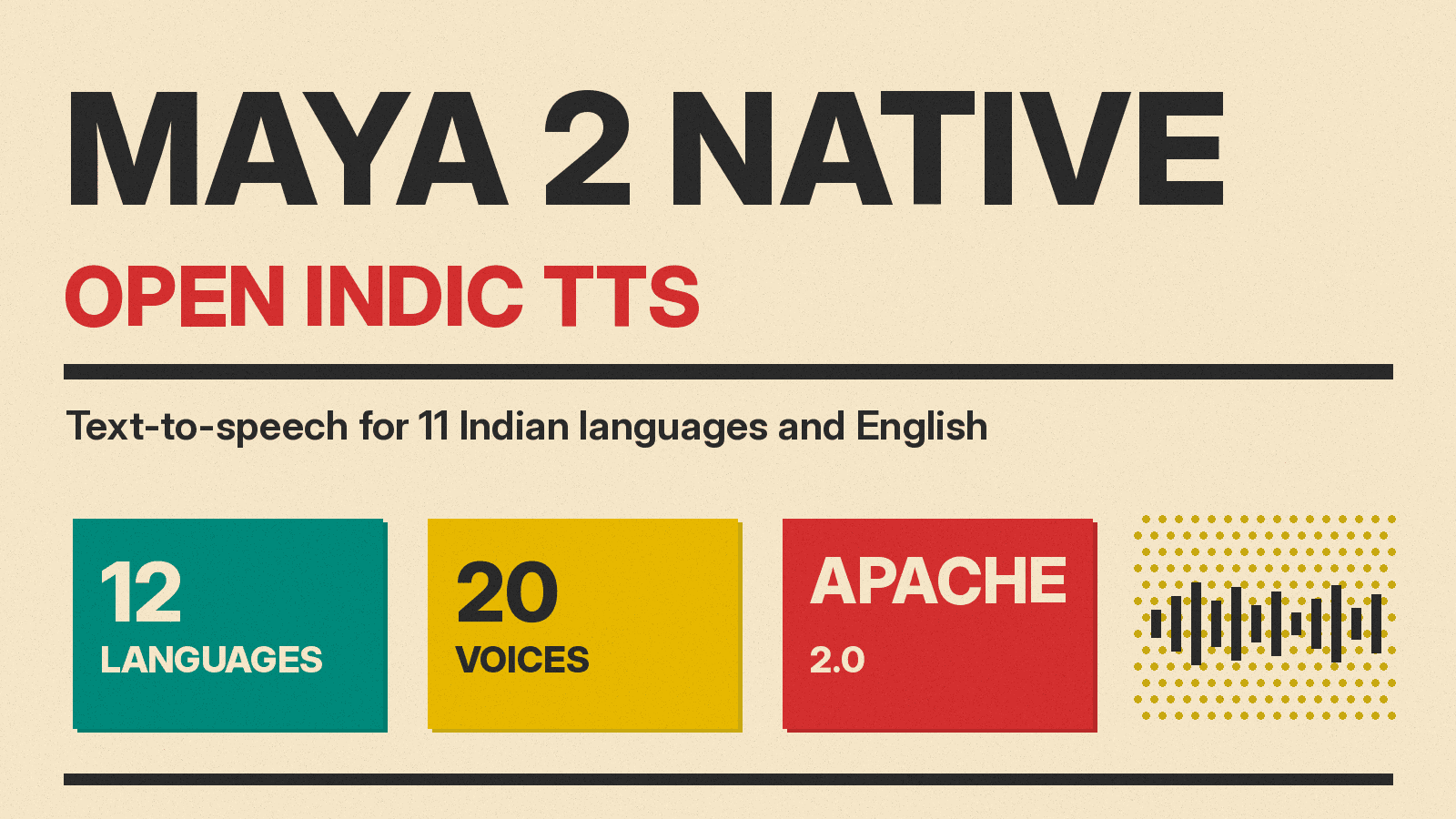
Maya Research has published the weights for Maya 2 Native, a streaming text-to-speech (TTS) model for 11 Indian languages and English. The model card on Hugging Face describes it as "Streaming text-to-speech for 11 Indic languages and English" and lists a checkpoint release date of October 25, 2026. The weights and the inference code are both under Apache-2.0, so developers can host the model themselves, subject to the license terms.
The weights follow an announcement two weeks earlier. When the company announced Maya 2 on October 14, Digit reported that Maya 2 was offered as hosted models, and that CEO Dheemanth Reddy said it would soon be free for all builders. Analytics India Magazine reported the open-weight release on October 27.
What Maya 2 Native does
Maya 2 Native turns text into 24 kHz mono speech and streams it in 80 ms audio frames, so an app can start playing the voice while the model is still generating. According to the model card, it has:
- 12 languages: Assamese, Bengali, English, Gujarati, Hindi, Kannada, Malayalam, Marathi, Odia, Punjabi, Tamil and Telugu.
- 20 built-in voices. The card says all 20 names "describe synthetic voice personas", not real people.
- Zero-shot voice cloning from 3 to 10 seconds of reference audio, plus its exact transcript.
- Cross-lingual speech. In the card's words, "a Hindi reference can become Tamil speech."
- Three ways to call it: a Python API, an OpenAI-compatible speech endpoint and WebSocket streaming.
Maya Research lists voice interfaces and agents, accessibility, reading and narration, IVR (phone menus), notifications and research as the intended uses. The sample sentences on the card include a loan EMI due date, a refund amount in rupees and an OTP that did not arrive.
How it works
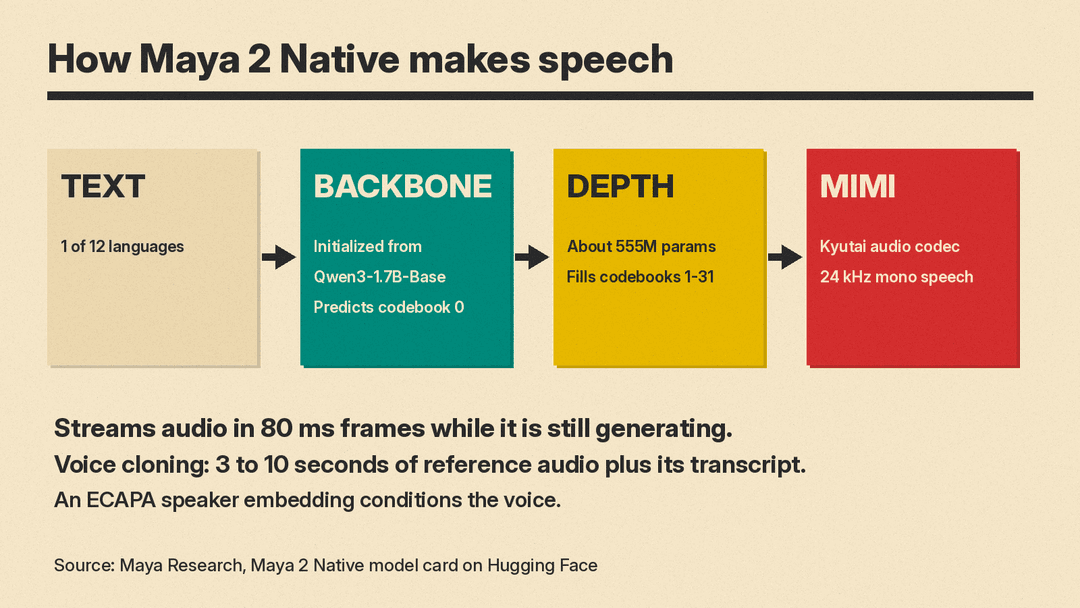
The card says the model generates audio tokens one step at a time, then turns them into sound with Kyutai's Mimi audio codec. The parts:
- A text and audio backbone initialized from Qwen3-1.7B-Base, with an extended vocabulary for language and audio tokens.
- A depth decoder of about 555M parameters that predicts codebooks 1 to 31 after the backbone predicts codebook 0.
- Mimi, with 32 codebooks at 12.5 frames per second, which decodes each frame into audio.
- A SpeechBrain ECAPA-TDNN speaker embedding for voice conditioning and cloning.
The card lists 2.50B unique parameters and about 5.0 GB of BF16 weights. Training used "a mixture of licensed and synthetic speech with transcripts" plus text-only data, followed by direct preference optimization (DPO) on candidates ranked by speech-recognition agreement and speaker similarity. Maya Research does not disclose dataset names, total training hours or per-language composition.
How Maya Research tested it
The company built a benchmark of 6,000 held-out texts, 500 per language across 31 content types such as names, numbers, dates, currency, addresses, URLs and code-mixed text. That produced 20.3 hours of speech. Three speech-recognition systems transcribed the audio, and the card reports character error rate (CER), where lower is better.
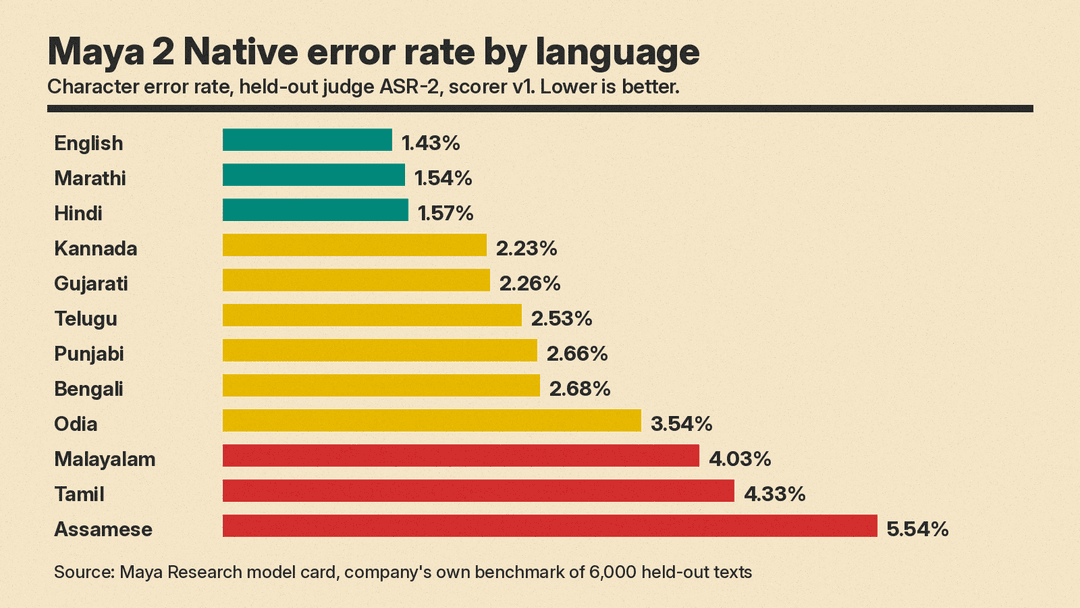
With the held-out judge (ASR-2) and the first scorer, overall CER was 2.86%. By language, it ranged from 1.43% for English and 1.54% for Marathi to 4.33% for Tamil and 5.54% for Assamese. With a second scorer that also harmonizes Latin and native-script spellings in mixed-language text, overall CER fell to 1.73%. The card notes that the lower v2 numbers "reflect a scoring change", not different audio.
Harder inputs show the limits. Web addresses had a 29.06% CER under the first judge and scorer, and heavy code-mix had 16.74%.
On the public VoiceArena leaderboard, the card says Maya 2 Native ranked second for Hindi among real-time TTS models on October 27, with an Elo of 1047 and a published rank interval of 2 to 4, behind Cartesia Sonic-3.6. The card adds that "scores and ranks change as samples are added." Digit reported a first-place Hindi rank in mid-October, so treat any single snapshot as a moment in time.
These are the company's own measurements. The card says it "does not report a human naturalness study" or "a controlled comparison with other TTS models." Reddy's post on X, quoted by Digit, says "Maya-2 officially outperforms ElevenLabs v3, Cartesia Sonic 3.5, and Bulbul v3" across Indian languages. Digit noted that the results "do not show how the test was conducted."
What it takes to run
The quickstart asks for Linux, Python 3.10 to 3.12 and an NVIDIA GPU with a driver that supports CUDA 12.8. One concurrent stream ("seat") needs about 7.7 GB of GPU memory steady and 9.2 GB at load, plus about 0.5 GB of CUDA context. The card says a 12 GB or larger GPU "provides more room." At 32 seats, steady memory is 15.8 GB.
For scale, Maya Research reports a run on one H100 NVL with 224 concurrent WebSocket streams, 323 seconds of audio per second, and a steady-state median of 111 ms to first audio. The card says these numbers "do not establish public internet or telephone latency." The built-in server has no authentication, so add access controls before you expose it.
Limits to know
The card lists these limitations:
- Assamese is weakest. No built-in voice has at least one hour of Assamese training data, and some outputs drift toward a Bengali-like timbre.
- Very short turns of one or two words are less stable in voice identity.
- URLs, symbols, dates and long digit strings remain difficult, even with text normalization on.
- Cloning is approximate, and no dedicated cloning benchmark is in this release.
- Emotion tags such as
[laughs]and[whispers]are "best effort." - No audio watermark. Apps must add their own consent, disclosure and abuse controls.
Maya Research asks users to clone only voices they own or have explicit permission to use, and to disclose synthetic speech to listeners.
Why it matters
Maya 2 Native ships with a measured per-language breakdown, a voice list with training languages, and hardware numbers. That lets a team test its own languages before it commits. Other recent open speech models include Hurston-1, which is itself a fine-tune of Maya Research's earlier Maya1, and Ant Group's Ming-3.0-audio. Teams that would rather buy a full voice-agent stack can compare it with Mistral's Voxtral 3.
Licenses
The weights and inference code are Apache-2.0. Upstream parts keep their own licenses: Qwen3-1.7B-Base (Apache-2.0), Kyutai Mimi (CC-BY-4.0) and SpeechBrain ECAPA-TDNN (Apache-2.0). The card asks users to preserve their notices and attribution.
