
OpenAI said on November 4, 2026 that it will acquire Pierre Computer Company, Inc., the company behind Code Storage and a set of open-source developer tools. The announcement does not state terms. It also says the deal is not done: closing is subject to customary conditions, including regulatory approvals.
For people who use Codex, the practical news is small. Pierre's file browser and change viewer are already inside the Codex app. OpenAI's announcement points to where it wants Codex to go next: work that runs "from the first branch an agent creates to that magic moment when code is deployed to the world."
What Pierre makes
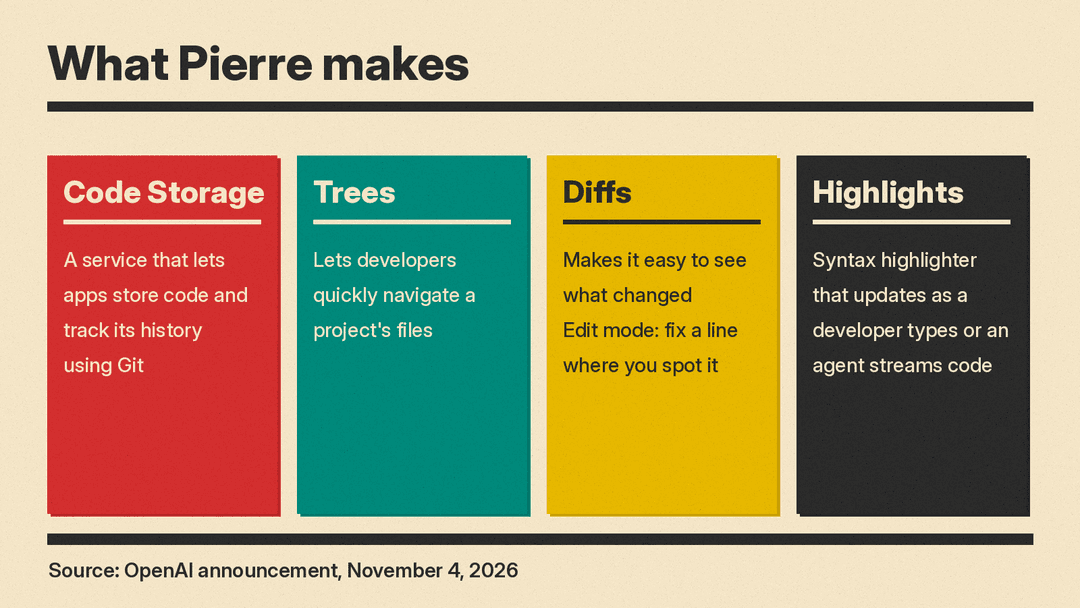
According to OpenAI's announcement, Pierre is "the company behind Code Storage and a family of standout open-source developer tools." Pierre's own company page describes it as a software company that produces "low level, composable product infrastructure for machine work." Four products matter here.
- Code Storage. OpenAI describes it as "a service that lets apps store code and track its history using Git." Pierre's Code Storage page says it stores code and other machine-generated artifacts, and offers SDKs in TypeScript, Python and Go.
- Trees. An open-source file tree library. OpenAI says it "lets developers quickly navigate a project's files." Pierre's Trees site lists options such as Git status badges on files.
- Diffs. An open-source library for rendering code and diffs on the web, per Pierre's Diffs documentation. OpenAI says it "makes it easy to see what changed." Its Edit mode "lets a reviewer fix a line of code right where they spot the problem."
- Highlights. A syntax highlighter Pierre released recently. OpenAI calls it "an extremely fast syntax highlighter that updates as a developer types or an agent streams code." Pierre's write-up reports speeds of up to 298 times Shiki's throughput in its own benchmark on large files. The Diffs documentation marks Highlights as beta.
OpenAI says that if you have browsed files or reviewed a change in the Codex app, you have already used Pierre's Trees and Diffs libraries.
What changes for Codex users
OpenAI states three commitments.
- Pierre's open-source projects will remain open-source, and OpenAI will "continue to contribute to them."
- Customers can continue using Code Storage after the acquisition closes, "while we work to bring its features and functionality into Codex."
- Until closing, OpenAI and Pierre "will remain separate and independent companies."
The announcement gives no timeline for moving Code Storage features into Codex. It names no new Codex feature and no price change. It says the companies "will ship new products and platforms that benefit all," but not which products or when.
OpenAI does state a goal. Once the deal closes, it wants Codex "to connect the code a company ships with the decisions its people make, at the scale the future demands." It also says it wants to "advance the future of source control across the industry." For earlier Codex changes, see our post on OpenAI doubling ChatGPT Pro Work and Codex usage.
How the deal connects to Pando
The announcement links the deal to a second OpenAI post from two days earlier, Scaling Git at OpenAI. Dated November 2, 2026, it introduces Pando, which OpenAI calls its "in-house source control backend for engineers and agents."
OpenAI wrote that its monorepo grew at "a staggering pace" and that Codex lets engineers "do far more work in parallel," which means more branches, pushes, merges and fetches. Starting around the end of last year, its systems suffered "slow fetches and pushes along with failed merges, with reliability at times falling below 90%."
Pando keeps compatibility with the Git protocol and client but changes the backend. OpenAI says Pando "now powers all development in OpenAI's monorepo," and that switching to it "reduced the latency of the median push by nearly 80%." It also says it built Pando with Codex in 10 weeks, and that it is "currently exploring ways to share the technology that makes Pando possible with our users."
This is the context for the Pierre deal. Code Storage covers storing code and its history. Diffs covers reading and fixing a change. Both sit on Git, which fits OpenAI's stated aim to "build on the Git workflows that developers already rely on and adapt them to how teams work with coding agents."
How the two Git systems relate
The sources do not say how Pando and Code Storage will fit together, so any answer would be a guess. The two pages do describe different designs. Pierre's Code Storage page says the service "leverages Git's three-phase commit protocol" with a quorum-based architecture. OpenAI's Pando post describes a three-phase commit design as one conventional approach it evaluated. It says Pando instead uses causal consistency, so pushes to unrelated branches do not wait on each other.
The competitive angle
Axios, which says OpenAI told it about the deal exclusively, framed the acquisition as a move against GitHub. It wrote that OpenAI "is joining a slew of companies challenging Microsoft's GitHub as AI agents take on more coding work." OpenAI's own announcement does not mention GitHub. The same day, Meta said it had bought Conductor, which makes an app for running several coding agents at once.
Other vendors also build tools around coding agents. Our posts on GitLab Orbit's context graph for AI coding agents and the GitHub Copilot app's Projects and computer use cover two of them.
What is and is not decided
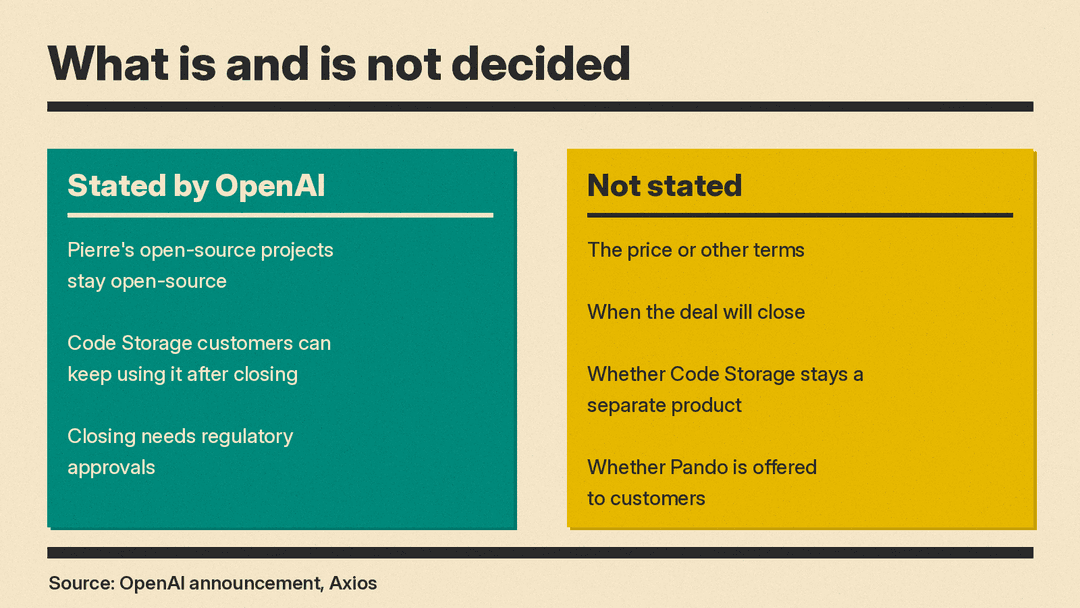
Stated by OpenAI:
- OpenAI will acquire Pierre Computer Company, Inc.
- Pierre's open-source projects stay open-source.
- Code Storage customers can keep using it after closing.
- Closing needs customary conditions, including regulatory approvals.
Not stated in the announcement:
- The price or other terms. Axios wrote that "Financial terms were not disclosed."
- When the deal will close.
- Whether Code Storage will continue as a separate product once its features move into Codex.
- Whether, or how, Pando will be offered to customers.
Readers who use Pierre's libraries or Code Storage today have no required action, since OpenAI says they can continue as before. The next facts to watch are the closing notice and any Codex release notes that mention Code Storage.
Separately on November 4, Cat Wu, who led product for Claude Code at Anthropic, said she is joining OpenAI to lead product management for Core Products. See our post on the hire for what she and Business Insider said.
