
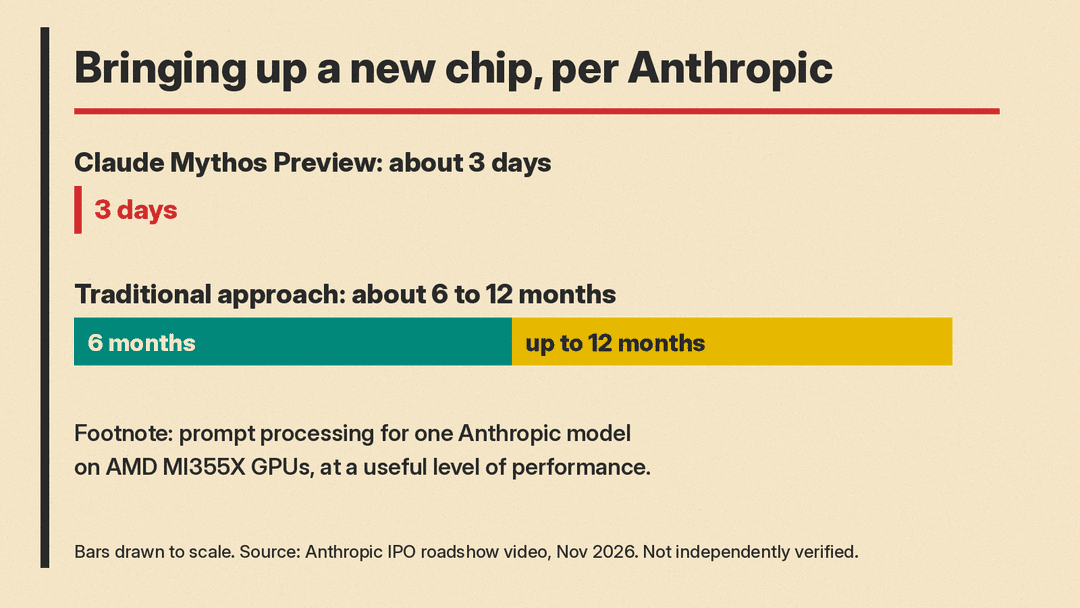
Anthropic says its most capable model, Claude Mythos, got Claude running on AMD GPUs in about three days, a job the company says used to take dozens of engineers months of work (about 6 to 12 months, per a chart in the video). The claim comes from the "Approach to compute" chapter of the roadshow video on Anthropic's IPO site, which the company posted as it markets its shares ahead of a Nasdaq listing under the symbol ANT.
The figure is Anthropic's own, made to investors, and the fine print is narrower than the headline number. Here is what the company said, what it did not say, and why chip makers are paying attention.
What Tom Brown said
Anthropic co-founder and Chief Compute Officer Tom Brown describes the AMD work in the video. From a transcript that Simon Willison made with MacWhisper, because Anthropic did not publish one:
"As an example, this year, we started working with AMD GPUs for the first time. In the past, bringing on a new chip platform took dozens of engineers months of work This time, we had Mythos try it out. It got Claude running on AMD in just three days, with basically no human intervention. Claude ported or wrote almost 100% of the kernels."
Kernels are small, heavily tuned programs that do a model's math on one specific chip. Each chip family needs its own set, which is why moving an AI model to new hardware is slow and costly.
The fine print: one model, prompt processing only
The headline claim is broader than the footnote under the chart. According to Mad Robot, the footnote says the three days is "the approximate time for Claude Mythos Preview to bring up prompt processing for one Anthropic model on AMD MI355X GPUs at a useful level of performance." The Decoder describes the chart the same way: the figures refer to prompt processing of an Anthropic model on AMD MI355X GPUs.
Prompt processing is the step where a model reads its input before it starts to write a reply. So the footnote covers one stage of one model, not every Claude model, and not training. Per Mad Robot, the footnote says the 6 to 12 month comparison "is based on the Company's historical experience bringing up new accelerators using traditional engineering approaches."
The Decoder notes that the figures come from Anthropic's investor presentation and have not been independently verified. Anthropic has not published technical details of the port.
What the prospectus says
Anthropic's amended S-1 filed with the SEC on November 10 makes the same point in more careful language, with no three-day figure:
"Historically, bringing a new chip platform into production required intense engineering effort over many months. By leveraging Claude, our engineering teams can now bring new chip platforms into production more quickly."
The filing adds that this speed "also rel[ies] on the robust foundation we have already built across multiple chip families, including a proprietary orchestration layer designed to seamlessly test and measure performance against our actual workloads." In other words, Mythos did not start from zero. It worked on top of years of Anthropic's own infrastructure.
Four chip families, one pool
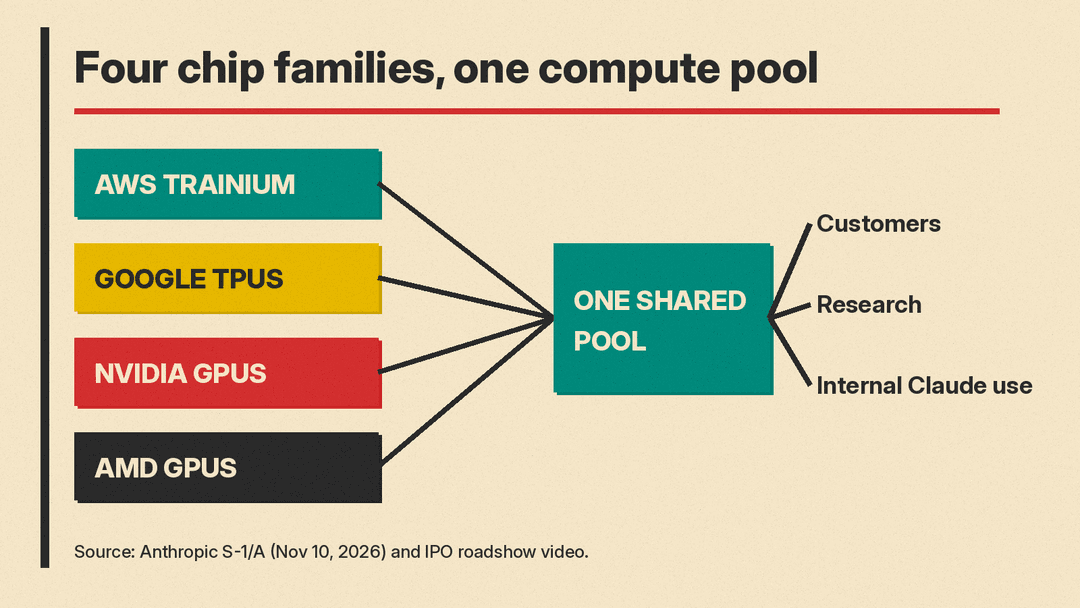
The AMD story is part of a larger pitch. The prospectus says Anthropic trains and serves Claude "natively across four major chip families (AWS Trainium, Google TPUs, NVIDIA GPUs, and AMD GPUs)." In the video, Brown calls this an early "unconventional bet on a multi-chip strategy," made when "many people thought that running AI models on different chips wasn't worth the effort."
The goal, per the prospectus, is a compute pool that is "fungible by design": capacity from any provider, chip type or location can be sent to customer work, research or internal use of Claude.
Anthropic ties this to its numbers. The IPO site lists a compute efficiency gain of more than 4x since the first quarter of 2025, measured as revenue divided by compute and infrastructure expenses. The prospectus says revenue grew 1,127% year over year in the three months ended September 30, 2026, while compute and infrastructure expenses grew 382%.
Why it matters for Nvidia
Nvidia's strongest advantage is software. Most AI code is written for CUDA, its programming platform, and moving to other hardware means rewriting and re-tuning the kernels underneath. If a model can do most of that work in days, labs can shop for chips on price and supply. The Decoder points out that Nvidia earns margins of more than 70% on its hardware, which it calls unusually high.
Brown does not name Nvidia or CUDA in the quoted remarks, and Nvidia is still a supplier. The Decoder notes that Nvidia committed in November 2025 to invest up to $10 billion in Anthropic. Under the prospectus, at the $74 midpoint of the $70 to $78 price range, Nvidia would buy about $10.0 billion of Anthropic's Class N stock in a private placement alongside the IPO, and AMD about $2.5 billion. The prospectus also describes a "multi-year engineering collaboration" with AMD and access to AMD Instinct MI450 Series GPUs. AMD named Anthropic as one of five customers that brought their first Helios racks online, in its third quarter results.
Compute multipliers and "recursive self-improvement"
Brown also says the second driver of Anthropic's compute advantage is its rate of discovery of "compute multipliers," which the prospectus defines as "algorithmic and methodological improvements in training and inference that increase the effective output of a given amount of compute." In the video he goes further: "We believe that this can accelerate even further as we approach recursive self-improvement. Claude will be able to discover compute multipliers entirely by itself."
That is a forward-looking claim in a sales document, not a result. Anthropic has published other Claude results this month, such as Claude designing working electronic devices. For Mythos 5.2 prices and access, see our Fable 5.2 and Mythos 5.2 launch guide.
What to watch
The useful test is outside evidence: a technical write-up from Anthropic or AMD on the MI355X port, or similar results from other labs. Until then, treat the three-day figure as Anthropic's description of one prompt-processing bring-up, offered to investors during a share sale.
Sources
- Anthropic IPO site: roadshow video, "Approach to compute" chapter, and financial highlights
- Anthropic, PBC amended Form S-1 (S-1/A), SEC, November 10, 2026
- Simon Willison: Anthropic's IPO roadshow video (transcript excerpts)
- The Decoder: Anthropic says AI is eroding Nvidia's CUDA lead
- Mad Robot: Anthropic's Mythos got Claude running on AMD chips in three days
