
AMD's third quarter showed how much of the company now runs on data centers. Data center revenue nearly doubled from a year earlier, the first volume shipments of its MI455X AI accelerator landed, and CEO Lisa Su told investors that growth will speed up again in the fourth quarter. Reuters reported that AMD shares rose 8% in extended trading on Tuesday after the results.
The quarter in numbers
According to AMD's Q3 2026 results, released November 3:
- Revenue was $13.4 billion, up 45% from a year earlier.
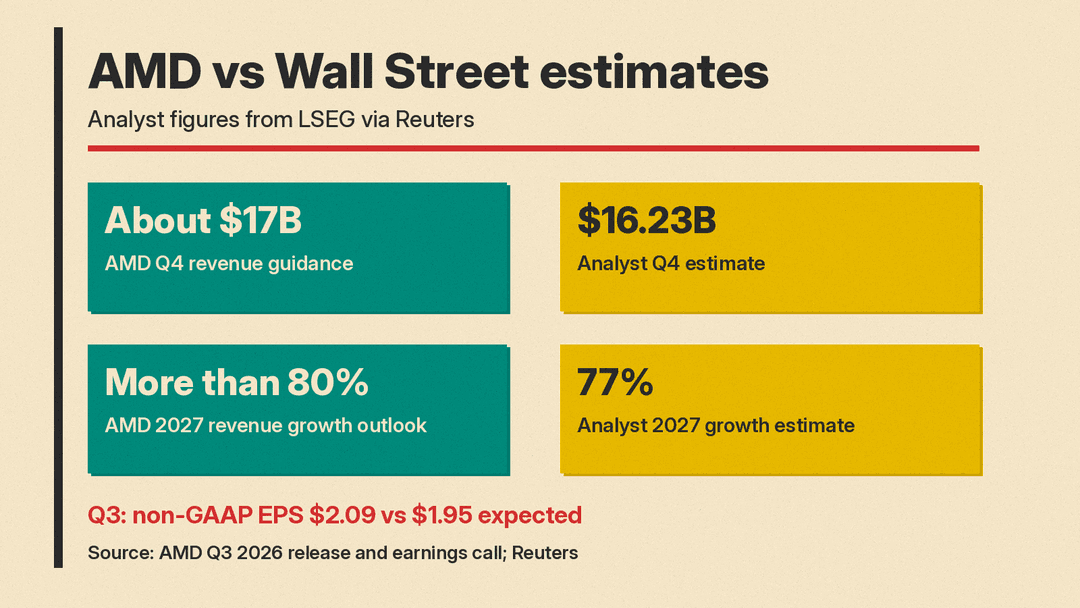
- Non-GAAP earnings per share were $2.09, up 74%. GAAP EPS was $1.46, which includes a $1.1 billion noncash charge tied to warrants issued under customer agreements.
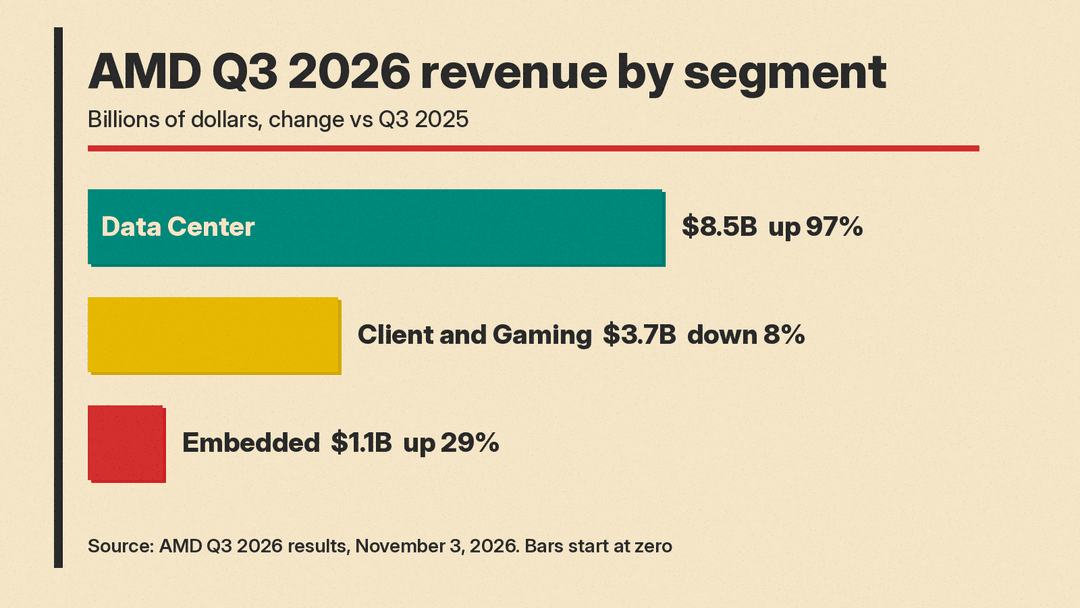
- Data Center segment revenue was a record $8.5 billion, up 97%.
- Client and Gaming revenue was $3.7 billion, down 8%. Gaming alone fell 40% to $773 million.
- Embedded revenue was $1.1 billion, up 29%.
Reuters said analysts expected revenue of $13.09 billion, adjusted EPS of $1.95 and data center revenue of $8.20 billion, so AMD beat on all three. In the prepared remarks, Su said the Data Center segment made up 64% of total revenue, up from 47% a year earlier.
Helios racks start to ship
The main AI hardware news is Helios, AMD's rack-scale design built around the Instinct MI450 Series. AMD's 10-Q says AMD develops and licenses Helios for customers and manufacturing partners to implement, and does not manufacture or sell the completed racks. Su said AMD "started shipping MI455X in volume in the quarter," and that Anthropic, Meta, Microsoft, OpenAI and Oracle brought their first Helios racks online. AMD's release lists the same five customers as running models and workloads on the first Helios racks.
AMD expects Helios deployments to "increase substantially" in the fourth quarter as HPE, Dell, Lenovo, Supermicro and other partners begin shipping systems. HPE has also announced that Vultr will deploy the first AMD Helios by HPE systems. For background on the Meta side, see our earlier post on AMD's $1 billion Meta stake and Helios testing.
CPUs for AI agents
Server CPUs drove a large part of the growth, not only GPUs. Su said both cloud and enterprise server sales "more than doubled" year over year, and tied part of the demand to AI agents that run continuously across software and enterprise systems.
AMD also introduced Helion, a reference design for rack-scale systems built on its next-generation "Venice" EPYC chips. Su said an all-CPU Helion rack holds up to 144 Venice processors with nearly 74,000 threads, and that AMD's partners have committed more than 240 Venice platforms, 20% more than for the previous generation. Venice began revenue shipments in the third quarter.
Guidance: Q4 and 2027
For the fourth quarter, AMD expects revenue of about $17 billion, plus or minus 3%. At the midpoint that is growth of about 66% from a year earlier and about 27% from Q3. Reuters, citing LSEG data, said analysts had expected $16.23 billion. AMD also expects a non-GAAP gross margin of about 55%.
Su went further on 2027. She said AMD expects total revenue to grow more than 80%, against the 77% analysts estimated according to LSEG. She said server revenue should double year over year and that data center AI revenue should grow "even faster than we projected 90 days ago." AMD expects the Data Center segment to be more than 80% of 2027 revenue.
Su also said AMD has "secured more supply" to support that growth, and that it has worked across its supply chain on wafers, substrates, advanced packaging and memory. Reuters noted that a global memory shortage has left the high-bandwidth memory used in AI processors scarce.
Two acquisitions
AMD said it agreed to acquire two companies. Taalas brings specialized silicon built for low-latency inference. World Labs, led by co-founder and CEO Fei-Fei Li, works on models that understand the physical world, and Li will join AMD as chief scientist. AMD expects both deals to close by the end of the year, subject to regulatory approvals and customary closing conditions, according to the filing. The filing values Taalas at about $2.9 billion in cash and stock, including up to about $1.4 billion of contingent consideration, and World Labs at about $8.2 billion in an all-stock deal.
Software, PCs and the gap with Nvidia
AMD released ROCm 10, the latest version of its GPU software stack. Su said Anthropic highlighted that one engineer used Claude to bring up the company's latest model on Instinct MI355X racks over a single weekend. She also said AMD is working with multiple frontier labs to optimize MI500, the next Instinct generation, as they plan "multigigawatt deployments."
The weak spot is PCs. AMD said PC sell-through slowed late in the quarter as higher memory and component costs weighed on demand, and it is planning for PC unit shipments to fall by a double-digit percentage in 2027.
The Next Platform offered a more cautious reading in an opinion column. Timothy Prickett Morgan argued that AMD cannot get enough HBM allocation to dent Nvidia's data center GPU business. He estimated Nvidia's 2026 sales at about $354 billion against about $52.2 billion for AMD, and said his own model, built on assumptions, puts AMD's Instinct GPU sales in Q3 at $3.43 billion. Those are his estimates, not AMD's reported figures.
Why it matters
AMD's results point two ways. Reuters wrote that the outlook signals AI computing spending "extending beyond Nvidia's accelerators," and Su said AI agents are adding CPU demand on top of accelerator demand. AMD's own plan for next year also depends on securing supply, from memory to packaging. For the other side of the server chip market, see our post on Intel's Q3 results, where Intel gave a weak fourth-quarter outlook.
Sources
- AMD Reports Third Quarter 2026 Financial Results
- AMD Third Quarter 2026 Financial Results Prepared Remarks (PDF)
- AMD Form 10-Q for the quarter ended September 26, 2026 (SEC)
- Reuters via The Indian Express: AMD forecast eases AI spending fears as data-center sales surge
- Reuters via Investing.com: AMD shares rise as AI-driven data-center strength fuels growth outlook
- The Next Platform: AMD Cannot Catch Nvidia, But It Sure Can Make Some Money
