
Anthropic published research on November 9, 2026, saying Claude Fable 5.2 designed three working electronic prototypes end to end with Diode Computers. The projects turned simple prompts into circuit boards, enclosures, firmware, and parts lists that Diode built and tested.
What Claude built
Anthropic began testing Claude on basic circuit design a little over a year ago with Diode Computers, which designs and manufactures circuit boards. Earlier models could not reliably lay out a circuit board and struggled to design components that fit together. Anthropic has a commercial relationship with Diode and has worked with Diode electrical engineers on PCB design since 2025.
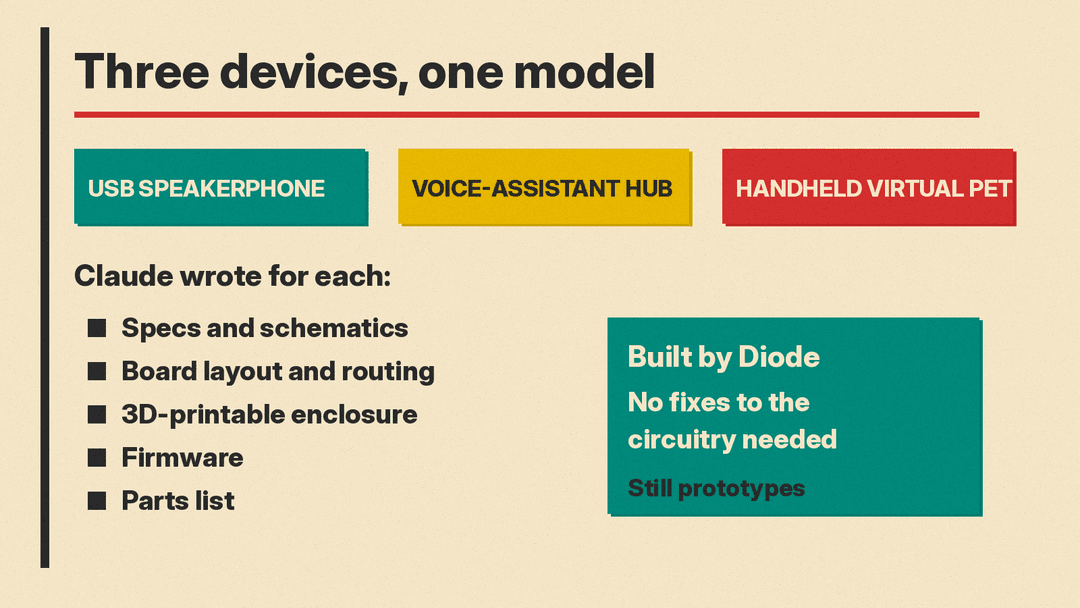
Claude Fable 5.2 was asked to design three devices: a speakerphone, a voice assistant hub, and a handheld virtual pet. Each started with a simple prompt. The speakerphone prompt asked for "a puck that plugs into a computer over USB-C and includes microphones and a speaker, supporting Bluetooth with a PCB antenna." A PCB is a printed circuit board, the flat board that holds a device's chips and the copper tracks between them.
Claude wrote specifications, drew schematics, placed components on the PCB, and routed the copper connections between them, a step engineers call routing. It also designed a 3D printable enclosure, wrote firmware, and prepared a parts list. Diode assembled the boards and ran the firmware under Claude's direction.
The prototypes worked without any fixes to their circuitry. The speakerphone still works after weeks of use, and the other two are also still in good working order. Diode manufactured all three boards directly from Claude's design files without back and forth adjustments, and the Diode team said they were surprised. Diode's prompting was minimal, using short directives to clean up the schematic or continue.
How it laid out the boards
Anthropic said the largest difference from the models in its earlier tests was geometric reasoning: deciding where parts go on the board and how the tracks between them run. Claude routed the most important connections first, including high speed, high current, and noise sensitive connections. On the hub, it routed USB and Ethernet pairs first, keeping each pair the same length and spaced correctly, and added small zigzag tuning patterns so signals arrive at the same time.
Claude often checked a part's datasheet, the technical document a manufacturer publishes, before a design decision. KiCad, a widely used circuit board design program, has a built in router that drew one track at a time. For the hub's long tracks from a 100 pin connector, Claude wrote its own grid search router in about half an hour, and that router laid each long track in roughly a second.
It also handled physical constraints. It wrote code to check the board fit in the enclosure. It found the speakerphone board must be tilted about 25 degrees during installation and added that to the assembly instructions. For the hub's enclosure, it calculated a 25 mm microphone port would resonate near 3.4 kHz, in the voice band, and moved to a wedge shaped enclosure that shortened ports to about 10 mm, raising resonance to about 8.9 kHz. Firmware dims the speakerphone LED ring as audio gets louder to stay under a current limit.
Fixing its own mistakes
Earlier models rarely revised their work. Diode designed many boards with them that were 95 percent complete but unusable. Fable 5.2 changed course unprompted. On the four layer speakerphone board, it reassigned signals to different chip pins so tracks under the touch controls stayed on one layer.
On the hub, Anthropic reported Claude's reasoning as saying the connections were "getting too tangled to trace visually" and then "I should just rip these traces and start fresh." It then deleted and rerouted dozens of times.
Claude ran design for manufacturing and sourcing checks itself, including whether parts were in stock. On the hub, checks flagged six solder mask slivers as too thin. It widened the openings without moving parts. It correctly ignored a flag on a deliberate connection between two grounds.
Benchmarks
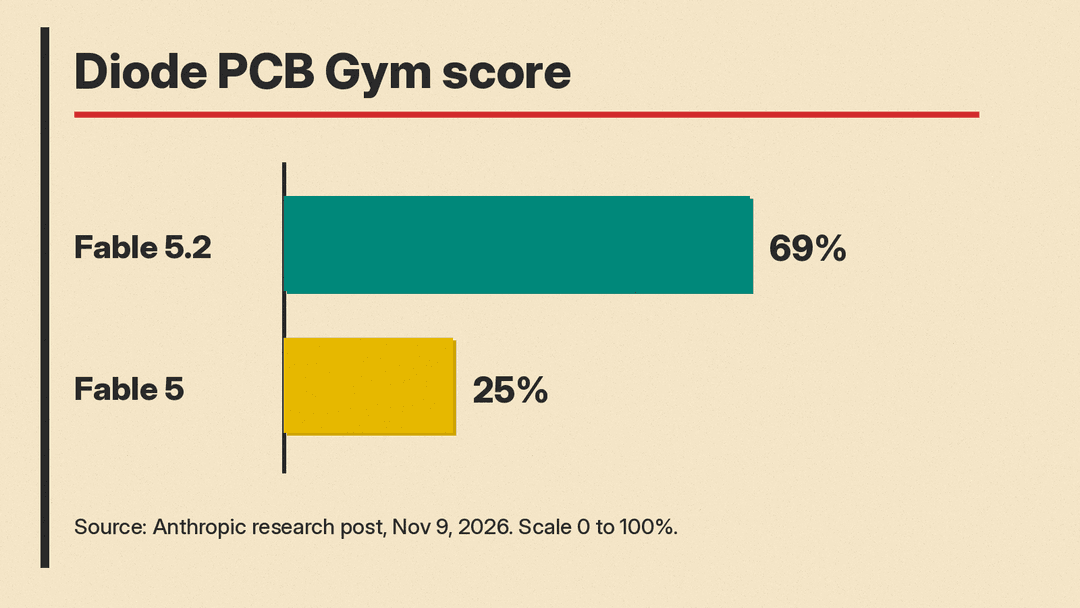
Diode's internal PCB Gym asks models to place components and reroute connections on boards with layouts removed. Fable 5.2 scored 69 percent, while Fable 5 scored 25 percent.
On the public BenchCAD 2.1 benchmark, which asks models to rebuild 3D parts, assemblies, and boards from drawings and images, Fable 5.2 scored 83.5 percent, nearly double Claude Fable 5.1.
For AI tools that help with 3D CAD work today, see our guide to the best AI CAD tools.
What it did not do
All three devices are prototypes. They did not receive electrical validation, antenna tuning, thermal testing, or certification, and they were not designed for mass production. Claude was not connected to test equipment or factory machines. Diode engineers physically built and tested them.
It is unknown how the devices hold up with continued use or whether they would pass commercial certification. Anthropic also notes OpenAI recently wrote about using its models to design a handheld device.
Why it matters
Hardware design is a multi step job. This test matters because the designs became physical devices, not just diagrams. Most of the hard work in electronics sits in steps that depend on each other: a placement choice affects routing, the board affects the enclosure, and the enclosure affects the sound. In this test, Fable 5.2 tracked those links across the whole job and fixed manufacturing problems before the boards went to the factory. The caveat is just as important. Anthropic has a commercial relationship with Diode, the results come from Anthropic's own write-up, and no device has been through the testing a product needs before it ships.
Diode is based in the Brooklyn Navy Yard. It describes boards in Zener, its open source language built on Starlark, which renders to KiCad projects. Diode says a Claude pipeline produced roughly 250 reference designs in two weeks, published at zener.diode.computer, and that engineers still sign off every design (Diode blog).
Anthropic cited the electronics work as one of the prerelease results when it launched Fable 5.2 and Mythos 5.2 on November 9 (our launch coverage). Anthropic plans to test denser, faster, more complex boards, check them in simulation, and learn from measurements on finished devices. Reaction is in what people are saying about Fable 5.2.
