
ByteDance's AI creation platform Jimeng (sold outside China as Dreamina) launched Short Drama Studio on October 26, 2026. It is a single workspace that takes a creator from a script to finished episodes of a short drama, the vertical, minutes-long serial format that Momenta Media calls one of China's most-watched online formats. Jimeng announced it on its official Weibo account, and TechNode and IT Home reported the details.
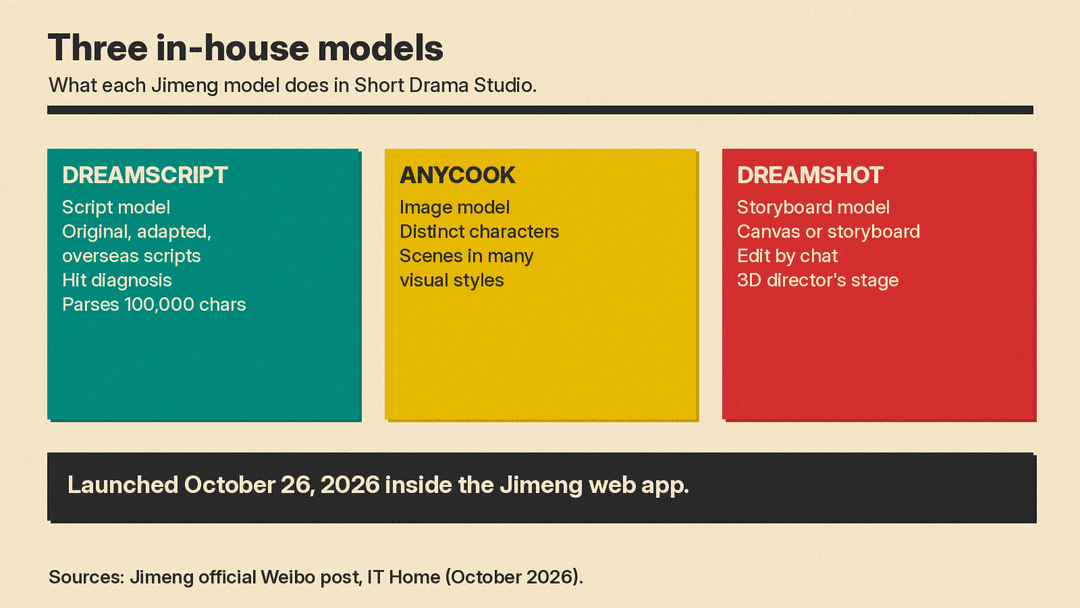
Despite the name, it is software, not a production company. The studio runs on three in-house models: DreamScript for scripts, Anycook for character and scene images, and DreamShot for storyboards. Jimeng also offers ByteDance's Seedance video models, which we covered in our Seedance 2.5 4K explainer.
What Short Drama Studio does
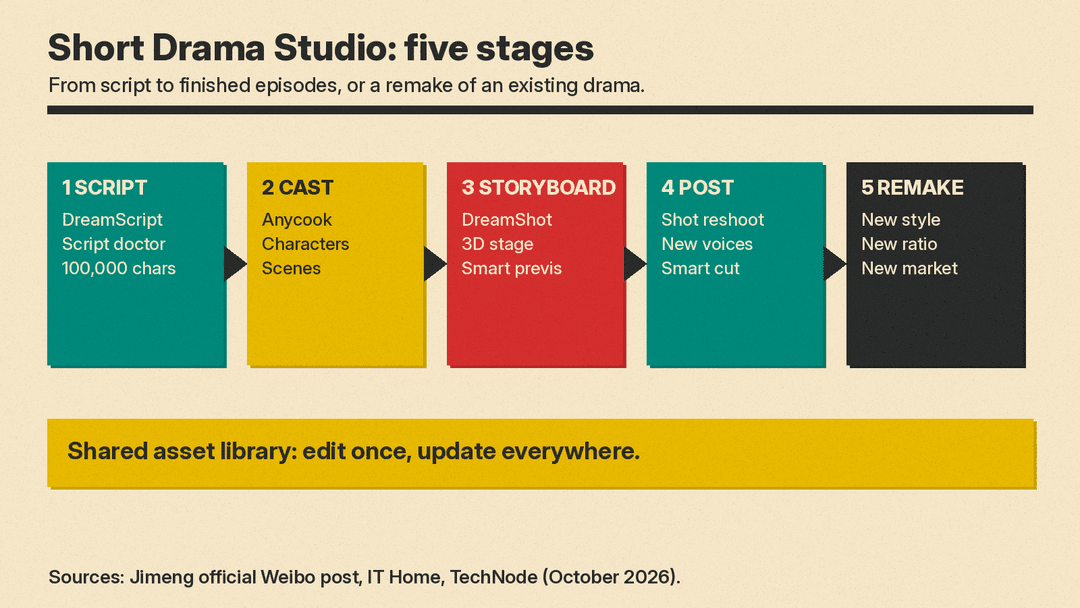
Jimeng splits the studio into five stages. Each stage maps to a step a human short-drama team would do.
1. Script: DreamScript
DreamScript is, per IT Home, Jimeng's first dedicated script model, trained for short-drama writing. According to Jimeng's launch post, it:
- Generates scripts in several genres: original stories, adaptations, scripts for overseas markets, and commentary-style dramas.
- Runs a "hit diagnosis" that looks at platform trends and what makes popular dramas work, and suggests changes to the plot structure.
- Parses long texts of up to 100,000 Chinese characters.
IT Home adds more detail. A "script doctor" checks the main storyline of the first three episodes, including whether the lead's identity and the core conflict are clear. A line check reviews dialogue sentence by sentence against each character's profile. IT Home also says the product supports continuous generation of up to 100 episodes.
2. Characters and scenes: Anycook
Anycook is the image model. Jimeng says it is tuned for short-drama art direction, to make characters that look more realistic and easier to tell apart, and to build scenes in many visual styles.
When a creator uploads a script, IT Home reports that the studio parses the whole drama and identifies main and minor characters, scenes, props, and even voices and costumes. It binds them to an asset library. The canvas and the storyboard share the same assets, so a change in one place carries through the project, and confirmed characters and settings can be reused in later episodes.
IT Home notes that characters that change from shot to shot, rough shot transitions and costly revisions have long troubled short-drama creators. A shared asset library is Jimeng's answer at the project level, not the prompt level.
3. Storyboard and previs: DreamShot
DreamShot is the storyboard model. Per Jimeng, it offers:
- Two modes, a free canvas and a storyboard, and creators can switch between them.
- Storyboard edits through chat, including global changes to the plot.
- A 3D director's stage where creators set camera positions and camera moves and preview the motion before they generate.
- "Smart previs" that strings key shots together so creators can check continuity and pacing early.
The 3D stage is the most film-like piece. It lets a creator block a shot first, instead of rolling generations until one looks right.
4. Post-production
Jimeng lists four post tools:
- Shot reshoot: regenerate one shot without redoing the whole episode.
- Sound reconstruction: separate dialogue from background audio and generate a new voice track.
- Smart cut: split complex footage into individual shots for editing.
- Asset sync: an edit to an asset updates everywhere it is used.
5. Remake and localization
This is the most unusual feature. A creator uploads an existing short drama. The system identifies its characters, scenes, props and shot structure, then regenerates the footage in a chosen visual style, aspect ratio and target region. Jimeng says it keeps the original's plot rhythm and camera language. TechNode describes this as remaking dramas "in visual styles suited to different markets."
Where it comes from
Short Drama Studio is not built from scratch. IT Home reports that part of it reuses capabilities from the short-drama agent that Xiaoyunque, another creation platform under ByteDance's CapCut (Jianying) group, launched in March, with updates on top. A Jimeng lead told IT Home the goal is to bring proven AI creation tools onto one platform, so creators can go from idea to finished video in a tool they already know.
For teams, IT Home says the studio also launched a team edition with multi-account asset management and shared credit management, so a project lead can assign credits across creators.
IT Home also reports Jimeng's own claim that the canvas stays smooth with more than a thousand assets and scales to 10,000 nodes. Those are company performance claims, not independent tests.
Access and price
The studio lives inside the Jimeng web app at jimeng.jianying.com. It is not a separate product. The launch post lists these limited-time offers:
- One free script generation and one free script analysis.
- Free 15 seconds of smart previs and 15 seconds of remake generation (a rough "white model" pass), listed with member perks.
- One free 15-second Seedance 2.0 fast generation and one storyboard generation.
Jimeng is also running a Singles' Day (Double 11) sale. The launch post says Seedance 2.5 drops to as low as 0.19 per second for a limited time, but it does not state the currency or unit in that line. Jimeng has not published a separate price list for the studio itself in the sources we checked, and we found no English-language Dreamina launch.
Why it matters
Most AI video tools still sell one clip at a time. A short drama needs dozens of episodes with the same faces, sets and voices. Short Drama Studio is ByteDance's bet that the next step is the pipeline, not only the model: script, cast, storyboard, shots and fixes in one place, with shared assets. It is the same direction we saw with VideoGen Model 1, which targets long multi-shot videos from one prompt.
The remake tool matters for another reason. It is built to take a drama made for one market and regenerate it for another. If it works as described, it lowers the cost of localizing a hit. It also raises questions the launch materials do not answer, such as who owns a remade drama and what rights a creator needs before uploading someone else's footage.
What we do not know yet
- Output quality and consistency across 100 episodes, from independent tests.
- Studio pricing beyond the launch offers.
- Whether, or when, the studio comes to Dreamina outside China.
- How DreamScript, Anycook and DreamShot compare to general models. Jimeng has published no benchmarks for them.
For a wider view of the tools in this space, see our guide to the best AI video generators.
