
Apple now sells a screen for the kitchen counter. Apple HomeView, announced on October 13, is a 7-inch smart display with a speaker base, a camera that recognizes who is standing in front of it, and the new Siri AI assistant built in. It costs $299 in the US and arrives on November 13. Preorders are open now.
It is Apple's first smart display, and it enters a category where Amazon's Echo Show and Google's Nest Hub already compete. Ars Technica frames it as an Echo Show competitor. The pitch is different, though. Apple is selling HomeView less as a gadget and more as a way to put its new Siri in a shared room, then make that shared screen feel personal to each person who walks up to it.
This guide covers what HomeView does, what the AI part actually means, what you need to own for it to work well, and what to check before you preorder.
The basics
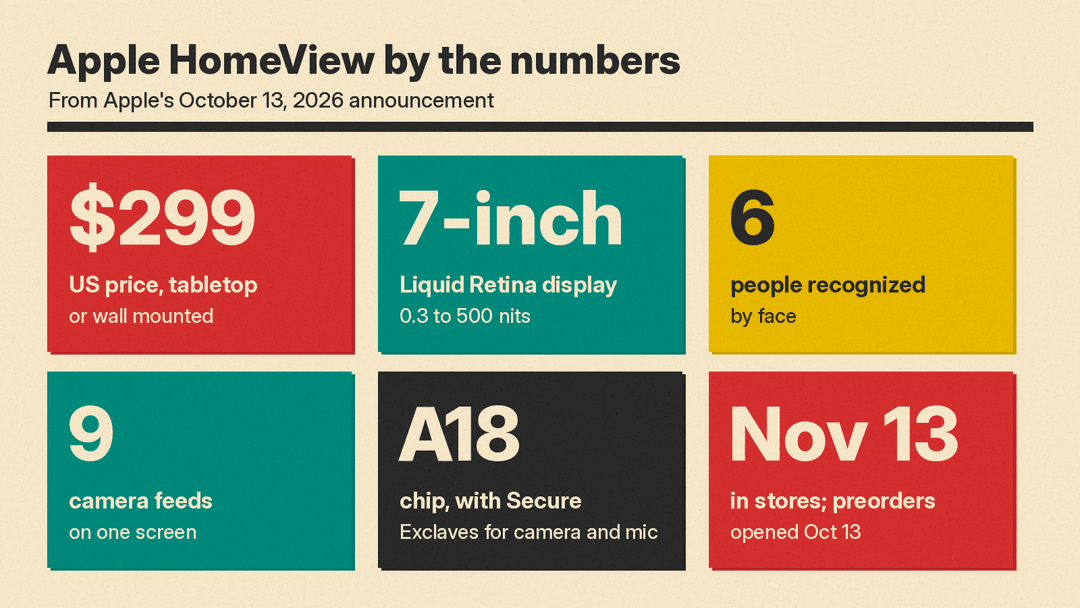
- Price: $299 in the US for the tabletop model and $299 for a separate wall-mounted model.
- Colors: silver, starlight, rose pink, and space gray for the tabletop model. The wall-mounted model comes only in space gray and silver.
- Screen: 7-inch Liquid Retina display with True Tone. Brightness runs from 500 nits down to 0.3 nits, so it can sit on a nightstand. The layout changes with your distance: simple information from across the room, more detail up close.
- Chip: Apple's A18.
- Sound: two full-range drivers in the display, plus a down-firing woofer and two passive radiators in the base. The wall model uses two custom drivers.
- Dates: preorders opened October 13. Both models are available November 13.
- Where: the US, UK, Canada, Australia, New Zealand, and India, with Singapore preorders from October 15 and South Africa through Apple Authorized Resellers.
The wall-mounted version needs one of three mounts made by Schneider Home, sold separately: a USB-C wall connector from $59.95, an AC wired mount from $79.95, and a Power over Ethernet mount for $129.95 that ships in early 2027.
What the AI actually does
The headline feature is Siri AI, the rebuilt version of Siri that Apple released last month. CNBC describes the HomeView launch as a showcase for those new Siri abilities. On HomeView, what Siri can do depends on who is asking and what phone they carry.
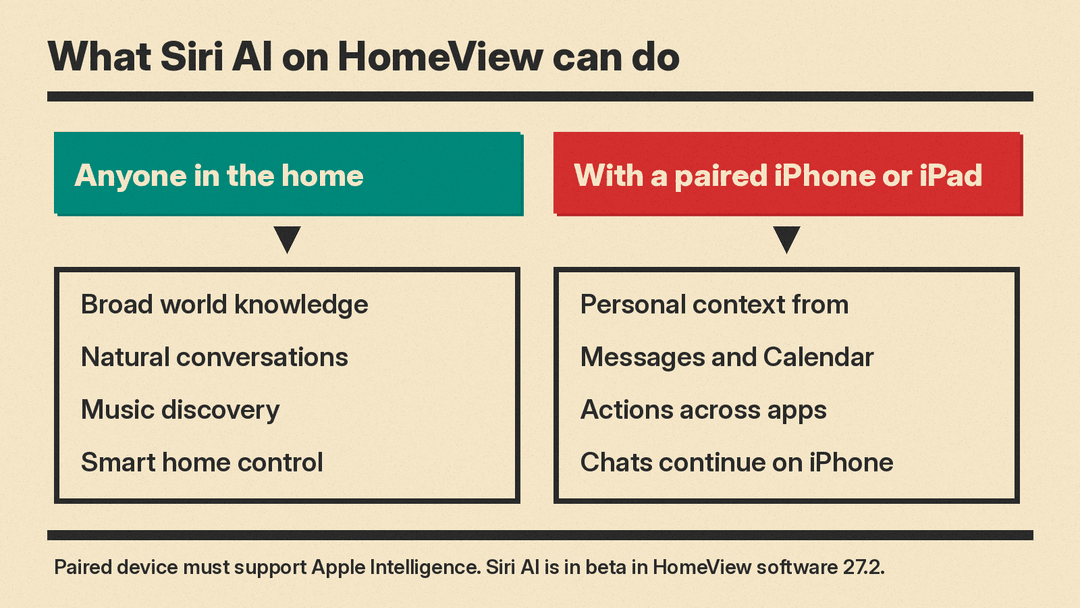
For anyone in the home, Siri AI on HomeView answers general questions using what Apple calls "broad world knowledge," holds back-and-forth conversations, helps find music, and controls smart home devices by voice. Apple says these work even for people who do not own an Apple Intelligence-capable iPhone or iPad.
For people with a paired Apple Intelligence iPhone or iPad, Siri can draw on personal context: what is in your Messages and Calendar, your Apple Music playlists, and information across your apps. It can also take actions across apps. A conversation you start on HomeView continues in the Siri app on your iPhone, iPad, Mac, Apple Watch, or Vision Pro, because Apple syncs Siri history through iCloud.
Two caveats sit in Apple's own fine print:
- Siri AI is still in beta. Apple says it is available in beta in HomeView software version 27.2.
- Some features have daily limits. Apple says Apple Intelligence features that rely on server-side models "are subject to daily usage limits," and that expanded access "will be available for a fee in the future." Apple has not said what that fee is or which features it covers.
Language matters too. Siri AI on HomeView works in English only for now, in the US, Australia, Canada, India, New Zealand, Singapore, South Africa, and the UK. Apple says Canadian French will come later in a free software update.
Face recognition and personal screens
HomeView uses its camera to recognize up to six people. Each person gets their own Home Screen with apps and widgets, and sees their own Messages, FaceTime, Calendar, Reminders, and Find My. Apple says personal content stays private from others in the household, while shared photo albums and music are available to everyone, including guests.
This is the part that makes HomeView different from a typical shared kitchen screen. A family calendar display usually shows the same thing to everyone. HomeView is designed to switch to your view when it sees you, then switch to your partner's when they walk up.
One detail is worth knowing. Apple's footnotes say that when a paired iPhone is off Wi-Fi, a recognized person's information may still be shown on HomeView if the phone was recently on the same Wi-Fi network, has an active cellular connection, is in the same location, and was recently unlocked. In practice that means your personal content can appear on the shared screen when you are home with your phone, even if the phone has dropped off Wi-Fi.
Privacy: what Apple says it does
Privacy is Apple's main argument against rivals, and the company makes three specific claims:
- Secure Exclaves: camera and microphone data is processed in protected, separate areas of the A18 chip. Apple says data processed there "cannot be accessed by the HomeView software, apps, the user, or Apple."
- Private Cloud Compute: Siri requests run either on the device or on Apple's Private Cloud Compute servers, where Apple says data "is not stored nor made accessible to Apple or anyone else."
- Encrypted camera analysis: with a supported iCloud+ plan and compatible cameras, HomeView can recognize people, familiar faces, pets, packages, and vehicles with end-to-end encryption, and can describe what happened in a HomeKit Secure Video clip without you watching it.
Jennifer Kent, principal analyst at Parks Associates, told CNBC that Apple is "going above and beyond what a lot of other companies do when it comes to privacy and security protections." These are Apple's claims and an analyst's view, not independent test results. HomeView is not shipping yet.
Smart home and everyday uses
Outside of Siri, HomeView works as a control panel for a smart home:
- View camera feeds, with a Home Camera face that can show up to nine feeds at once.
- Adjust thermostats and lights, lock doors, and close blinds by touch or voice.
- Get alerts on your iPhone, iPad, or Apple Watch when HomeView hears a smoke or carbon monoxide alarm.
- Use Intercom to broadcast a message to one room or the whole house.
- Make FaceTime calls with Center Stage, which keeps people in frame as they move.
- Follow recipes from the web as step-by-step instructions with hands-free timers.
- Use it as a photo frame with a shared album that family members can add to.
It works with Matter accessories and other Works with Apple Home devices, plus Apple Home Collection, a new line of cameras, thermostats, and a lock made with LG Electronics and Schneider Electric. Apple says that line starts arriving in December, with some accessories in early 2027.
Who should consider it
HomeView makes the most sense if your household already runs on iPhones. Setup and multiuser support require a compatible iPhone or iPad, and the personal Siri features need an Apple Intelligence-capable one. If most people in your home use Android, you would get a speaker, a screen, general Siri answers, and smart home control, but not the personal side that justifies the price.
It is also a fit if you already use Apple Home or HomeKit Secure Video cameras, since the camera dashboard and AI video descriptions are among its most concrete features. Some of those need a paid iCloud+ plan.
Reasons to wait:
- Siri AI is a beta. Apple labels it beta on HomeView, so expect changes and rough edges after launch.
- Usage limits and a future fee. Apple has said heavier use of server-side AI features will cost extra later, without saying how much.
- No EU availability. Apple says HomeView is not for sale in the European Union because Siri AI is not available in iOS there.
Why it matters
Smart displays have mostly been timers, weather, and recipe screens with a voice assistant that answers simple commands. HomeView puts Apple's rebuilt, conversational Siri at the center and ties it to each recognized person's own phone data. If Apple's privacy claims hold up, it gives families a shared AI device that does not treat everyone as one account. If Siri AI stays unreliable, it is a $299 photo frame and speaker.
CNBC also notes the device comes as Apple raises prices elsewhere in the home lineup: the new Apple TV 4K costs $299, up from $199, and the HomePod mini rose from $129 to $149. HomeView's price puts it well above a basic smart speaker, so the AI features carry most of the case for buying one.
