
Amazon is working on a new robot for the home, five years after its Astro robot rolled on stage and then stalled as an invite-only product. A CNBC analysis of Amazon job posts, published November 8, found that the company has built a new team for a "new-to-world robot product" meant to live in people's houses.
Amazon has not announced a product, a price or a date. But the job listings, an acquisition from earlier this year and a statement from an Amazon spokesperson offer clues about where the work is going, though CNBC says it is unclear what kind of robot the group is building.
What the job posts say
According to CNBC, a recent engineering listing, since removed, opened with the line "Robots are about to step out of the movies and into our homes." It described a product that can navigate "dynamic home environments" and work with "autonomous operation alongside family members."
Other listings are still live on Amazon's careers site under the name Fauna. An Applied Scientist role for Fauna Robotics says that "deploying robots in home environments requires you to anticipate challenges not encountered in structured settings like warehouses," and that "consumer-grade sensors and actuators" force the team to work around their limits. A navigation scientist role focuses on getting robots to move safely through "complex, dynamic indoor environments with static and dynamic obstacles." An actuator engineer role talks about owning motor performance "from the bench all the way to robots running in people's homes."
CNBC also points to an October posting for a field support engineer who would handle customer support and on-site repair, and a user experience designer listing that asks for someone to "define what it feels like to live with a Fauna robot."
Where Fauna and Sprout come from
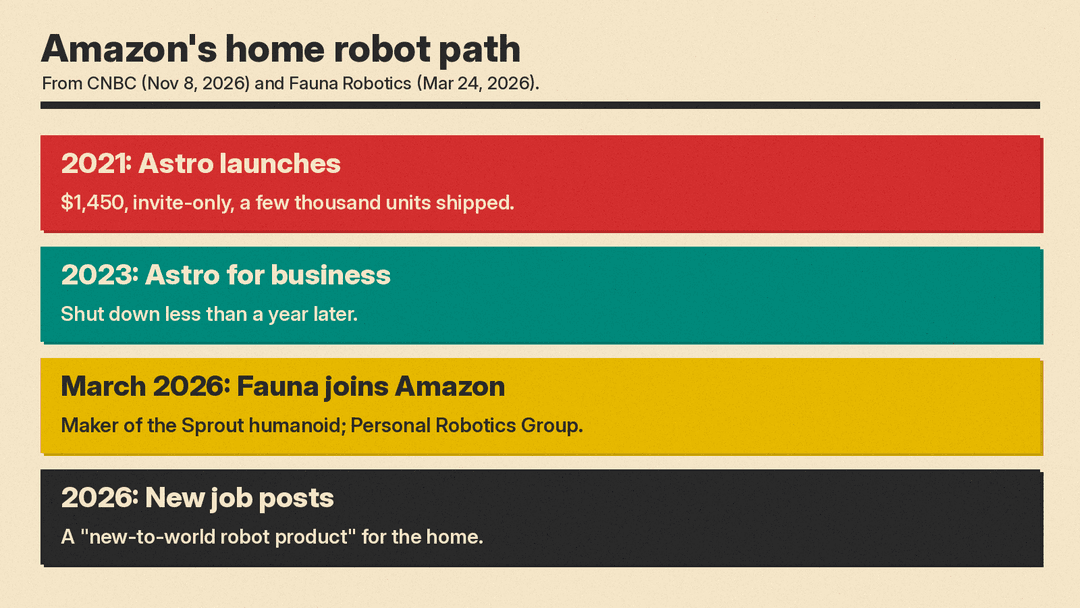
Fauna Robotics is a New York startup that Amazon bought in March. In its own announcement, dated March 24, 2026, Fauna said it launched in New York City in February 2024 with a mission "to build capable, safe, and fun robots for everyone." It said it would keep selling its Sprout Creator Edition robots and supporting existing customers, now as "Fauna Robotics, an Amazon company."
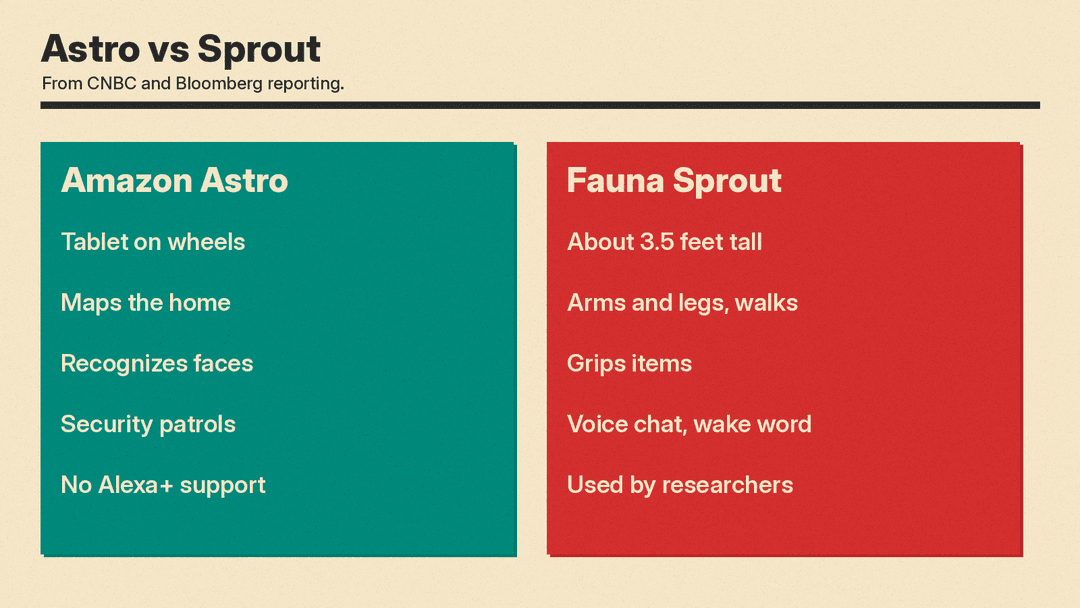
Sprout is a small humanoid robot, about 3.5 feet tall, with arms, legs and expressive yellow eyebrows. Bloomberg reported at the time of the deal that Sprout can walk, grip items, dance and hold back-and-forth voice conversations, answering to the wake word "Sprout." Fauna sees it handling chores such as picking up toys and fetching food from the pantry, according to Bloomberg. So far it has mostly gone to developers and to commercial and academic researchers, CNBC says.
Bloomberg reported that Fauna's roughly 50 employees joined Amazon's Personal Robotics Group and that Amazon did not disclose the price. CNBC adds that Amazon moved much of the old Astro team onto the home robot project and brought in an MIT roboticist, based on LinkedIn profiles. Some group members came from Lab126, the hardware unit behind the Kindle, Echo speakers and Fire TV, and also the Fire Phone.
Why Amazon is trying again
Astro was Jeff Bezos's bet on a home robot. It launched in 2021 at $1,450, essentially an Alexa tablet on wheels that could navigate a home on its own, recognize faces and act as a roving security monitor. CNBC reports that it shipped to only a few thousand customers and never left invite-only status. A business version arrived in 2023 and was shut down less than a year later.
Owners CNBC spoke with describe a mixed result. One North Carolina owner said she still uses Astro to check on her pets and appliances while she is out, but that it has mostly become a party trick and a "trip hazard." In Astro owner groups on Facebook, users complain that Amazon's Alexa+ assistant does not run on Astro, which some read as a sign the robot will be dropped. Amazon spokesperson Brad Glasser told CNBC that the company continues to support Astro customers.
Colin Angle, co-founder and former CEO of Roomba maker iRobot, told CNBC that the tools have advanced by "leaps and bounds" and that "it's difficult to understate just how much the robot industry has changed in the last two years." CNBC points to advances in AI models, sensors, battery systems and actuators. Glasser said Amazon is "optimistic about a future where personal robots are helping people in meaningful ways in everyday life," while noting there is still a substantial gap between what is possible in a controlled lab and in settings like a living room or a lobby.
What this means for you
There is nothing to buy yet, and no sign of a launch date. The useful signals for regular buyers are these:
- Amazon's own job descriptions talk about "dynamic home environments" and robots working "alongside family members."
- An October listing, CNBC says, seeks a field support engineer for customer support and on-site repair.
- The technology Amazon bought is a walking humanoid with arms, not another tablet on wheels, though CNBC says it is unclear what form the final product will take.
Amazon is not alone. CNBC notes that Apple is reportedly working on home robot projects, and startups such as Sunday, Tau and Nori say their robots can fold laundry or clear a table, though those remain mostly prototypes or niche devices. Astro owner Joe Martin told CNBC he would consider another robot "if it could bring a drink to me or dust furniture."
