
AI governance is a set of job functions more than a single job title. The work spans policy drafting, risk assessment, technical controls, legal interpretation and assurance. The International Association of Privacy Professionals (IAPP) has published a skills framework for the field, a profession report on where the work sits, and, for the first time, salary data that includes AI governance roles. This article summarizes what the work involves, which teams own it, what it pays and how people move into it.
What is an AI governance job?
The IAPP's AI Governance Skills Framework, published 30 Sept. 2026, states: "For an industry that is still nascent, the work seems to be more common than the label."
To build it, the IAPP collected public job profiles that explicitly called for AI governance work from January to July 2026 and combined them with IAPP annual surveys from 2023 to 2026. Contributor Ashley Casovan is Managing Director of the IAPP AI Governance Center. AI Governance Skills Framework
The practical implication is that openings may not carry the words "AI governance" in the title. In our reading, a job search built only on that phrase will undercount the available roles.
Eight types of AI governance work
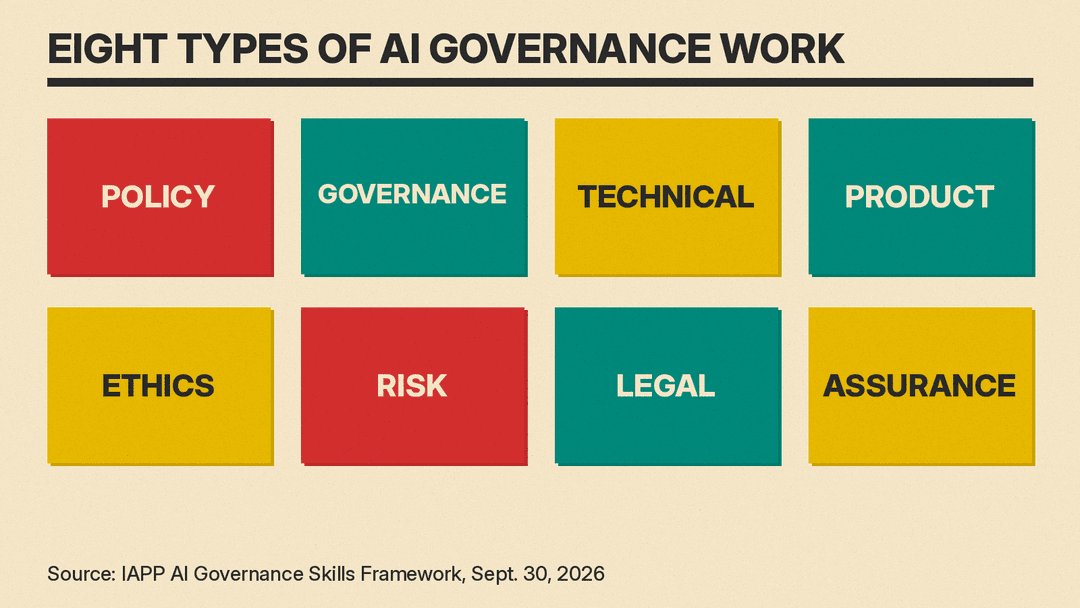
The framework categorizes AI governance work into eight types: policy, governance, technical, product, ethics, risk, legal and assurance. AI Governance Skills Framework
The document has two parts:
- Part I, Executive Functions, covering leaders responsible for oversight and accountability.
- Part II, Professional Profiles.
The IAPP also notes that most organizations are unlikely to assign a different person to each profile, and that a single role is likely responsible for two or more functions. Priorities depend on organization size, complexity and the types of AI the organization develops or deploys. AI Governance Skills Framework
For candidates, our reading is that one opening may bundle several of these types under a title that does not say governance. If the technical and risk side interests you, see our guide to AI safety careers, courses, fellowships and jobs.
Where AI governance teams sit
The AI Governance Profession Report 2025, produced by the IAPP and Credo AI and published 16 April 2025, identifies the functions with primary responsibility for AI governance:
- Privacy: 22%
- Legal and compliance: 22%
- IT: 17%
- Data governance: 10%
- Ethics and compliance: 6%
- Security: 5%
The report states that 50% of AI governance professionals are typically assigned to ethics, compliance, privacy or legal teams. Over 50% of respondents said privacy, IT, security, and legal and compliance would gain additional responsibility. A strong number of privacy professionals are continually asked to take on AI governance roles. AI Governance Profession Report 2025
Hiring intent points the same direction. Only 10 of 671 respondents, or 1.5%, said they will not need additional AI governance staff in the next 12 months. Separately, 23.5% said finding qualified AI professionals was part of the challenge of delivering AI. AI Governance Profession Report 2025
Regulation also touches staff training. Article 4 of the EU AI Act says providers and deployers of AI systems shall take measures to ensure, to their best extent, a sufficient level of AI literacy of their staff and other persons dealing with the operation and use of AI systems. Our EU AI Act explainer covers deadlines, scope and fines.
How much do AI governance jobs pay?
The IAPP Salary and Jobs Report 2025-26, published 3 Aug. 2025, is the first year the survey includes AI governance salaries. The full report is members-only. The survey ran for six weeks from March to April 2025, used 27 questions and drew more than 1,600 respondents from over 60 countries. The report defines base salary as regular salary or wages, not including bonuses. IAPP Salary and Jobs Report 2025-26
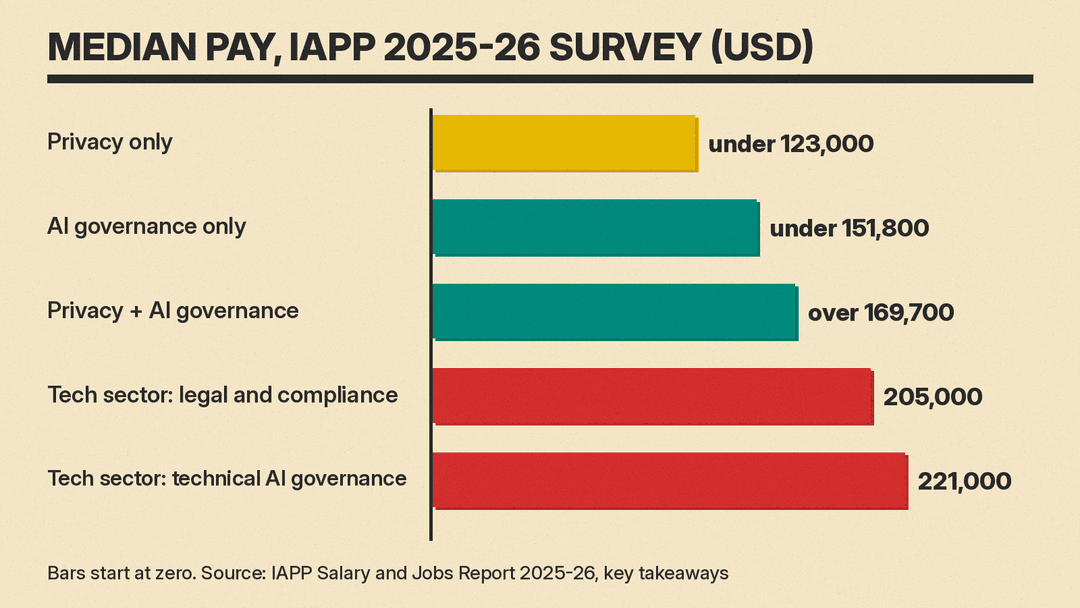
Median pay by focus area, from the report's key takeaways:
- Respondents working in both privacy and AI governance: half earned more than USD169,700.
- Respondents solely in AI governance: half earned less than USD151,800.
- Respondents solely in privacy: half earned less than USD123,000.
In the technology sector, legal and compliance roles had a median of USD205,000 and technical AI governance roles a median of USD221,000. The IAPP identifies these as the highest median salaries relative to other respondents. Almost 7 in 10 respondents received a bonus. IAPP Salary and Jobs Report 2025-26
The report infographic adds three figures: a USD190,000 average base salary for AI governance legal and compliance professionals, an average bonus of 17% of base salary, and a finding that AIGP certified professionals earn 26% more than those with no certifications. At least 77% of survey respondents held at least one IAPP certification. On the certification results, the IAPP says they "are not necessarily meant to prove a direct cause-and-effect correlation". IAPP Salary and Jobs Report 2025-26
Treat the 26% figure as a survey association, not evidence that the certificate raises pay on its own. Experience, sector and location are not isolated in that comparison, in our reading.
Skills employers look for
The AI Governance Profession Report 2025 describes the qualified professional in three parts:
- Understand AI.
- Have experience in governance, risk and compliance.
- Be able to translate legislative requirements into actionable policies.
Company size changes how those skills are packaged. Larger companies can split these tasks across roles, while smaller companies look for people who cover all of them. The report also says skills such as red teaming will be increasingly necessary. AI Governance Profession Report 2025
A vocabulary layer helps with all of it. The IAPP publishes an AI governance glossary of key terms. It is a quick way to learn the vocabulary of the field.
The AIGP certification: cost and format
The IAPP's AI Governance Professional (AIGP) exam is listed on the IAPP store. As of November 2026:
- Exam price: USD649.00 for members, USD799.00 for non-members.
- Format: 100 questions in 2.75 hours, with a 15-minute break.
- Delivery: virtually from home or office, or at a test center.
- Window: the exam must be taken within one year of purchase.
Renewal runs on a two year certification term. Holders submit 20 continuing education credits and pay a certification maintenance fee. For non-members, a USD250 certification maintenance fee is required upon recertification. For members, it is covered by membership. Annual professional membership is listed at USD295.00. IAPP store, AIGP exam
The exam is based on the AIGP Body of Knowledge version 2.1, effective 2 February 2026 and available as a PDF. The AIGP certification page lists it among its free exam prep resources. It has four domains:
- Understanding the foundations of AI governance.
- Understanding how laws, standards and frameworks apply to AI.
- Understanding how to govern AI development.
- Understanding how to govern AI deployment and use.
Our suggestion: read the Body of Knowledge before paying for anything. It shows whether the content matches the work you want.
Free ways to learn AI governance
These resources cost nothing to read or join:
- The AIGP Body of Knowledge 2.1 outlines the four domains the certification tests.
- The NIST AI Risk Management Framework, released January 26, 2023, is "intended for voluntary use" and is open to read on the NIST site.
- The NIST AI RMF Playbook gives suggested actions across four functions: Govern, Map, Measure and Manage. The page states that AI RMF 1.0 is being updated and that the Playbook will be updated afterward.
- The EU AI Act Article 4 text on AI literacy, plus the IAPP AI governance glossary.
- The BlueDot Impact Frontier AI Governance course: online, 40 hours, six units, cohort-based, offered as a six-day intensive or six-week part-time. The page says "Completely free. No hidden costs." No previous BlueDot course or technical qualification is required. The application deadline shown is 15 Nov 2026.
BlueDot's FAQ notes the focus is frontier AI and AGI policy and states: "It is not a course on corporate compliance or internal AI-use policies." Pair it with corporate-facing material such as the NIST AI RMF if your target role is in-house. Our roundup of free AI ethics and responsible AI courses covers more no-cost options.
How to move into AI governance
- Start where the work already lives. Privacy, legal and compliance, IT and security hold primary responsibility in the IAPP and Credo AI data, and those functions are the ones expected to gain more of it. AI Governance Profession Report 2025
- Take on AI work in your current team. In our reading, tasks like AI literacy training are a low-risk way to build a record, and Article 4 AI literacy duties give in-house teams in scope of the EU AI Act a reason to assign them. EU AI Act Article 4
- Read the free core texts first: the AIGP Body of Knowledge, the NIST AI RMF and its Playbook, and the EU AI Act. Together they cover the exam syllabus, a voluntary US framework and EU law text.
- Match your existing skill to one of the eight types. In our reading, legal and compliance people map to the legal and policy types, IT and security people to the technical and assurance types, product people to the product type. The IAPP expects one role to cover two or more functions. AI Governance Skills Framework
- Search job boards with alternative titles. Because the work is more common than the label, in our reading use the eight category names combined with "AI", such as "AI policy", "AI risk", "AI assurance", "AI ethics", "responsible AI" and "AI compliance". AI Governance Skills Framework
- Consider the AIGP with the costs in view: USD649.00 for members or USD799.00 for non-members, a two year term, 20 continuing education credits and a USD250 maintenance fee for non-members at recertification. The IAPP's 26% pay premium for AIGP holders comes with its own caveat that results "are not necessarily meant to prove a direct cause-and-effect correlation". IAPP store
- Do not assume a computer science degree is required, in our reading. The report's qualified professional description centers on understanding AI plus governance, risk and compliance experience, and on translating legal requirements into policy. If you are weighing that question, see our guide to AI jobs without a CS degree.
Bottom line
In the IAPP and Credo AI data, AI governance work sits mainly with privacy, legal and compliance, IT and security teams. The IAPP framework names eight types of work and expects individuals to cover several of them at once. Reported pay sits above privacy-only work in the same survey, with USD221,000 and USD205,000 medians for technical and legal-compliance AI governance roles in the technology sector. IAPP Salary and Jobs Report 2025-26
Entry does not require the certification. The Body of Knowledge, the NIST AI RMF and Playbook, the EU AI Act text and a free 40-hour BlueDot course are all available at no cost, and the IAPP and Credo AI report describes the needed skills as AI understanding, governance, risk and compliance experience, and turning legal requirements into policy. AI Governance Profession Report 2025 Only 1.5% of that report's respondents said they would need no additional AI governance staff in the next 12 months.
Sources
- IAPP: AI Governance Skills Framework
- IAPP and Credo AI: AI Governance Profession Report 2025
- IAPP: Salary and Jobs Report 2025-26
- IAPP: Salary and Jobs Report 2025-26 infographic (PDF)
- IAPP store: AIGP exam
- IAPP: AIGP certification
- IAPP: AIGP Body of Knowledge 2.1 (PDF)
- IAPP: AI governance glossary
- NIST: AI Risk Management Framework
- NIST: AI RMF Playbook
- EU AI Act, Article 4: AI literacy
- BlueDot Impact: Frontier AI Governance course
