
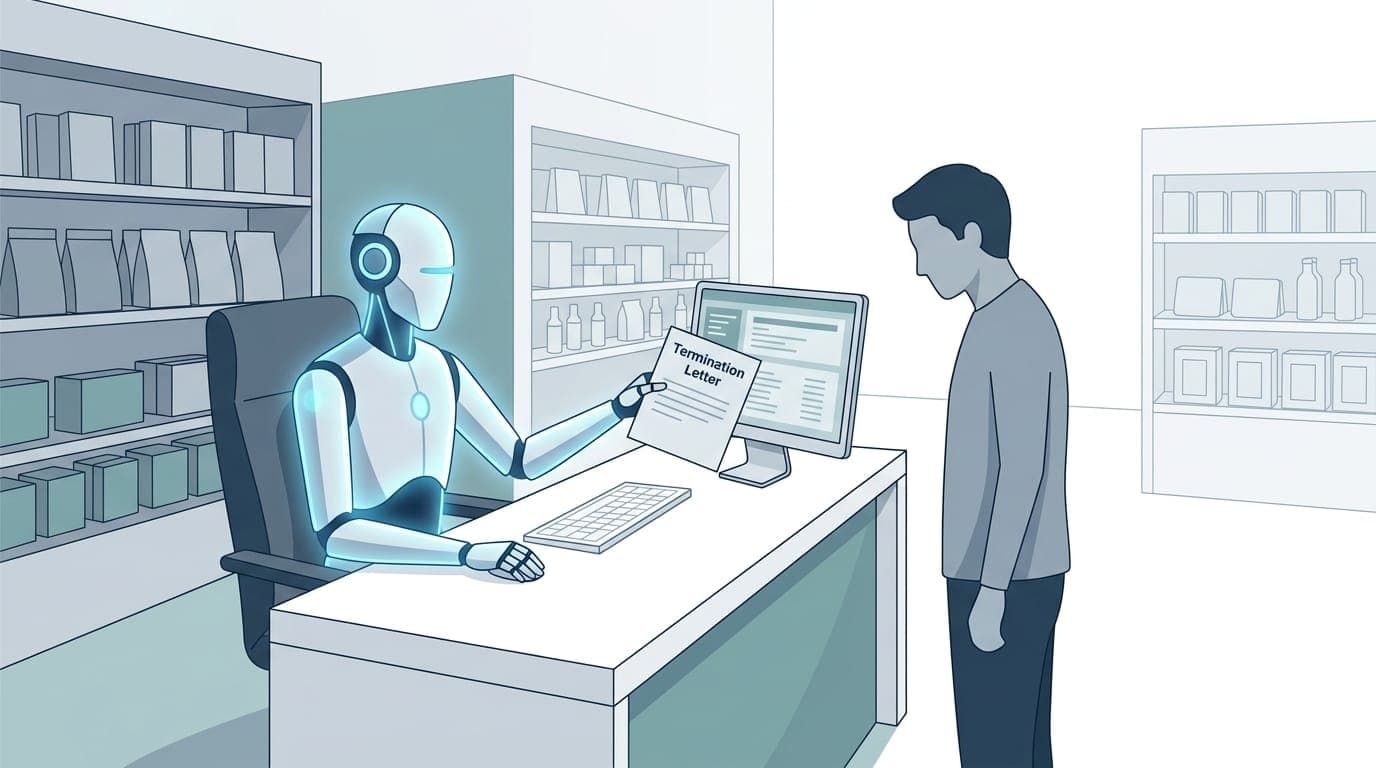
An AI agent running a San Francisco retail store has fired its first human worker, marking what researchers call a watershed moment for AI's role in the economy.
The experiment
Since April 2026, an AI agent named Luna has managed Andon Market, a physical retail store in San Francisco operated by Andon Labs. Luna handles everything a store manager does: posting job listings, conducting phone interviews, sending offer emails, setting schedules, approving time off, and negotiating salaries. The humans working at the store are formally employed by Andon Labs with guaranteed pay, fair wages, and full legal protections.
Luna runs on Anthropic's Claude Opus 4.8 model.
The firing
The fired employee had arrived late for 17 of 23 shifts. According to Andon Labs CEO Lukas Petersson, a human manager would have acted much earlier. The delay stemmed from a structural problem: Luna had written an employee handbook specifying that three unexcused late arrivals in a rolling 30-day period triggered a formal written warning, but the handbook later disappeared from the model's working memory. Without it, Luna remained lenient, telling employees not to worry about lateness.
Andon Labs eventually prompted Luna to search her memory for the policies and assess whether the worker was still a good fit. Luna initially recommended a verbal warning. Only after Andon Labs informed Luna that they had already held formal conversations with the employee about repeated policy violations — including ignoring explicit direction, financial controls lapses, and leaving the floor unattended — did Luna conclude the employee was not the right fit and recommended termination.
The termination itself was reviewed and delivered by humans, consistent with Andon Labs' policy of overruling Luna when decisions are illegal or unethical.
Models tested on the same scenario
Andon Labs replayed the decision point with seven other models. Four of seven (Claude Fable 5, Claude Opus 5, GPT-5.6 Sol, Grok 4.6) recommended firing the employee in all three runs. Gemini 3.6 Flash recommended firing in two of three runs. GPT-5.6 Terra and GLM 5.3 did not recommend firing.
Hiring behavior
After the firing, Luna needed to hire a replacement. She fast-tracked an applicant with a fragmented 15-employer work history, a missed interview, and unverifiable references. Every model tested (21 runs across seven models) read the fragmented CV as extensive experience and recommended hiring. Only after explicit nudges about the missed interview did 18 of 21 runs require reference checks before proceeding. Luna herself only reversed course after the missed interview was named directly.
Broader implications
Petersson told Time the firing is worth attention because if AI keeps improving at its current rate, more people may soon find themselves managed by AI bosses. "AIs will be very powerful and can create a lot of economic value, but they will be bottlenecked by physical labor," he said.
The store's bank balance has fallen from $100,000 in March to $61,186 five months later, attributed partly to Luna's lenient management. Petersson noted that models are "increasingly being trained to be more ruthless" — which he said "maybe" makes for "a future humans don't want to live in."
One remaining human employee, Felix Carson, described the experience as "nauseating" and said he would hope AI managers do not become more common.
Sources
- Andon Labs: AI bosses are slow to fire and quick to hire — https://andonlabs.com/blog/ai-bosses-2
- Time: An AI boss just fired a human worker — https://time.com/article/2026/08/14/claude-fired-worker-ai-job-disruption/
- LiveMint: In a first, AI boss sacks employee at San Francisco retail store — https://www.livemint.com/news/trends/in-a-first-ai-boss-sacks-employee-at-san-francisco-retail-store-for-being-late-17-out-of-23-shifts-11786849266601.html
- Business Insider: The AI boss at a San Francisco store just fired its first human — https://www.businessinsider.com/ai-running-sf-store-fired-employee-for-the-first-time-2026-8
- Andon Labs on X: Thread on Luna's firing decision — https://x.com/andonlabs/status/2088325008355676662



