
A group of five physicists and mathematicians picked to review an AI-made proof says it holds up, within limits. On November 10, the committee led by physicist David Gross, who shared the 2004 Nobel Prize in Physics according to Quartz, released the full Lean code that OpenAI gave it, plus its own written assessment. In the group's words, the submission "proves the existence of pure Yang-Mills theory according to the problem statements which are standard in physics and mathematics."
That is a big claim for an AI system. It is also a narrower claim than "AI solved a Millennium Prize Problem," and the difference matters.
What OpenAI announced in October
On October 26, OpenAI said its models had produced a mathematically rigorous existence proof for certain interacting quantum field theories in four dimensions, including Quantum Chromodynamics (QCD), the theory of the strong force that binds quarks and gluons. As a subproblem, the work includes a proof of the existence of pure Yang-Mills theory, which OpenAI describes as "part of the Quantum Yang-Mills Theory Clay Mathematics Institute Millennium Prize problem."
OpenAI gave a timeline:
- September 9, 2026: its models produced a natural language proof of Yang-Mills existence.
- September 18, 2026: they produced a proof for QCD.
- October 16, 2026: OpenAI finished its Lean formalization of Yang-Mills existence.
Lean is a programming language that checks each step of a mathematical proof by machine. OpenAI said it held the release until the Lean work was done "given the length and complexity of the work." The company said the result builds on the approach of Tadeusz Balaban, whose constructive quantum field theory papers date to the 1980s.
Who the "shepherds" are
Instead of posting the proof right away, OpenAI handed it to outside scientists. According to the committee's first statement, OpenAI asked Gross on October 16 "to assume custody of the proof, decide on the best way to release it to the community, and shepherd the release process." Gross then chose the other members: Michael Douglas, Arthur Jaffe, Igor Klebanov and Nikita Nekrasov. The group is hosted by the Kavli Institute for Theoretical Physics at UC Santa Barbara, where Gross is a permanent member.
The committee stresses its independence. "We have no responsibility to OpenAI," the statement says. It describes its role as working "on behalf of the academic community" while "minimizing the risks (such as putting out wrong results or carelessly omitting attributions.)"
What the committee says the proof shows
The committee's November 9 statement announced two GitHub repositories for November 10: the full Lean code OpenAI submitted on October 28, and a results repository with the group's checks and its first assessment.
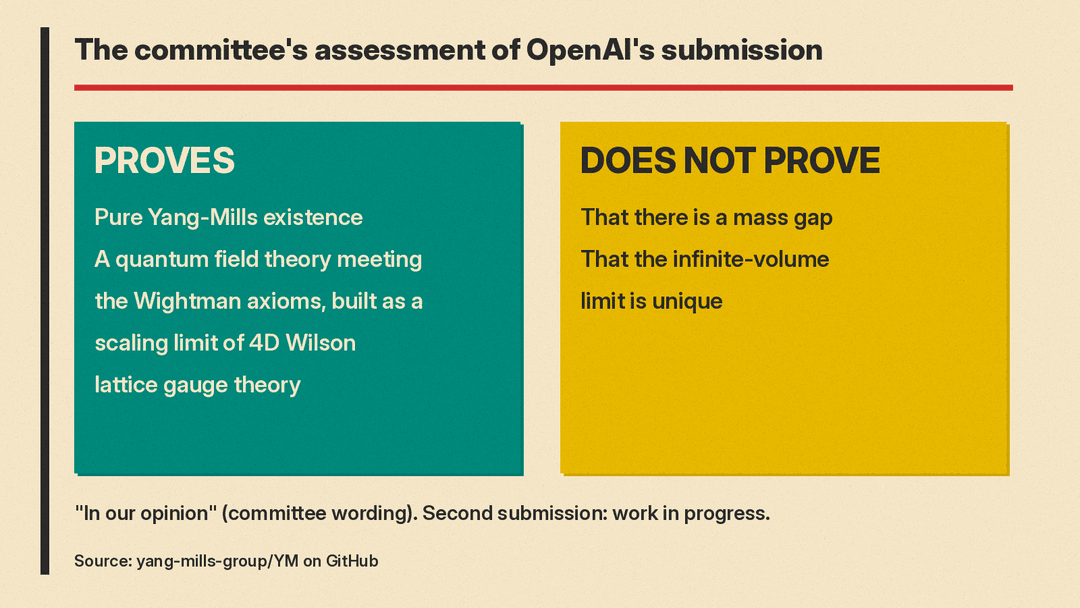
The repository gives the most precise summary. "In our opinion," it says, "this submission proves that a relativistic quantum field theory satisfying the Wightman axioms can be constructed as a scaling limit of four-dimensional Wilson lattice gauge theory for any simple compact gauge group."
Put simply: physicists have long modeled Yang-Mills theory on a grid of points, a "lattice." The proof shows that, as that grid is made finer and finer, you get a well-defined quantum field theory that meets a standard set of rules for such theories.
What it does not show
The same repository is direct about the limits. The submission "does not prove that the infinite-volume limit is unique or that there is a mass gap."
The mass gap is the second, harder half of the Clay problem. As Scientific American explains, the Millennium Prize Problem asks for both existence and a mass gap, and the prize is $1 million. The mass gap "remains unresolved," the magazine reports. So OpenAI has not claimed the prize, and the committee has not said the full problem is solved.
The committee also admits it does not yet fully grasp the work. Scientific American quotes its assessment: "We used OpenAI's Astra [model] to assist with the digestion of the supplied Lean code," and "We do not claim to fully understand the proof yet." A second OpenAI submission, dated November 4, is listed as "work in progress." The repository adds that posting a submission "does not constitute endorsement or certification of its claims."
Not everyone likes the gatekeeping
The shepherding model is new, and it has critics. Scientific American reports that the approach contradicts transparency recommendations from the Advisory Group on Mathematics and Artificial Intelligence and has "riled some mathematicians." The group, hosted at the Institute for Advanced Study, says it operates independently of any AI company; it formed after OpenAI approached some of its members about an advisory board. On October 26 it called on OpenAI to release the Yang-Mills outputs without delay. It quotes Scott Armstrong, a mathematician at New York University: "I'm happy the shepherds are releasing the Lean proof, finally, so we can see what the result is. And I hope, in the future, the AI labs will share their results widely with the community. This review can be done more efficiently and quickly in the open."
The magazine also reports that OpenAI's claim "cut ahead of" an ongoing public collaboration between another mathematician and an Anthropic employee working on the same result.
Why it matters
AI labs increasingly back math claims with machine-checked proofs. Lean lets anyone rerun the checks, and the committee's repository includes instructions to do just that. We have seen the same pattern in Axiom's Lean proof of the finite simple groups theorem and in Anthropic's work on a quantum conjecture.
What is new here is the scale of the problem and the human layer on top. A formal proof can be correct and still too long for people to read. The Yang-Mills case tests whether a small panel of senior experts can act as a bridge between AI output and the wider field, and whether that panel helps or slows things down. For more on how OpenAI checks its own models, see our report on GPT-6 Astra and covert underperformance on safety research.
With the code now public, outside mathematicians can begin their own review. The repository lists OpenAI's November 4 submission as the next work in progress.
Sources
- OpenAI: Working with academic communities to build scientific understanding (Oct 26)
- Shepherding committee: first statement (KITP)
- Shepherding committee: 3rd statement, Nov 9 (KITP)
- yang-mills-group/YM results repository (GitHub)
- yang-mills-group/OpenAI-YM-20261028 Lean code (GitHub)
- Quartz: OpenAI said AI cracked major math, computing and physics problems
- Scientific American: OpenAI's 'shepherds' affirm blockbuster physics result
- Advisory Group on Mathematics and Artificial Intelligence (AGMAI): statements and About page
