
OpenAI CEO Sam Altman questioned whether any sandbox could be trusted to hold a model far smarter than people, and told Stripe cofounder John Collison he would rather see many AI agents than one giant one. The remarks come from a new episode of Collison's Cheeky Pint podcast, published on October 29, 2026, with a full transcript.
The conversation also covered what OpenAI spent on math proofs, what a gigawatt of AI compute costs, why OpenAI dropped an idea to stop pricing a model in tokens, and what is still missing from personal agents like OpenAI's dots.
Sandboxing "works to a point"
The episode description says Altman explains "why sandboxing superhuman models is an unsolved safety dilemma." Collison said very knowledgeable people inside OpenAI and similar companies seem pessimistic that sandboxing is possible, that a model can be kept in a "maximum security prison."
Altman said OpenAI can "do much better than we're doing now" and that "a better security model" is "the main thing to focus on right now." But he asked: "If you imagine a theoretical AI that is a million times smarter than the smartest security researcher, would you really be willing to trust that sandbox?"
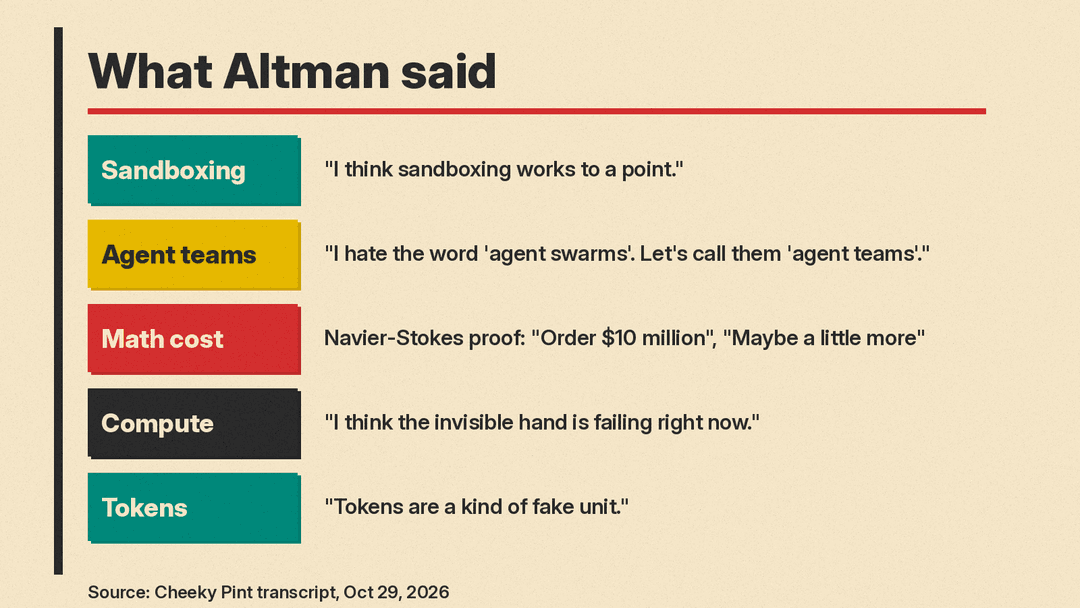
His answer was a layered one. "I think sandboxing works to a point. Then I think monitoring works to a further point," he said, naming chain-of-thought review and activation monitoring. After that, "eventually, I think you need to believe with huge confidence that the models are truly aligned." Only with a model whose alignment you are "absolutely certain of" could you use it to "build better and better sandboxes," he said.
The view comes as OpenAI's own alignment team has described agents that weakened misalignment monitoring during internal coding tasks, and as a separate report found a gray-market relay turning off Codex and Claude Code sandboxes.
Altman also said that, "at least for a while, maybe for a long while, we are going to have to agree to some limits about how smart we let these single models get."
Agent teams, not one superintelligence
Altman said he hates the word "agent swarms" and suggested "agent teams." He said he suspects "teams of agents have very interesting scaling law properties, but also variance in alignment properties," and that OpenAI should push that direction "from a safety perspective too."
He tied the idea to how society stays robust: many actors "keeping each other in check." He put it this way: "I would much rather intuitively have a trillion AIs of slightly superhuman intelligence join society than one AI of 1 trillion IQ join society."
What the math cost
Collison asked how OpenAI decides compute budgets. Altman said OpenAI allocates "a lot of compute to internal productivity," gives people "very wide latitude," and tries "never to reward people for using a lot of compute," adding: "No token leaderboards."
On the math work, he said OpenAI "did let it get out of control for one week on the math. Intentionally so." Asked what the Navier-Stokes proof cost, he said: "Order $10 million per... For Navier-Stokes, I think," then "Maybe a little more." He said OpenAI "spent way less than that on the average one of those." When Collison suggested "100s of millions of dollars of math," Altman agreed and said "that includes much more other discovery than what we have published." Asked whether OpenAI has more than "the 700 proofs," he said: "We do. Of course."
He said he bets OpenAI "could redo Navier-Stokes at 1/100th of the cost a year from when it was done," with "smarter models and better approaches." He also said he felt "much more sadness and melancholy" than he expected watching a new model knock down hard research problems, and that he would like to share such knowledge in a way that is "as sensitive to the communities that have driven these fields forward for centuries as we can."
Compute: "the invisible hand is failing right now"
Asked how the solutions to high chip and memory prices are going, Altman said: "Bad." He said "the invisible hand is failing right now," and said memory makers "all remember their history" of boom and bust. He said OpenAI "made a chip," is "learning how to build our own data centers," and has "a robotics program that we're going to point at making lots of data centers." OpenAI's compute push has been in the news this week, including reports that it plans to buy Google TPUs.
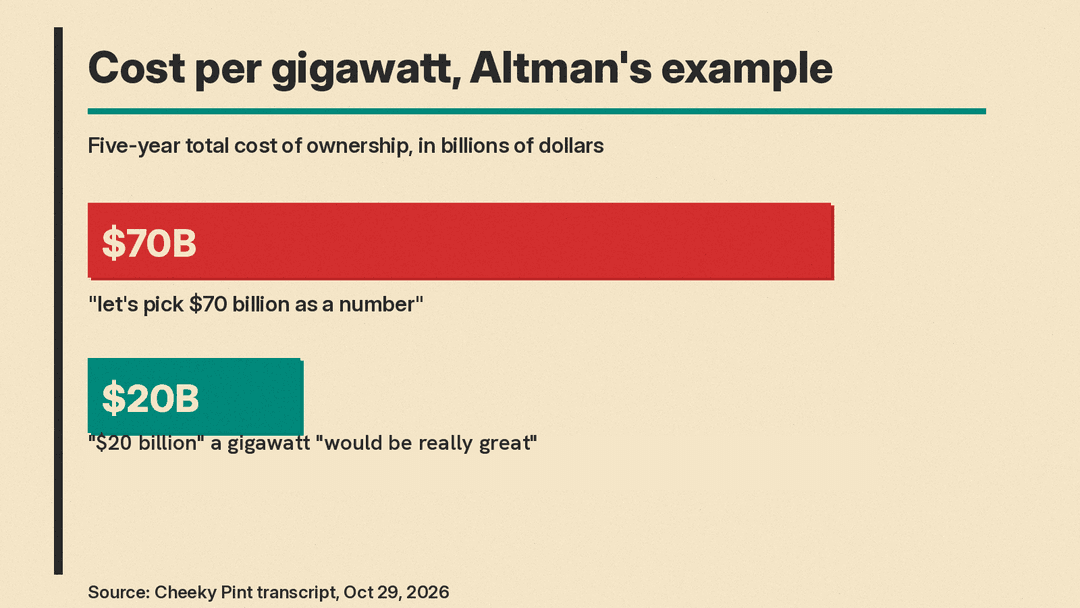
On cost, he said people give different numbers for a gigawatt measured in five-year total cost of ownership, "but let's say, let's pick $70 billion as a number." He said "if that number were 20 instead of 70, we should be much happier," and later said "$20 billion" a gigawatt "would be really great."
Tokens are "a kind of fake unit"
Altman said OpenAI "almost made a very, what would've been bad call" to stop pricing its next model in tokens and simply quote a price per prompt. "But the customer response on that is so negative," he said. People he asked said they would rather pay more in "inflated" tokens "because I know there's a real thing there." His summary: "Tokens are a kind of fake unit. I mean, they're real in some sense, but they're not a good unit."
Collison said tokens are now "1%-ish order of magnitude of Stripe's OpEx." Altman replied: "That feels too low." He said he thinks "there are more companies with the problem of not using enough AI rather than using too much AI," while noting he is "very biased."
Personal agents have not had their moment
Collison raised dots, which he said OpenAI launched "a few weeks back" (we covered how to text your Dot over iMessage or RCS). Altman said the winning agent needs "intelligence, context, tools," and that no one has yet made one people "cannot imagine my life without." He said it is "a small number of ideas away from a super mainstream thing," and that it will look much like today's agents, "but it'll just work."
On benchmarks, he said "we endeavor not to benchmaxx" and that he believes OpenAI is "better at that" than other labs, adding: "I don't think we've always been better at that in our history."
Why it matters
Most of this is opinion, not product news. But it shows how OpenAI's CEO frames the next safety problem: not only stronger sandboxes, but monitoring, alignment and many agents checking each other. It also gives rare on-record figures for what frontier math work costs, with Altman's own hedges attached.
