
Vienna Symphonic Library (VSL) has released Vienna Performer, according to a company press release that Sonicstate published on November 9, 2026. It is an AI plug-in that does not write music. Instead, VSL says, it takes the notes a composer has already written and returns them as an audio performance. The company says the models behind it were trained only on recordings VSL made itself. That puts it in a different category from prompt-based music generators such as Suno, which faces lawsuits from music rights holders.
What is Vienna Performer?
According to a press release covered by Sonicstate, Vienna Performer is a plug-in that takes the notes a composer has written and returns them as a performance. You write your parts as usual in a DAW or a notation program. Vienna Performer renders them and places the audio back on the track.
The press release states: "Vienna Performer does not compose. It has no prompt and no generative function."
VSL says the musical substance, meaning the notes, the dynamics and the phrasing, comes entirely from the user. What comes from the models is the performance: articulations, transitions between notes, small timing details, and the acoustic character of the hall.
How does it work?
The composer provides note lengths, velocities, a single CC lane for dynamics, and a handful of articulation switches, per the press release. The product page says the input can be a MIDI file, a track in your DAW, or a score inside Dorico or Sibelius, and it lists MusicXML as well. The product page says what gets added is phrasing, breath, bow direction and vibrato, although the press release lists phrasing among the things the user supplies.
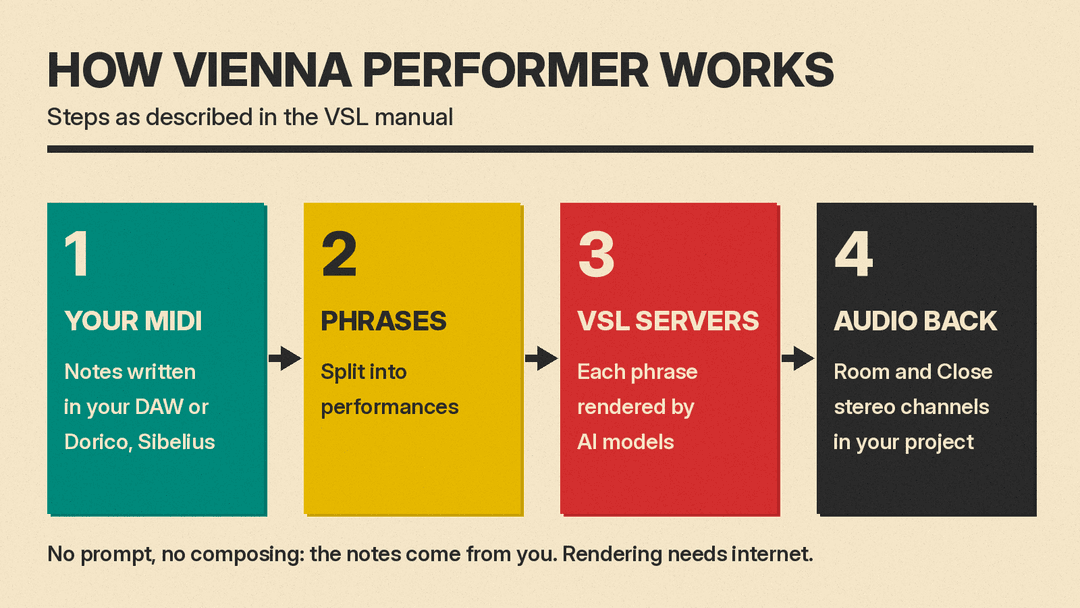
The manual describes the rest. The plug-in captures the MIDI and splits it into phrases, which VSL calls performances. Each phrase is rendered on VSL render servers. Finished renders are stored as audio files in the project folder and play back like a recording. Each model delivers two stereo channels: Room (Decca Tree) and Close. Before a render is ready, you hear a simplified preview sound. The manual also says rendering is never started without your say-so.
What was it trained on?
The press release says the AI models were trained exclusively on recordings VSL made for the purpose, in sessions with musicians of the Vienna Synchron Orchestra at VSL's own Vienna Synchron Stage. The product page lists web scraping: none, and third-party audio: none. It is the same hall and the same players as VSL's Synchron sample libraries, and Synchron Player presets are provided for each instrument.
Which instruments are available?
At launch, Vienna Performer offers solo Violin, Cello, Flute, Clarinet and French Horn, plus string ensembles: 1st Violins (14 players), 2nd Violins (12), Violas (10) and Cellos (10). A solo Trumpet and a Double Bass ensemble (6 players) follow shortly. The press release says the ensembles are recorded as ensembles, not stacked from solo instruments.
Who owns the rendered audio?
VSL says renders may be used commercially without restriction and without further fees, and that this license continues after a subscription ends. Submitted material and rendered audio are deleted from the service after the audio is returned. Neither is used to train any model, and VSL acquires no rights in the music a user submits.
How much does Vienna Performer cost?
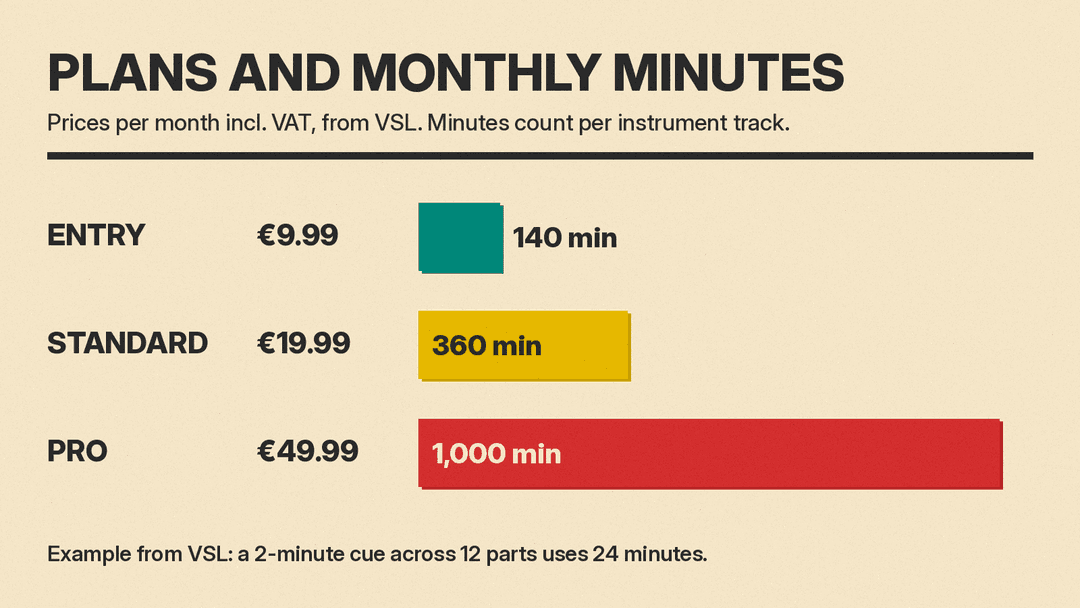
As of November 9, 2026, there are three subscription plans, with prices including VAT per the product page. Entry costs €9.99 per month and includes 140 render minutes. Standard costs €19.99 with 360 minutes. Pro costs €49.99 with 1,000 minutes. Yearly payment is ten times the monthly price: €99.90, €199.90 and €499.90, which VSL describes as two months free. Minutes are allotted monthly in every plan, yearly plans included.
Minutes are counted per instrument track. A two-minute cue across twelve parts uses 24 render minutes. If you need more, top-up credits cost 10 cents per performance minute and are sold from €50 for 500 minutes up to €1,000, in €50 steps. Top-up credits never expire.
Edits are billed by phrase. The product page says changing two bars re-renders only the phrase those bars belong to, rounded up to the next 10 seconds. A phrase runs until a pause of two seconds or more.
What do you need to run it?
Vienna Performer runs on macOS 12 or later and Windows 10 or later. The product page lists VST3, AU and AAX on macOS, and VST3 and AAX on Windows. The press release also mentions VST. You need a VSL account and an internet connection to render. There is no standalone version and no offline rendering, although renders already on disk play back without internet. No iLok is required.
Why it matters
Where training audio comes from matters because AI music companies are being sued by rights holders. On November 6, 2026, rights holders for Elvis Presley and the publisher of many Eminem songs sued Suno. Prompt-based generators turn text descriptions into finished songs, and our explainer on how AI music generators work walks through the steps. Suno also accepts MIDI uploads in Create.
Vienna Performer sits on the other side of that line. The press release says the notes, dynamics and phrasing come from the user, and that its models were trained only on recordings the company made with its own orchestra in its own hall.
VSL also pitches it as a mockup tool, not a replacement for players. On the product page, composer H. Scott Salinas is quoted saying: "This in turn actually helps me make the case for recording live musicians."
