
Two reports in two days point at the same gap in US chip policy: Chinese companies could not buy top AI chips, so they rented them. The Financial Times reported on November 3 that Nvidia is telling cloud partners to limit Chinese business, and on November 4 that Oracle has canceled a roughly $7 billion chip lease with Tencent. Oracle, Tencent and Nvidia have not confirmed the reports, so everything below is attributed to the FT and the outlets that relayed it.
What the FT reported about Oracle and Tencent
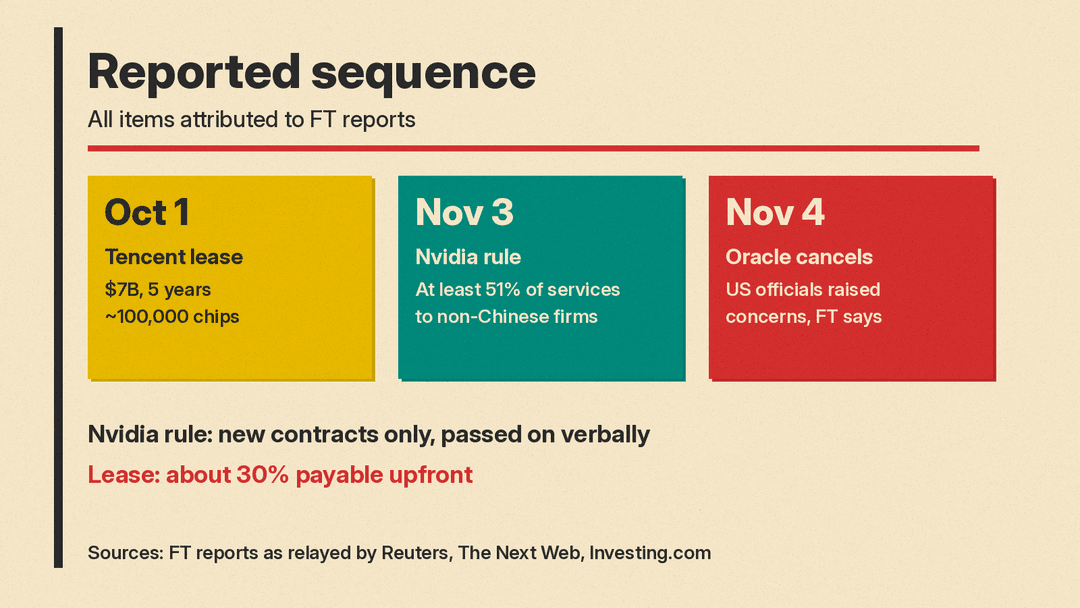
On October 1, the FT reported that Tencent had signed its largest overseas lease deal with Oracle, according to Reuters' summary of the report. The deal gave Tencent access to about 100,000 advanced AI chips that were not available in China. It was a five-year lease across multiple Oracle data centers in Southeast Asia, estimated at about $7 billion.
Investing.com reported that about 30% of the value was payable upfront and that the payment weighed on Tencent's free cash flow in its second quarter results. TrendForce put numbers on that quarter: capital expenditure up 176% year on year to RMB 52.8 billion, and free cash flow negative at RMB 13.8 billion.
On November 4, the FT reported that Oracle had scrapped the contract. According to The Next Web's account, US officials went to Oracle with concerns about the deal, citing people familiar with the matter. The same report said senior officials from Guangdong, the province where Tencent is based, visited the company and urged it to back chips made in China.
The reporting has gaps. Reuters said it could not immediately verify the report, and Oracle, Tencent and the White House did not respond to its requests for comment. Network World noted in October that neither company had disclosed which processors were involved, and that Oracle's cloud offers both Nvidia and AMD accelerators. Data Center Dynamics describes the deal as parting ways just weeks after signing.
The reported Nvidia rule, a day earlier
On November 3, the FT reported that Nvidia now requires cloud computing clients to sell at least 51% of their services to non-Chinese companies, according to Investing.com's summary. The company previously had no such restriction. Per The Next Web, the rule applies to new contracts and leaves existing agreements untouched, and it was passed on verbally through Nvidia's sales force and regional teams rather than in writing. The FT cited five people familiar with the matter.
According to The Next Web, Nvidia neither confirmed nor denied the move when AFP asked. It gave a statement: "America cannot win the AI race unless America's AI infrastructure wins worldwide."
As reported, the rule would hit a common workaround. Data Center Dynamics notes that many Chinese companies have leased compute in Malaysia and Indonesia, and such deals could face limits under the new rule. It quotes a Singapore-based cloud group telling the FT that it is "difficult to find enough non-Chinese clients outside the US" and that "If strictly implemented, it will definitely hurt business."
Chip Dispatch adds that operators would need to track the share of Chinese customers, and that the penalties for missing the threshold are not specified in the reported terms. That is the weakest part of the story: a verbal rule with no published penalty is hard to measure from outside.
Why renting was the loophole
Investing.com explains the legal background: Chinese tech companies are blocked from directly buying advanced AI chips, but under US rules they are allowed to lease them internationally. That is how a Chinese firm could use chips it cannot import. Our explainer on US AI chip export controls on China covers what the rules restrict and who needs a license.
Network World called this an emerging problem for US semiconductor policy, because controlling access to accelerators gets harder when customers can rent capacity outside the country. It reported that the Commerce Department has initiatives and proposed legislation to close that loophole, and said the Oracle and Tencent arrangement could become an important test case for how the US regulates AI compute rather than only AI chips.
Read together, the two reports describe pressure arriving from two directions. One is a supplier setting a customer-mix rule. The other is a government raising concerns about one specific contract.
Supply on the other side
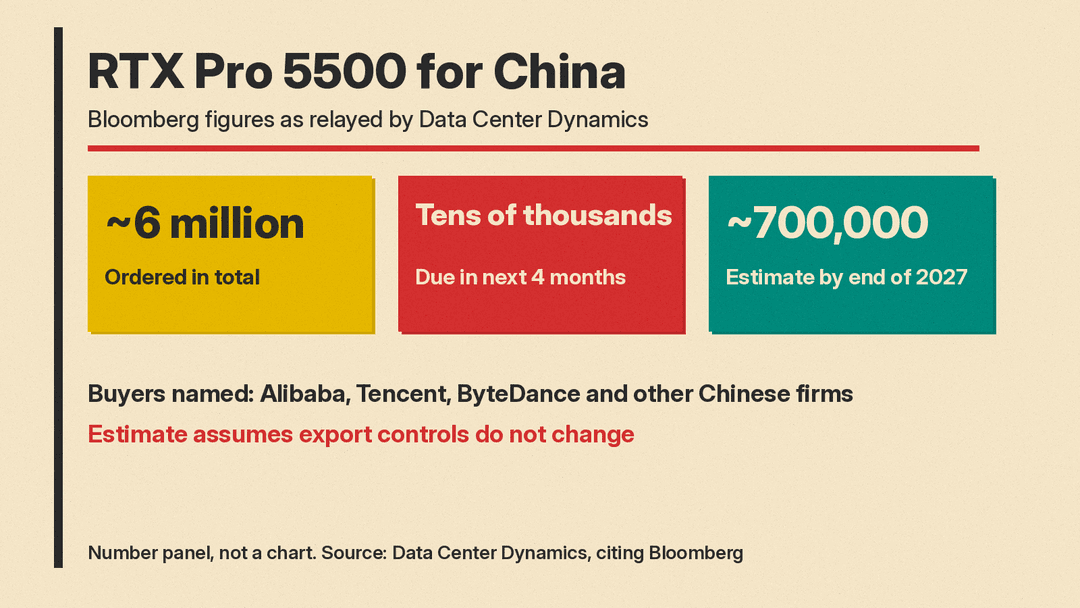
Buying inside China is also tight. Data Center Dynamics reports that Nvidia has more than halved the number of Asian customers authorized to buy its AI chips, and created a "white list" of companies that passed tougher compliance checks. It says B300 chips are banned from export to China, while the less powerful RTX Pro 5500 workstation card is cleared.
Citing Bloomberg, it says Alibaba, Tencent, ByteDance and other Chinese firms ordered about six million RTX Pro 5500 chips but will receive only a few tens of thousands over the next four months. Chinese hyperscalers estimate about 700,000 units by the end of 2027 if export controls do not change. An Nvidia spokesperson blamed outdated US export controls and China's own limits on US imports. For the other side of China's chip access, see our post on Beijing clearing initial H200 shipments to ByteDance and Tencent.
What it means for Oracle
For Oracle, the lease was one of several large, long-term contracts behind its fast build-out of AI cloud capacity. Oracle has also been widening the chips it rents out, as covered in our post on Oracle adding Google TPUs and Cerebras hardware to its cloud. The Next Web reports the company is paying for that expansion partly with borrowed money and recently priced a $20 billion funding round with interest of up to 8.65%. It also reports that Oracle's shares have roughly halved over the past year as investors weigh AI growth against the cost of funding it.
Data Center Dynamics adds that Oracle keeps major contracts with ByteDance. What the lost Tencent business does to Oracle's backlog is not reported anywhere yet, so any estimate would be a guess.
What to watch
Three things would settle the open questions. First, whether Oracle, Tencent or Nvidia confirms any of this on the record. Second, whether Southeast Asian and other neocloud operators publish how they will measure the 51% threshold. Third, whether the Commerce Department proposals that Network World mentioned move forward, since a formal rule on remote access would replace a verbal one.
The practical point is that chip access is now shaped by who rents the chips as well as who buys them. A lease the FT first reported on October 1 was reportedly canceled by November 4.
Sources
- Reuters, Tencent leases 100,000 chips from Oracle, FT reports
- Investing.com, Tencent leases 100,000 chips from Oracle for $7 bln
- TrendForce, Tencent reportedly signs $7B deal with Oracle
- Network World, Oracle reportedly lands $7B GPU deal for Tencent
- The Next Web, Oracle cancels $7B Tencent AI chip lease
- Reuters via StreetInsider, Oracle abandons $7 billion Tencent AI deal
- Data Center Dynamics, Oracle drops Tencent as cloud client
- Investing.com, Nvidia tells data center partners to limit China sales
- The Next Web, Nvidia tells cloud partners to cap Chinese business
- Data Center Dynamics, Nvidia tells data center partners to cut China exposure
- Chip Dispatch, Nvidia reportedly caps Chinese customer share
