
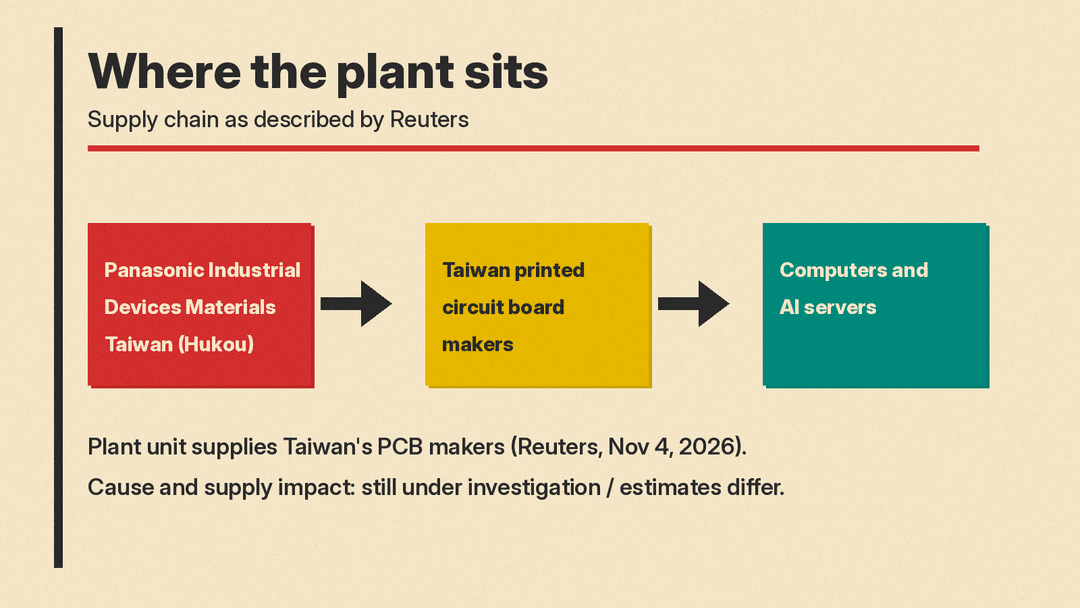
A fire and an explosion at a Panasonic materials plant in northern Taiwan on November 4 has put a quiet part of the AI server supply chain in the news. The plant belongs to Panasonic Industrial Devices Materials Taiwan, a unit that, per Reuters, supplies the island's makers of printed circuit boards, which are essential for products such as computers and AI servers. How much supply is actually at risk is still unclear, and the Taiwanese trade press is split on it.
What happened
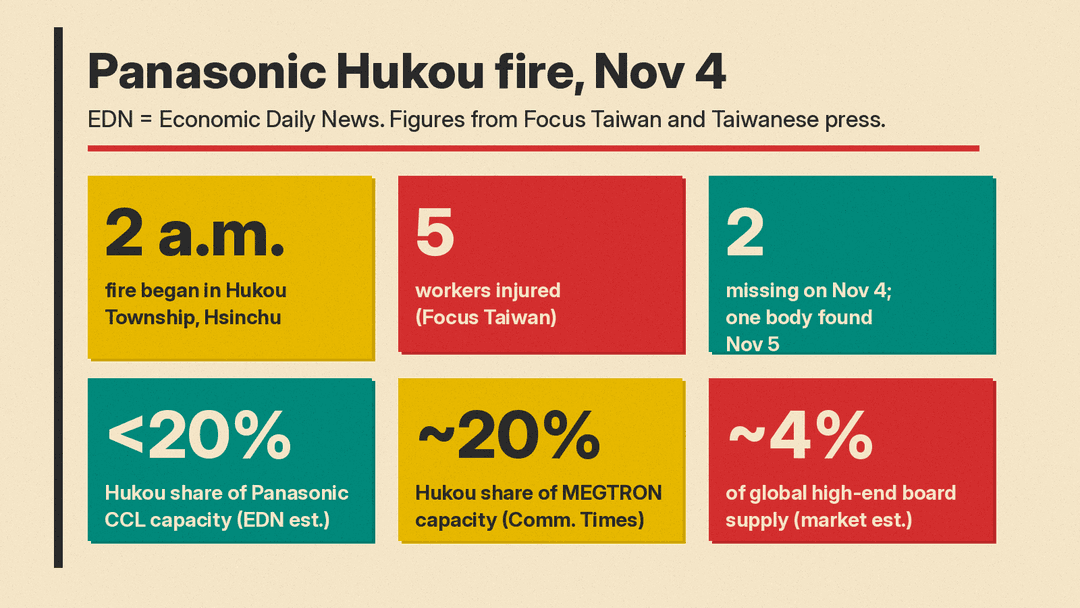
According to the Hsinchu County Fire Bureau, as reported by Focus Taiwan, the fire broke out at 2 a.m. on Wednesday, November 4, at Panasonic's five-story factory on Guangfu Road in Hukou Township. The building had a steel frame and sheet-metal walls. Five men were injured, three Taiwanese and two Vietnamese, and all five were conscious when taken to hospital. Two Taiwanese employees were missing inside the building.
Reuters reported, citing Hsinchu County officials, that the flames were put out shortly before noon, and that Panasonic confirmed an explosion at the facility, saying it was investigating the details and cause. The Taipei Times carried the same account of the injuries and the missing workers.
On November 5, Focus Taiwan's Japanese service reported that the fire bureau had found one body during the search with heavy equipment, that the person's identity was being confirmed, and that the search for the other missing worker was continuing. It added that more than 20 people were working on the production line when the fire started.
The cause is not confirmed. The Chinese-language business paper Commercial Times wrote that the county fire bureau's preliminary view was a chain of explosions possibly triggered by boiler operation or by a leak of organic solvents such as methanol and methyl ethyl ketone. Treat that as a preliminary view, not a finding.
Why AI hardware watchers care
The plant makes copper-clad laminate, known as CCL, the base material that circuit boards are built from. Commercial Times described the Hukou site as an important production base for Panasonic's high-end MEGTRON series. AI server main boards and 800G switches use high-grade laminates of this kind. Commercial Times also quoted analysts saying that high-end board material was already tight because Nvidia and large US cloud providers keep pulling supply.
That tightness is the link to the chip story. A GPU or accelerator only works once it sits on a board in a server, so board material is one more input that AI server builders depend on. Our recent coverage of Supermicro's quarter and AMD's data center growth shows how fast AI server demand is growing.
How big is the supply hit
The estimates conflict, and none of them comes from Panasonic.
- Economic Daily News said on November 4 that the actual impact was still being watched, but that it expected material supply to tighten further, and said high-end laminate was already in short supply. It roughly estimated the Hukou plant at under 20% of Panasonic's overall CCL capacity by area, with most capacity at Koriyama in Japan and at Guangzhou and Suzhou in China.
- Commercial Times, on November 5, quoted industry sources putting Hukou at about two tenths of Panasonic's global MEGTRON capacity, mainly grade M6, with some M7 and M8. It said M8 may still be in trial production. It also cited a market estimate that a line stoppage would affect about 4% of global high-end multilayer board supply.
- A second Economic Daily News report on November 5 said PCB industry sources saw a limited supply impact and more of a psychological effect. It said most of Panasonic's high-end M7 and M8 laminate is made in Fukushima, Japan.
On restart time, Commercial Times said analysts expect a return to production to take several months or more, because the site needs building repairs, equipment replacement and customer requalification. That is an analyst expectation, not a Panasonic schedule.
Who could pick up the orders
Economic Daily News described two routes if orders have to move: Panasonic shifting work to its own plants in Japan or China, or customers moving part numbers with overlapping high-speed, low-loss specifications to the large Taiwanese laminate makers Elite Material, Taiwan Union Technology and ITEQ. The paper also said these makers and Tengyi Electronic are already short of capacity for their circuit-board customers, that adding capacity takes time, and that the industry does not expect them to absorb extra orders right away.
Commercial Times reported that a US-based foreign institutional investor saw Elite Material as the most likely beneficiary, followed by Taiwan Union Technology and China's Shengyi Technology. The same article noted that the market did not trade that way on November 5: Elite Material, Taiwan Union Technology, ITEQ and Tengyi Electronic fell to the daily limit intraday.
What to watch
Three things will settle the question. First, whether Panasonic publishes a cause and a restart plan for the Hukou plant. Second, whether it moves MEGTRON output to Japan or China, and how quickly. Third, whether circuit-board makers report laminate shortages or longer lead times in coming weeks. Until one of those shows up, the fair reading is that a serious industrial accident has hit a supplier to AI server board makers, and that the size of the supply effect is an open estimate.
Sources
- Reuters via Internazionale: Taiwan douses fire at Panasonic factory
- Focus Taiwan: 5 injured, 2 missing in Panasonic factory fire in Hsinchu
- Focus Taiwan (Japanese): one body found, search continues
- Taipei Times: Five injured and two missing in fire at Panasonic site
- Commercial Times: Panasonic fire and CCL stocks
- Economic Daily News, November 4: CCL supply outlook
- Economic Daily News, November 5: PCB industry view
