

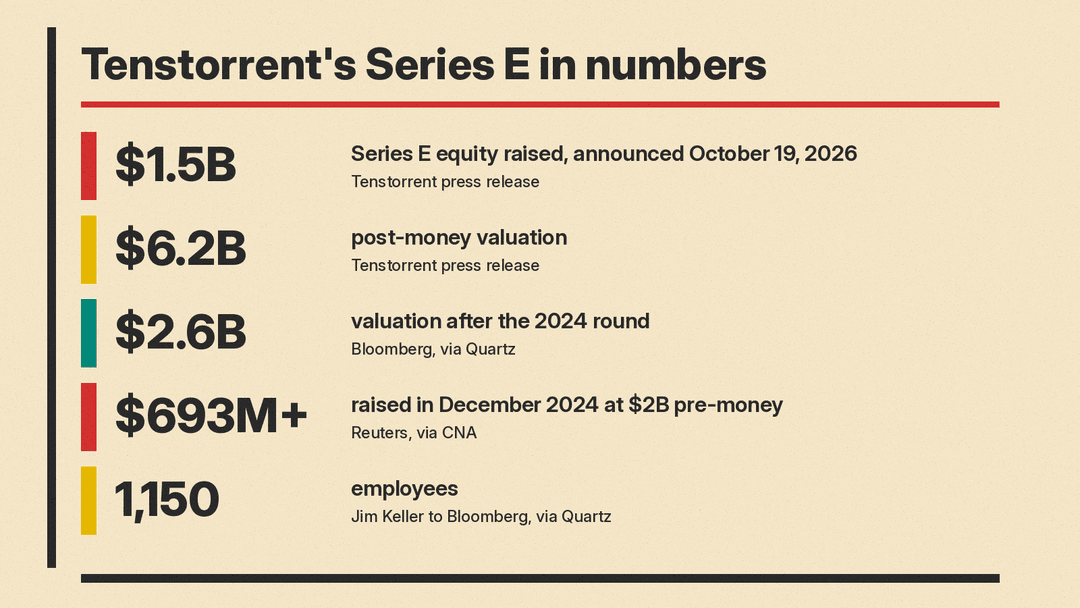
Tenstorrent, the AI chip company run by veteran chip architect Jim Keller, said on October 19 that it has closed a $1.5 billion Series E round at a $6.2 billion post-money valuation. Trace Capital and Innovation X led the round, according to the company's announcement.
The raise more than doubles the company's value. Reuters reports that Tenstorrent's last round, in December 2024, raised more than $693 million at a $2 billion pre-money valuation. Bloomberg, as summarized by Quartz, puts the valuation after that 2024 round at $2.6 billion.
Who invested
The press release lists these new and existing investors alongside the two leads:
- Agostinelli Group, ARK Invest, Brett Barna, Cadence Ventures, Eclipse
- Fidelity Management & Research Company, Maverick Silicon, Morgan Stanley, Protagonist
- Sandisk, accounts advised by T. Rowe Price Associates, Tether Investments
- Troluce Capital, Virtu Financial, XTX Markets
Trace Capital is new. The release says Ben Mahdavi, who co-founded Quiet Capital, founded it in 2026. Innovation X is a late-stage venture firm founded in 2016 that reports over $4.5 billion under management.
Cadence Ventures is the venture arm of Cadence Design Systems, per Quartz.
Where the money goes
Tenstorrent says it will use the capital for three things.
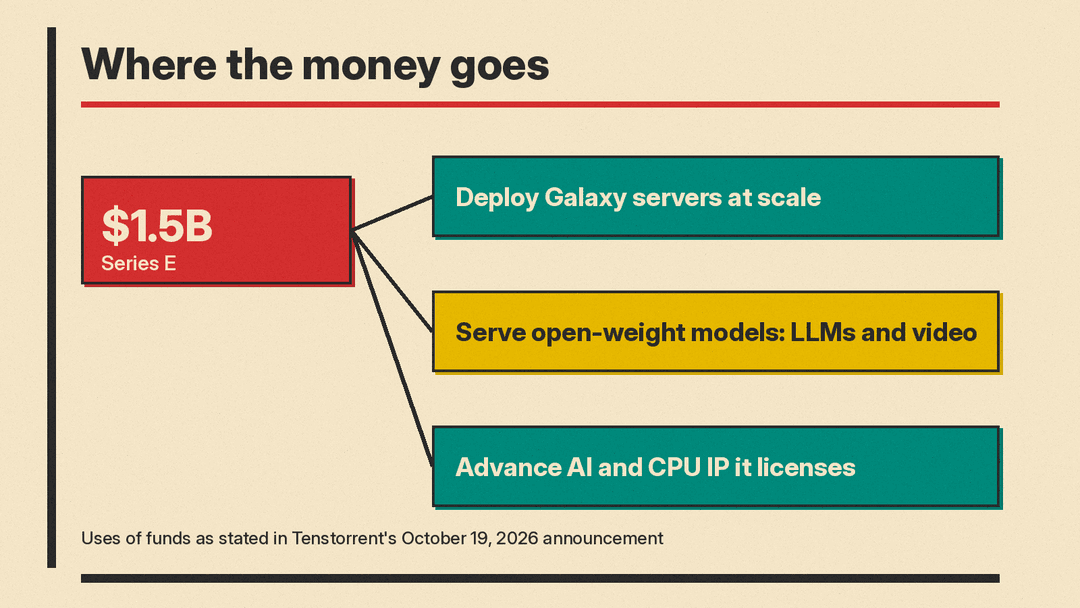
- Galaxy servers at scale. Galaxy is Tenstorrent's server product. Reuters describes it as a system that combines dozens of the company's AI chips to run chatbots, coding assistants and video generators.
- Serving open-weight models. The company says it will continue to serve open-weight models across LLMs and video generation.
- Licensable IP. Tenstorrent licenses its TT-Ascalon RISC-V CPU and Tensix AI cores to chip designers. The release names Samsung and LG as licensees.
The company frames the round around a shift it sees in the market: "chip designers, sovereign players, and inference platforms move to own their AI compute." It sells at every size, from a single card or workstation to racks, superclusters and custom IP, with an open-source software stack.
"We built one architecture and sell it at every size," Keller said in the release.
Why RISC-V matters here
Tenstorrent builds its chips on RISC-V. Reuters explains it as an open-source chip architecture that lets companies design processors without license fees and lowers their dependence on proprietary ecosystems such as Arm's.
That choice links the two halves of the business. Tenstorrent sells finished hardware, and it also sells the CPU and AI core designs inside that hardware to companies that want to build their own silicon. Samsung is both a backer and a licensee, per the release. Samsung also appears on this beat for another reason: it is reportedly making Nvidia's NVHBM base dies on TSMC 3nm.
Sale talks came first
Bloomberg reported that Tenstorrent drew takeover interest earlier this year and spoke with Intel, Qualcomm and others about a possible sale, according to Quartz. Keller told Bloomberg the company chose new funding instead.
He pointed to a May demonstration that, he said, showed Galaxy servers could handle powerful DeepSeek models. "Once we had the ability to fundraise and demonstrate the performance and started to ship, the investor interest came in," Keller said, per Quartz.
Keller also told Bloomberg that Tenstorrent has 1,150 employees and can take orders that may be too small for larger rivals. "People are looking for alternatives," he said. He added that the company can compete on price.
Why it matters
Nvidia, AMD and Broadcom dominate the market for AI chips, as Quartz notes, and a growing number of startups are trying to compete with them. Intel is also pitching inference hardware, with its Data Center GPU D-Series. Amazon is going after Nvidia's software advantage with TorchNeuron, which runs PyTorch code on its Trainium chips.
The company says the raise will fund volume manufacturing and global commercial expansion. The open question is demand. Keller's own growth path, quoted by Bloomberg, starts small: "you start with $10 million and $100 million, then $500 million." The company has not given revenue figures in its announcement.
For buyers, the practical signal is that a non-Nvidia option with an open software stack and licensable cores now has late-stage funding from investors including Fidelity, Morgan Stanley and T. Rowe Price.
Keller's background is part of the investor pitch. The release calls him the architect of Apple's A4 and A5, AMD's Zen and Tesla's Full Self-Driving chip. Tenstorrent was founded in 2016 by Ljubisa Bajic, Milos Trajkovic and Ivan Hamer, according to Quartz. The company operates from Santa Clara, Austin, Toronto, Belgrade, Tokyo and Bangalore.
Sources
- Tenstorrent Announces a $1.5B Series E at a $6.2B Valuation (Tenstorrent via ACCESS Newswire)
- AI chip startup Tenstorrent more than doubles its valuation to $6.2 billion in funding round (Reuters via CNA)
- Tenstorrent raised $1.5 billion, more than doubling its valuation to $6.2 billion (Quartz, summarizing Bloomberg)
