
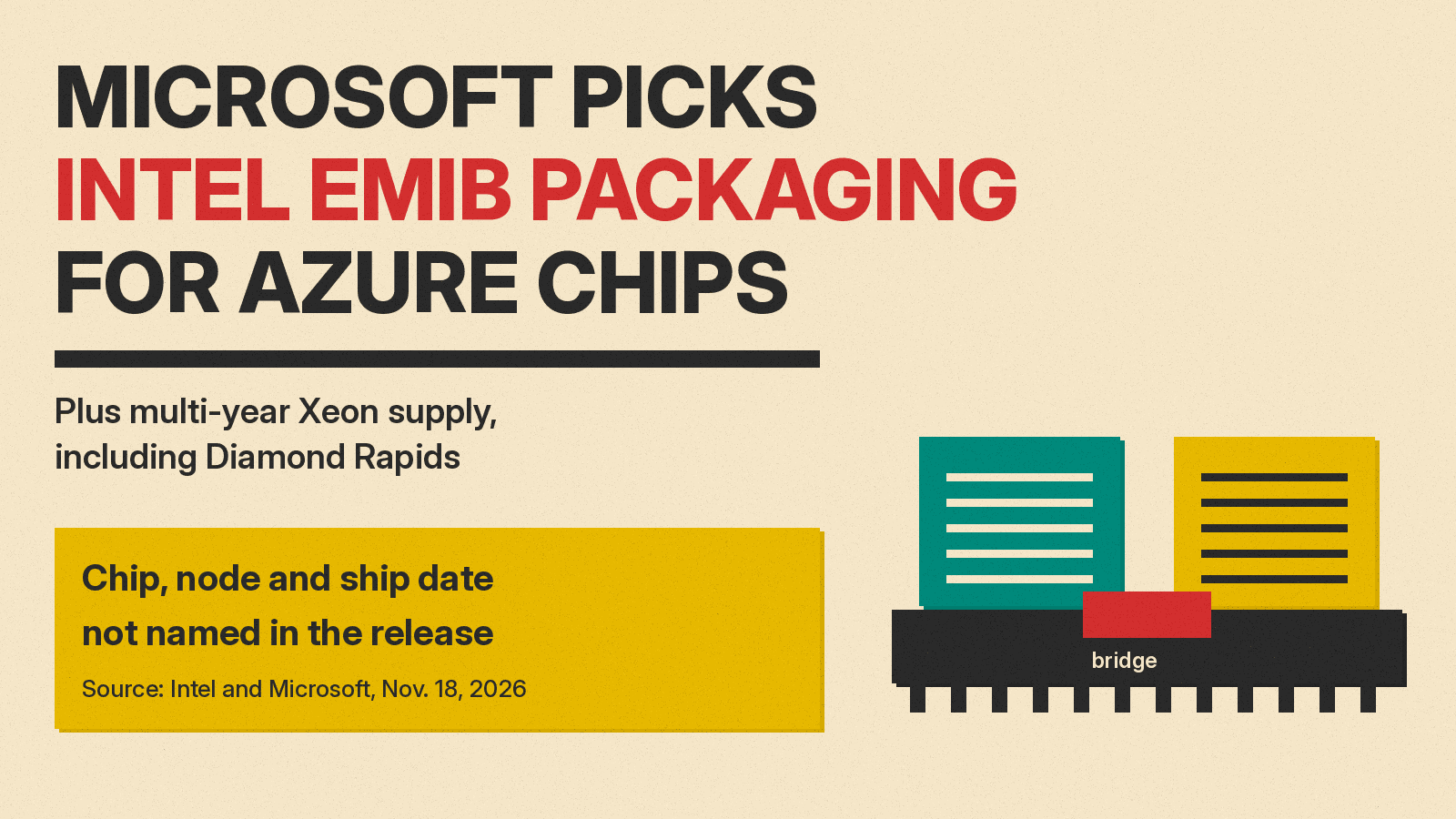
Microsoft will use Intel Foundry's EMIB advanced packaging for its own Azure chips, the two companies announced on November 18, 2026. The joint release says Microsoft "is the first company to announce use of Intel Foundry's EMIB (Embedded Multi-die Interconnect Bridge) advanced packaging technology for Azure first-party silicon." The same long-term agreement also confirms multi-year supply of Intel Xeon server processors for Azure, including the next-generation chips codenamed Diamond Rapids.
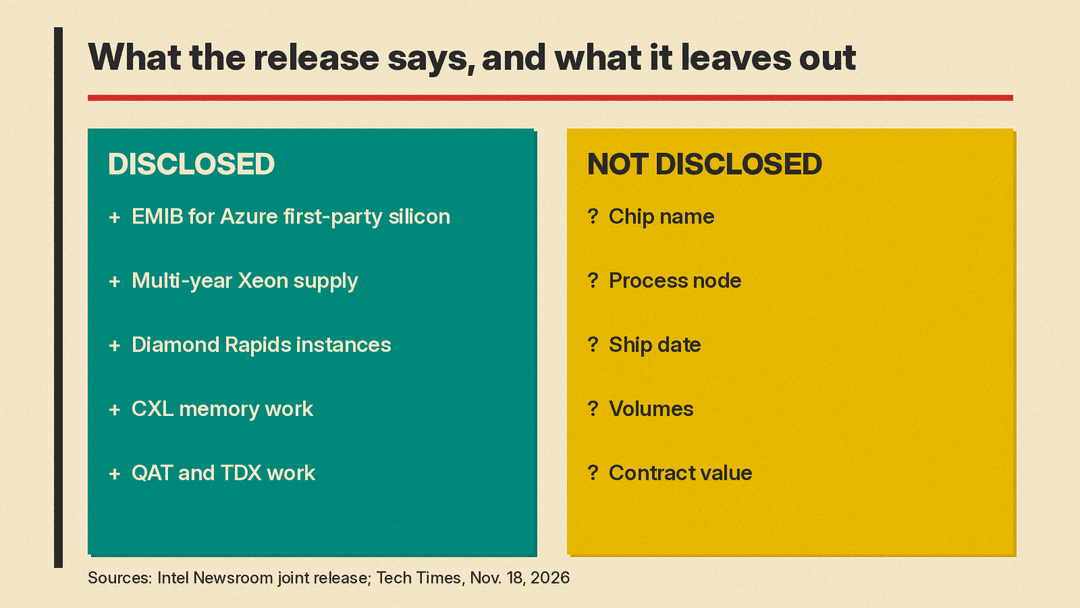
The release does not name the Azure chip that will use EMIB, the process node, a ship date or what Microsoft will pay, as Tech Times noted. Even so, the deal gives Intel Foundry a named cloud customer for EMIB on that customer's own chips.
What Microsoft and Intel announced
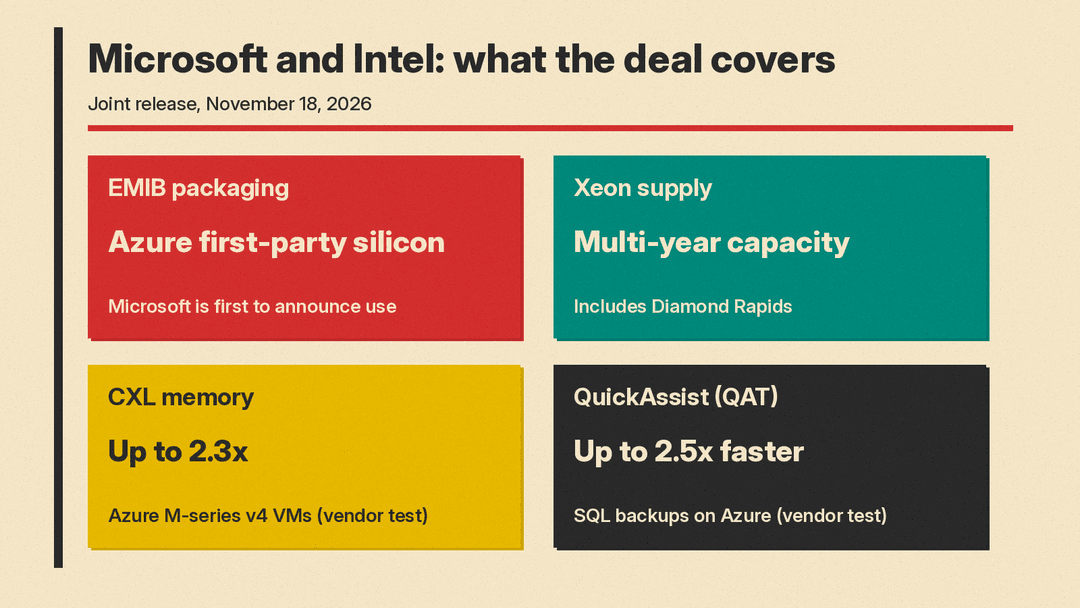
The Intel newsroom release, also posted on Microsoft Source, lists four parts to the expanded collaboration:
- EMIB packaging for Azure first-party silicon. Microsoft is the first company to announce use of EMIB for its own Azure chips.
- Xeon supply. The agreement "confirms multi-year Intel Xeon supply capacity," including instances of Diamond Rapids, and expands work "across the Azure roadmap and Intel-based Azure hardware systems."
- CXL memory. Microsoft will work with Intel on Xeon with Compute Express Link (CXL) "to drive greater memory efficiency and system-level innovation across Azure."
- QuickAssist and confidential computing. The companies will also collaborate on Intel QuickAssist Technology (QAT) and confidential computing.
The release ties that work to three existing Azure results:
- "Up to 2.3x greater performance and memory flexibility for demanding workloads in Azure M-series v4 virtual machines with CXL memory and Intel Flat Memory Mode in Xeon 6 processors."
- Up to 2.5x faster SQL backups on Azure "through the first Intel QuickAssist Technology (QAT) enabled virtual machines in the cloud."
- "Virtual machine memory and CPU register state encryption as confidential VMs move between hosts through Intel Trust Domain Extensions (Intel TDX)."
What EMIB is
A modern AI chip is often several pieces of silicon, called chiplets or dies, placed in one package. Packaging is the step that joins those dies so they can pass data quickly. EMIB, short for Embedded Multi-die Interconnect Bridge, puts small silicon bridges inside the package substrate to connect neighboring dies.
Tech Times explains that TSMC's CoWoS-S uses a full silicon interposer instead, while CoWoS-L embeds bridge dies inside the interposer, a design closer to EMIB. The same outlet cites Bernstein analysts who estimate standard EMIB packaging costs "in the low hundreds of dollars per chip, against roughly $900 to $1,000 for CoWoS on a Nvidia Rubin-class accelerator." Tech Times also cites TrendForce reports that put EMIB substrate yield at about 45% (a September report) and EMIB-T substrate yield near 35% in the third quarter (an October report). Tech Times says those figures come from industry sources and refer to substrates, not finished packages.
Wccftech wrote that TSMC's CoWoS "has been the go-to solution, but as supply pressure mounts, customers such as Microsoft are looking at other places." For background on the TSMC side, see our report on TSMC CoWoS pricing and Nvidia supply deals.
Which chip? The release does not say
Microsoft's current custom chips include the Maia accelerators and Cobalt CPUs. TechPowerUp reported that Microsoft will use Intel's EMIB-T variant and that "the next-generation versions of these silicon projects will be packaged at Intel Foundry." The joint release does not say this. It names no chip and no EMIB variant.
Tech Times points out that "first company to announce" use is not the same as first to use, and that the release says nothing about Intel 18A or 14A wafers. Because chiplet designs can combine dies from different factories, Microsoft could use Intel packaging while its dies are made elsewhere. Tech Times labels that point as inference. It also notes that Microsoft's Maia 200 is built on TSMC's N3P process.
The Xeon half of the deal
The Xeon commitment is a separate supply arrangement. Tech Times reports that Diamond Rapids, Intel's Xeon 7 generation, is due in 2027 on the 18A-P process with 256 cores, and that it uses UCIe-S links rather than EMIB to join its fabric hub tiles to its core chiplets. It adds that Oracle said on October 27 that planned OCI X14 offerings are expected to use Diamond Rapids, and that AMD said in July that Azure HDv2 virtual machines will use its Venice processors. So the Intel supply deal does not make Azure an Intel-only fleet.
For Intel's most recent data center numbers, see our report on Intel's third-quarter results.
Read the performance claims with care
The 2.3x and 2.5x figures are "up to" results from vendor tests. Tech Times read Intel's footnotes and found that the 2.3x test compares a 76-vCPU instance with 1,764 GB of memory, including CXL, against a 64-vCPU instance with 1,007 GB of DRAM only. The 2.5x SQL backup test compares an Intel Xeon Gold 8362 system with 128 CPUs against a Xeon 6973P-C system with 384 processors, according to Intel's footnote. In both cases the test system has more CPUs and more memory than its baseline, so the results do not isolate CXL or QAT.
What the executives said
Saurabh Dighe, CVP of Azure System and Architecture at Microsoft, said in the release: "Our customers need infrastructure built around the workloads that matter to them."
Naga Chandrasekaran, Intel's EVP, chief technology and operations officer and general manager of Intel Foundry, said in the same release that using EMIB to scale future generations of Azure infrastructure lets the two companies combine the flexibility of heterogeneous integration with manufacturing scale, which he said gives customers new levels of performance and economics on Azure.
Why it matters
Microsoft designs its own Azure chips, and those chips need packaging to ship. The November 18 release makes Microsoft the first company to announce EMIB use for Azure first-party silicon, and it adds a multi-year Xeon supply commitment. What is still missing is the chip name and the year it ships. Those two facts will show how much of Azure's custom silicon actually moves through Intel's packaging lines. For more on how AI is changing chip work itself, see our report on OpenAI's models in AMD GPU design.
Sources
- Intel Newsroom: Microsoft and Intel deepen collaboration to deliver differentiated Azure infrastructure (Nov. 18, 2026)
- Microsoft Source: same joint release (Nov. 18, 2026)
- Tech Times: Microsoft Will Use Intel EMIB Packaging for Azure Silicon, but Release Omits Chip and Date
- TechPowerUp: Microsoft to Use Intel's EMIB Advanced Packaging Technology
- Wccftech: Microsoft Becomes The First Announced Intel EMIB Customer For Its Azure Custom Silicon
