
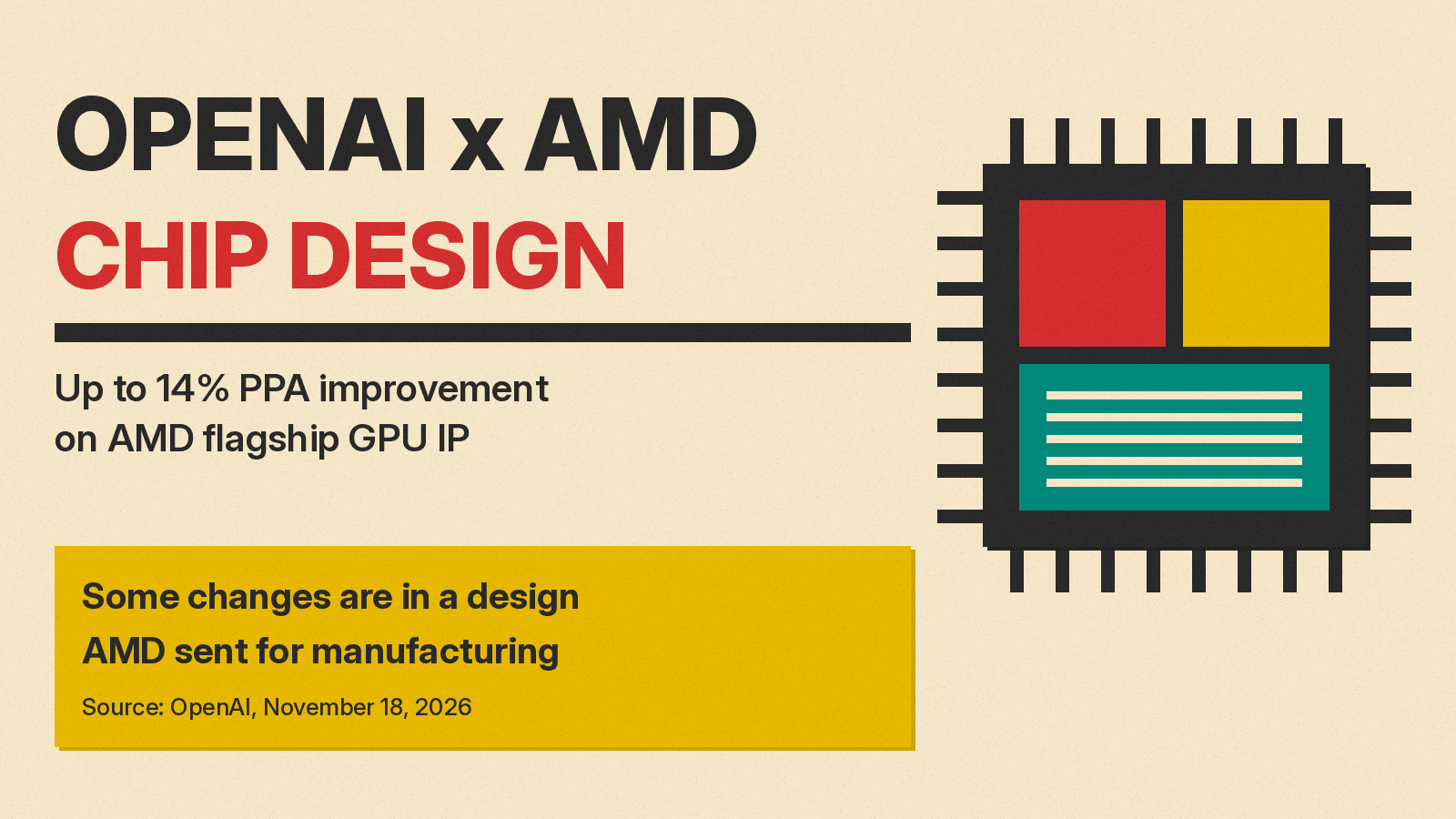
OpenAI said on November 18, 2026 that its AI models improved the design of AMD's flagship GPU, with gains of "up to 14% improvement relative to heavily optimized baselines" in power, performance and area. In a post on its site, OpenAI said "AMD has already included some of these changes in a recent design it sent for manufacturing, and added others to its production design files for use in future versions."
The same post gives new detail on how OpenAI's models shrank parts of Jalapeño, its own inference chip, and how five of its model generations scored on two open-source processor design tests. It also points to GPT-Synopsys, a chip design model OpenAI is training with Synopsys.
What OpenAI says its models did for AMD
Power, performance and area, or PPA, are "the three measures chip designers trade off," as The Next Web put it.
According to OpenAI, its model found further improvements by rewriting the code that describes the chip's circuits, called SystemVerilog RTL. OpenAI said its model "can rewrite circuits that perform calculations, control operations, or move data," and that it used Synopsys tools to check that each rewrite kept the block's behavior and to weigh the trade-offs in power, performance and area.
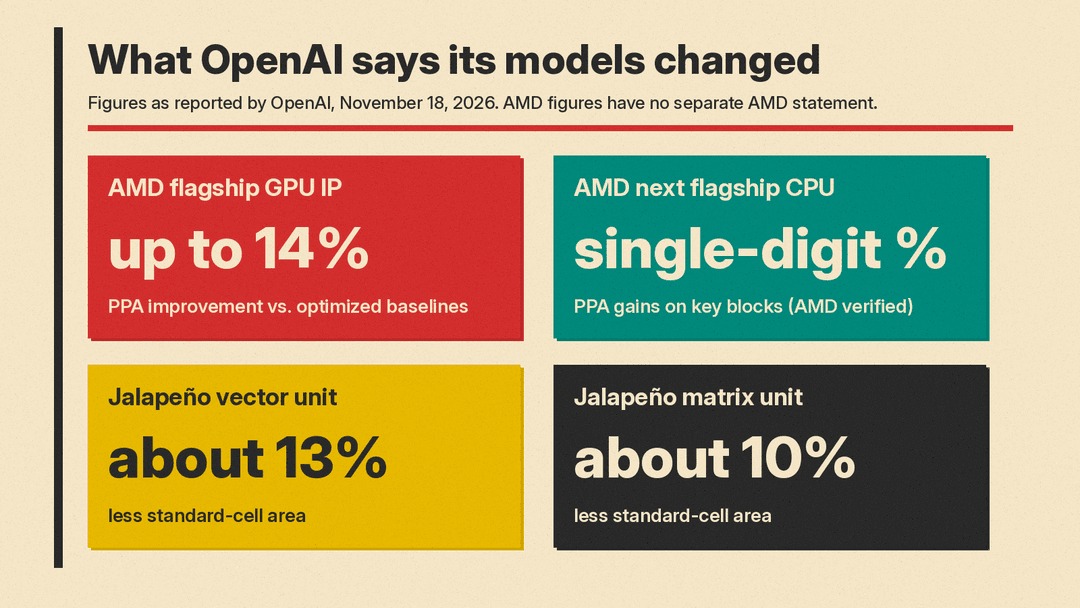
OpenAI described the result as "roughly a year of progress achieved in less than 5 months." It also said AMD "verified single-digit percentage gains in PPA across key blocks of its upcoming next-generation flagship CPU using designs written by our model."
Some limits on what the post says:
- It does not name the AMD GPU or CPU products.
- It gives "up to 14%" as the top figure. It does not say how many blocks reached that level or give a breakdown by power, performance and area.
- The AMD figures are reported by OpenAI. The post does not include an AMD statement.
The Next Web noted that OpenAI's chip chief, Richard Ho, "said last month he still does not fully trust AI design changes, so every one is checked."
The Decoder set the news next to another AI lab's claim about AMD hardware. Anthropic said its Mythos model brought up prompt processing for one of its models on AMD MI355X GPUs in about three days, as we reported. That was software work. OpenAI's claim is about the chip design itself.
Jalapeño: the first test case
OpenAI first showed Jalapeño, its custom inference chip, in August. The new post says OpenAI "started using GPT-4o to help design Jalapeño in early 2025."
OpenAI said its team estimates that across the broader Jalapeño design effort, "model proposed changes reduced standard-cell area by about 13% in the vector unit and 10% in the matrix unit." It said these changes "were silicon proven during Jalapeño's silicon bring-up."
The post gives two examples from the matrix unit:
- One multiplier redesign "used about 15% less cell area in synthesis while reducing latency from two clock cycles to one."
- A separate adder redesign "reduced cell area by about 15% while retaining its two-cycle latency."
In the vector unit, OpenAI said the savings came from floating-point adders and multipliers, conversion functions, reduction logic and the special-function unit.
How OpenAI's models scored on RISC-V cores
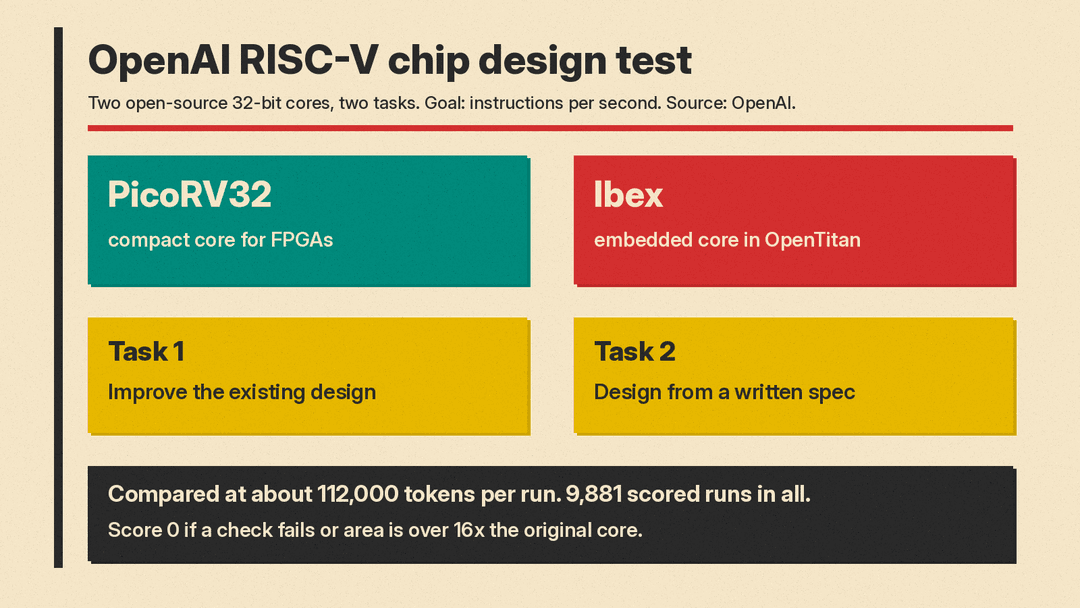
To compare model generations, OpenAI tested them on two open-source 32-bit RISC-V cores: PicoRV32, a compact core for FPGAs, and Ibex, which OpenTitan uses as the embedded processor in its security chip.
The goal was throughput, or instructions per second. OpenAI said designs "scored zero if they failed a check or used more than 16 times the original core's area." The best result seen for each core set a score of 1.0.
There were two tasks:
- Improve an existing design. "With a comparable budget of about 112,000 tokens per run, GPT-6.2 Astra had the highest average score on both cores," OpenAI said. On PicoRV32, near that budget, its score was "about twice GPT-6 Astra's."
- Design a core from a written specification. OpenAI said that at about 112,000 tokens per run, all five models scored higher on this task than on the first, on both cores. GPT-6.2 Astra "passes a mean score of 0.7" on PicoRV32 near 112,000 tokens and "averages about 0.75" on Ibex.
OpenAI said the full evaluation had 9,881 scored runs. It also flagged a limit: a model working from a specification can leave out features the original cores have, "such as performance counters and additional instructions," which "could explain part of the score advantage."
What comes next: GPT-Synopsys
OpenAI said it is "partnering with Synopsys to train GPT-Synopsys, a new model, to use Synopsys electronic design automation (EDA) tools the way expert chip designers do."
Synopsys and OpenAI announced that deal on September 30, 2026. The Synopsys release said GPT-Synopsys "will run on OpenAI-hosted infrastructure" and that "Early technology engagements are underway with leading semiconductor customers." It gave no launch date. Synopsys CEO Sassine Ghazi said in that release that "The future of semiconductor engineering requires dramatic acceleration of the chip design process without compromising PPA or first-time-right silicon."
Why it matters
The AMD work moves the method from OpenAI's own chip to another company's. OpenAI said it is "applying the same approach to deliver significant gains on third-party hardware with AMD."
AMD's data center GPU business is covered in AMD's Q3 2026 data center results.
OpenAI says some model-made changes are now in a design AMD sent for manufacturing. The post gives no AMD comment and no product names, so for now the 14% figure is OpenAI's own number.
Sources
- OpenAI: Advancing chip design with OpenAI models (November 18, 2026)
- Synopsys: OpenAI and Synopsys Announce GPT-Synopsys (September 30, 2026)
- The Next Web: OpenAI says its AI found 14% gains in AMD's flagship GPU design
- The Decoder: OpenAI says its models delivered a year's worth of chip optimization on top of AMD's own engineering
