
VideoGen, a San Francisco startup backed by Y Combinator, has unveiled VideoGen Model 1, its first AI video generation model. The pitch: one text prompt, plus optional images, becomes a finished, multi-shot video up to ten minutes long, with dialogue, sound and music.
Access is limited. A private-partner rollout began on October 20, 2026, and the company has opened applications for a $1 million pool of free credits. This explainer covers what Model 1 does, how it works according to VideoGen's own whitepaper, how to apply, and what is still unknown.
What VideoGen Model 1 is
VideoGen is not new. Its Y Combinator profile lists it as a Summer 2024 company founded in 2023, with a team of six. Until now, its product turned a prompt, script or article into a video with AI voiceover, subtitles and b-roll, using other companies' models such as Seedance, Veo, ElevenLabs and Kling. The profile says over 5 million users trust VideoGen.
Model 1 is the company's own model. According to the press release, it:
- Supports text-to-video and image-to-video. You can start with a written prompt or add up to 16 images as visual references.
- Lets you set a target duration and aspect ratio, so the system plans around the format.
- Generates video and audio together: dialogue, sound and music.
- Produces finished, multi-shot videos up to ten minutes long.
The Model 1 page shows three long examples: an anime short film at 5:00, a 3D animated short at 5:00 and a claymation short at 4:33. VideoGen says each one "was generated from a single prompt, with no editing or post-production." Shorter examples on the page run from about 6 seconds to 43 seconds, including film scenes and ads. These are the company's own picks, so treat them as a best-case reel, not a test.
How it works: a model plus a "writers' room"
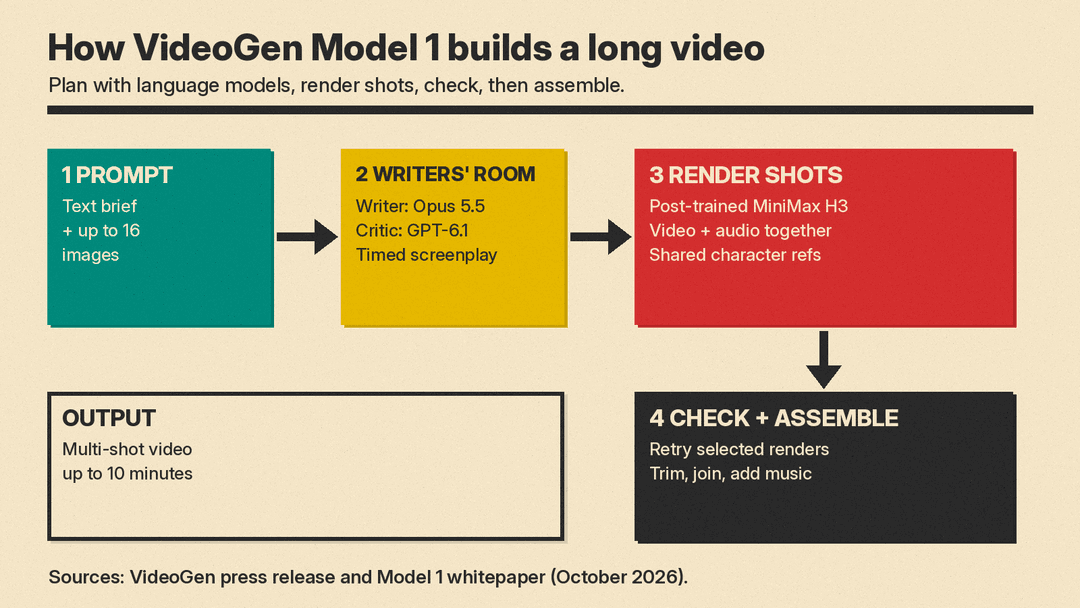
The ten-minute claim does not mean one model renders ten minutes in a single pass. The press release says longer videos "are assembled from multiple generated shots." The real product is a pipeline around the video model.
The base model. VideoGen's technical whitepaper describes Model 1 as "our post-trained version of MiniMax H3." That is the same base model behind HeyGen Video 1, which we covered on October 26. The press release adds that the architecture uses joint audio-video attention and works in latent space, and that VideoGen tested style-focused post-training, low-rank adapters and bfloat16 inference.
The writers' room. Before anything is rendered, a group of language models plans the video. The whitepaper names them: Claude Opus 5.5 is the primary writer, GPT-6.1 is the critic, and Claude Sonnet 5.5 handles intake and reader checks. For an open-ended prompt, the writer proposes six concepts, then five more per round, over two or three rounds. A critic scores them with a rubric for the category (film, marketing, social, explainer, music video or microdrama). For marketing and explainer videos, the checks "also reject invented claims." The two best concepts advance and become timed screenplays.
Dialogue checks. Three separate model "readers" read only the spoken lines and on-screen text, and flag lines that are confusing. The whitepaper says these are "automated proxies, not human participants." Code also checks that scene durations add up to the requested length and that every speaker has a voice description.
Clip prompts. A rewriter, also Claude Sonnet 5.5, turns each scene into the structured prompt format MiniMax H3 expects, with separate fields for the shots and dialogue, the soundscape and the background music. Its planner can return up to two search queries when a prompt names a real product, brand, place, event or landmark that needs visual facts.
Continuity and assembly. For recurring characters, objects and locations, the press release says the system keeps AI representations and shared visual references across shots. The pipeline checks for problems such as incomplete dialogue and visual inconsistencies, retries selected renders within a set budget, then trims and joins the chosen clips. On the writers' room path, background music is composed after the clips are cut together.
What the whitepaper actually tests
The whitepaper does not benchmark ten-minute videos. It is a small, controlled pilot on one question: does creative prompt expansion produce better clips than just reformatting the prompt?
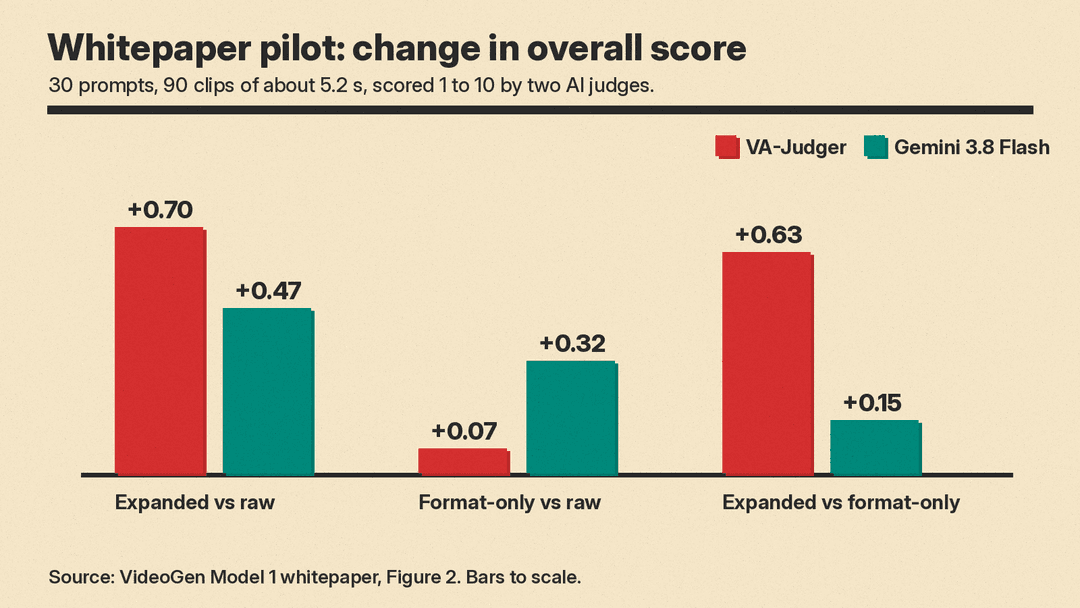
VideoGen wrote 30 prompts and rendered each one three ways: raw, format-only and expanded. That gave 90 clips of approximately 5.2 seconds each, at 832 by 480 or 480 by 832, all with the same seed. Two AI judges, VA-Judger and Gemini 3.8 Flash, scored every clip from 1 to 10 on five dimensions.
The results were modest:
- Expanded versus format-only: +0.63 points under VA-Judger, +0.15 under Gemini. The Gemini interval included zero, so that gain is uncertain.
- Expanded versus raw: +0.70 under VA-Judger, +0.47 under Gemini.
- The clearest shared gain was prompt alignment: +0.97 under VA-Judger and +0.50 under Gemini.
- Video quality barely moved: +0.07 and -0.03.
The authors flag their own limits. Expanded prompts added background music in 22 of 30 cases, which may explain part of the audio gain. The judges rated the same clips, so they are not independent. And "generalization to new prompts, seeds, and longer videos remains untested." Prompt expansion cost an average of $0.02 per prompt in model charges, not counting rendering.
In this pilot, detailed prompts helped clips follow the prompt but did not raise video quality scores. For tools you can use today, see our guide to AI video generators.
Speed and cost claims
VideoGen makes two efficiency claims, both from internal work:
- Cost. "Based on internal validation, VideoGen expects Model 1 to cost more than 50% less than comparable models." The release also says "final pricing, official benchmarks and third-party validation are underway." There is no public price yet, so you cannot compare it with the per-second rates in our AI video pricing comparison.
- Speed. In an internal experiment, an eight-step adapter cut average clip render time by 58.2% compared with the same system's 28-step baseline. VideoGen says this "measures an experimental rendering configuration rather than a guaranteed speed improvement."
How to get access and the $1 million credit program
You cannot sign up and render today. To apply, the Model 1 page says to sign in, select Request access, and describe what you plan to create or cover. Details:
- Credits are "primarily for filmmakers, creators, and studios making and sharing work." Students and amateurs are welcome.
- Some credits will go to journalists and software reviewers covering Model 1.
- Allocations depend on project scope and distribution plan. VideoGen plans to hand out credits through the end of 2026.
- A creator program offers promotion, bonus credits and industry introductions for films that credit Model 1 and link the launch page.
The press release says general availability is "expected to follow shortly after additional safety testing," with no date.
Safety
VideoGen says Model 1 includes guardrails designed to block adult and illegal content, and that generated outputs carry invisible watermarks identifying their synthetic origin. The release does not say how the watermark works or how to check it.
Why it matters
VideoGen pitches Model 1 on planning, continuity and assembly, not only on single clips. If it works as described, the hard part of a long AI video, keeping the same characters and story across dozens of shots, moves from the creator to the software.
VideoGen did not train its base model from scratch. It post-trained MiniMax H3 and wrapped it in a pipeline that uses Claude and GPT models for planning and checks. HeyGen Video 1, which we covered on October 26, is also built on MiniMax H3.
What is still unknown
- Price per video or per minute.
- Independent benchmarks or third-party tests.
- A general availability date.
- Maximum resolution and frame rate for finished videos.
- How often long videos need retries or manual fixes outside VideoGen's own examples.
Until VideoGen publishes pricing and outside testers get access, the ten-minute claim rests on the company's own demo films, the longest of which run 5:00 on the Model 1 page.
