
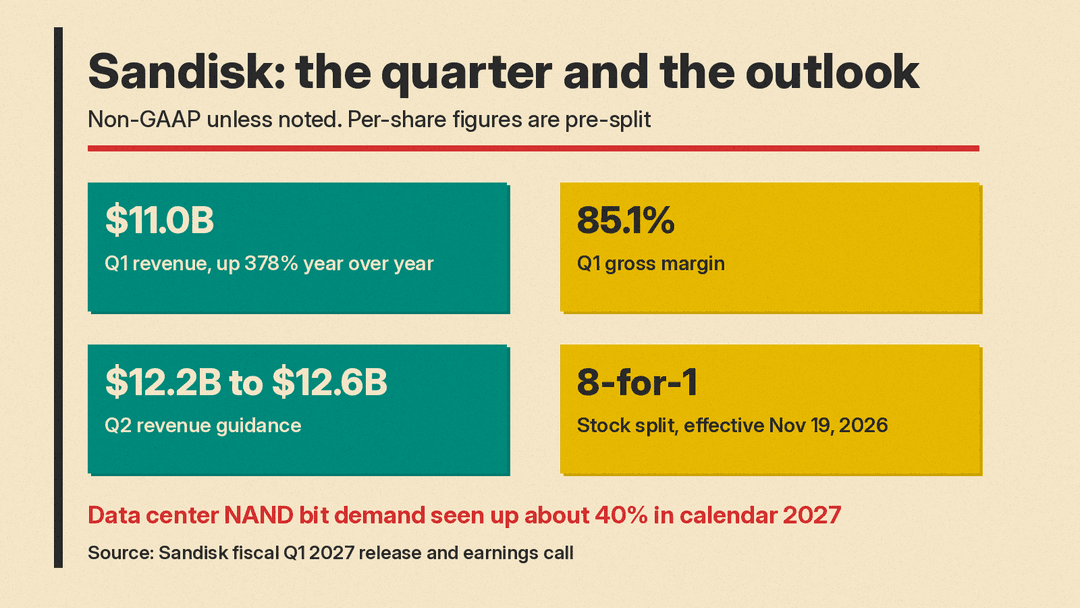
Sandisk's fiscal first quarter of 2027 shows how far AI demand has moved flash memory. Revenue reached $11.0 billion in the quarter, up 23% from the prior quarter and 378% from a year earlier, according to the company's results release. A year ago the same quarter brought in $2.3 billion.
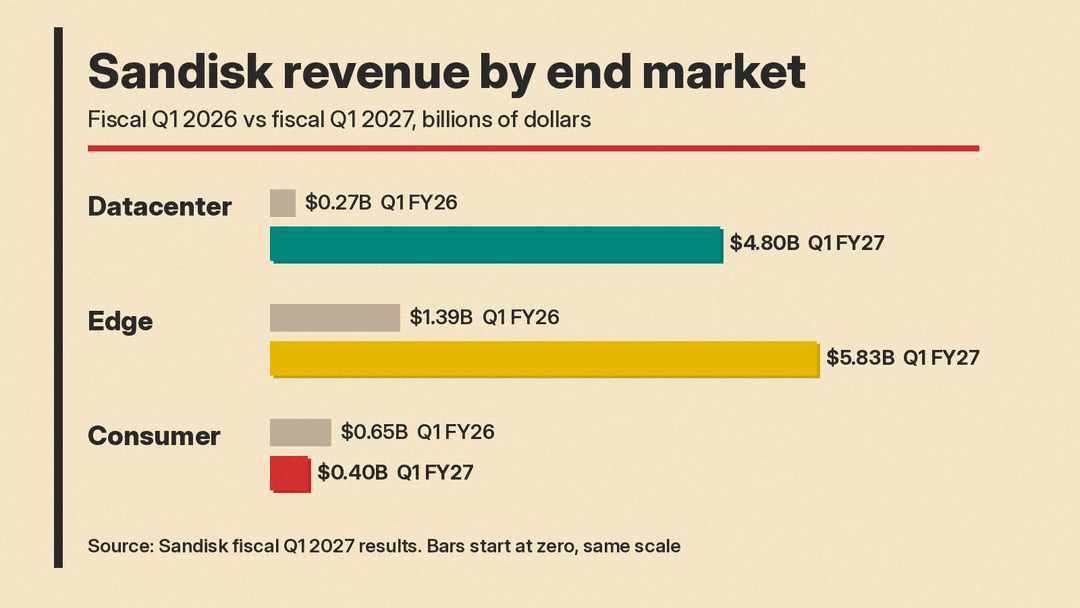
The growth came mostly from data centers. Sandisk's datacenter revenue was $4.8 billion, up 61% sequentially and up from $269 million a year earlier. On the earnings call, CEO David Goeckeler called it "17x growth year-over-year" and said he expects data center to take a larger share of the mix through 2027.
The numbers
From the release and the call:
- Revenue: $11.031 billion, against Sandisk's own guidance of $10.3 billion to $10.8 billion.
- Gross margin: 85.0% GAAP and 85.1% non-GAAP, up from 29.8% GAAP a year earlier.
- GAAP net income: $8.1 billion, or $52.60 per diluted share. Non-GAAP earnings per share were $49.51, against guidance of $44 to $46.
- Datacenter revenue: $4.802 billion. Edge revenue (phones, PCs, cars and similar devices): $5.832 billion, up 7% sequentially and 320% year over year. Consumer revenue: $397 million, down 29% sequentially.
- Adjusted free cash flow: $5.7 billion. Sandisk spent $5.0 billion to buy back about 3.2 million shares and ended the quarter with $5.1 billion in cash and no debt.
CFO Luis Visoso said on the call that about 60% of the revenue increase came from higher volume and about 40% from higher prices. He also said consumer revenue fell "as the market adjusts to higher pricing."
Per-share figures are on a pre-split basis. Sandisk also announced an eight-for-one forward stock split. Holders of record on November 9, 2026 get seven extra shares for each share, issued after the close on November 19, with split-adjusted trading expected to start November 20.
The outlook
For the second fiscal quarter, Sandisk guides revenue of $12.2 billion to $12.6 billion and non-GAAP earnings per share of $55 to $57 before the split. On the call, Visoso said the guidance includes "modest like for like price increases" and gave a gross margin range of 84.5% to 85.5%.
For calendar 2027, Visoso said Sandisk expects data center to "represent over 55% of the market, with bit demand growing about 40% year-on-year, enabled by higher AI driven capital spending," after more than doubling in 2026.
Why AI needs this much flash
The call spent a lot of time on why inference uses so much NAND storage. Goeckeler's argument: when a model generates each token, it refers back to the context before it. That stored context, the KV cache, is the model's working memory. Longer prompts, more reasoning steps, multimodal inputs and saved user context all make it bigger. HBM and DRAM hold the fastest tier, and flash holds the rest so systems do not have to recompute it.
Sandisk said it expects KV cache to be about one-third of the AI data center flash market by the end of the decade. It also cited its own lab comparison from Investor Day, where systems using SSDs delivered about 3x the token throughput with about 75% less energy than comparable systems that used volatile memory alone. That is a company test, not an independent benchmark.
For agent orchestration, Goeckeler said Sandisk sees demand of "something 60-90 GB per CPU."
High Bandwidth Flash
Sandisk said it taped out its first High Bandwidth Flash (HBF) memory die during the quarter, and fabrication is underway. HBF is a new memory design for inference that targets HBM-class read bandwidth with much more capacity, for larger models, longer context and bigger KV caches. Sandisk said it remains on track to sample its first HBF-based products next calendar year, and that HBF is not in its long-term financial model.
Long contracts and a tight supply
A large part of Sandisk's output now goes through what it calls new business model (NBM) partnerships: multiyear supply deals backed by customer commitments. Goeckeler said these cover about half of Sandisk's bits for this fiscal year and two-thirds for next year. Visoso said most of the commitments are financial guarantees held by third-party financial institutions, with prepayments the smallest part.
The company's message is that demand is ahead of supply. "Our NBM pipeline exceeds our supply throughout the end of the decade," Visoso said. Even so, Sandisk is not speeding up. Management said on the call that the company is "committed to the bit growth we talked about, mid to high teens" and has no plan to change its fab plan. Gross capital spending was $378 million, or 3.4% of revenue, and Sandisk expects it to rise to a mid-single-digit share of revenue for the fiscal year.
Why it matters
Flash used to be the cheap, commodity layer of a server. Sandisk's results suggest AI inference is changing that. Data center buyers are signing multiyear deals for NAND, and a supplier is holding output growth to mid to high teens while it says data center bit demand will rise about 40% next year. That gap gives Sandisk pricing power: Visoso said about 40% of the revenue increase came from higher prices.
It also hits buyers outside AI. We covered earlier how AI data centers are pushing up flash prices for Apple. Sandisk's own consumer revenue fell 29% in a quarter as prices rose. If the company's 2027 forecast holds, flash prices may stay high for phone, PC and storage buyers.
