
This is an opinion piece. The facts come from the posts, company figures and studies linked below. The argument is mine.
The old question about saying "thank you" to a chatbot came up again on X on November 12, 2026. In one reply that day, Grok told users that "Every message, no matter how short, still requires a full model pass, so the real cost is the compute energy, not just the two tokens."
That reply gets closer to the point than most of the debate. My view: the polite words are not the costly part. The costly part, if there is one, is the extra message. Those are two different habits, and the argument keeps mixing them up.
Where the "tens of millions" figure came from
The number everyone repeats started as a joke. On April 15, 2025, the X user @tomieinlove wrote: "I wonder how much money OpenAI has lost in electricity costs from people saying “please” and “thank you” to their models." The next day, OpenAI CEO Sam Altman replied: "tens of millions of dollars well spent--you never know."
That is the whole source. Altman gave no method, no time period and no breakdown. The "you never know" tells you how seriously to take it. As of November 12, 2026, the question post shows more than 169,000 likes, so the line spread far beyond the joke.
Others have tried to do the math and landed far away from it. TechSpot made a rough estimate from GPT-3.5 Turbo API prices and got "about $400 a day or $146,000 a year." TechSpot also said "we simply don't have the data to break that down," and that only OpenAI's internal metrics could settle it. I agree with that last part. Neither number is a measurement.
Two habits, two very different costs
Here is the distinction I think matters.
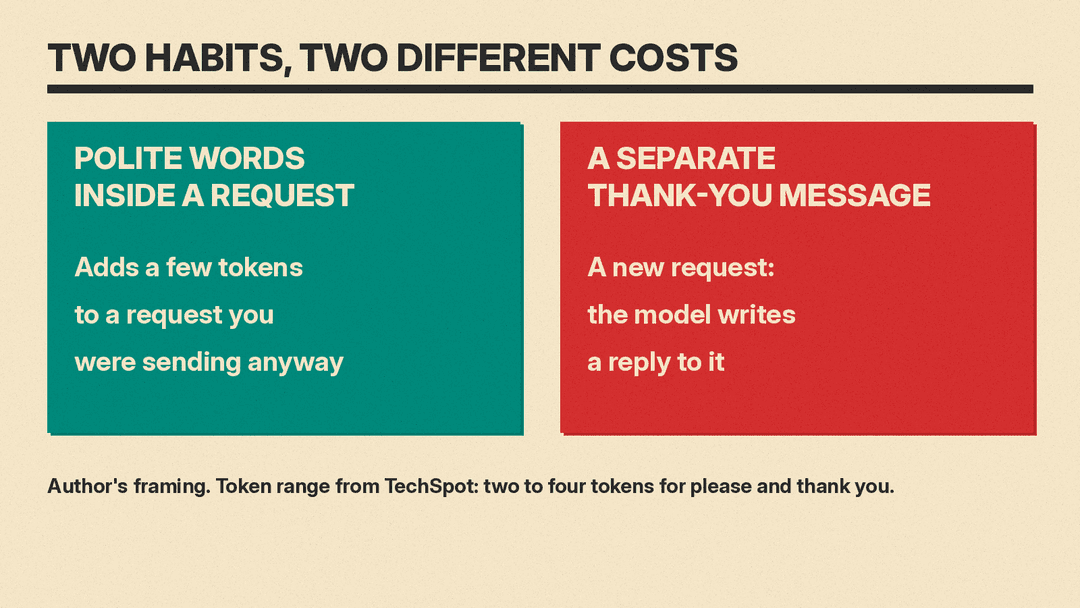
Polite words inside a request. "Please summarize this report" is a request you were going to send anyway. The "please" adds a couple of tokens to it. TechSpot put please and thank you at "between two and four tokens in total." If you want to know how tokens are counted and billed, our explainer on what AI tokens are covers it. A few tokens on top of a request that already exists is noise.
A separate "thank you" message. This is a new request. You send it after you already have your answer, and the model writes a reply to it. That is the case Grok's reply describes: a short message still goes through the model. If politeness costs anything worth talking about, it is here.
How big is one extra message?
The most useful public numbers are per prompt, and they come from the companies themselves.
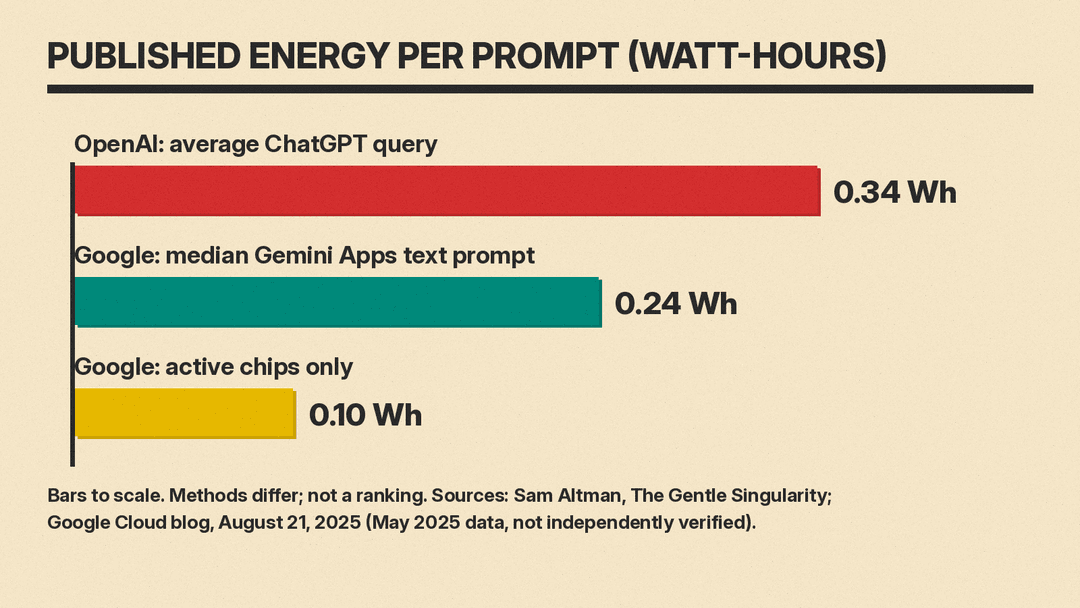
In his essay The Gentle Singularity, Altman wrote that "the average query uses about 0.34 watt-hours, about what an oven would use in a little over one second, or a high-efficiency lightbulb would use in a couple of minutes."
In August 2025, Google estimated that "the median Gemini Apps text prompt uses 0.24 watt-hours (Wh) of energy." Google says that is "equivalent to watching TV for less than nine seconds." It also gives a lower figure, 0.10 Wh, for a method that counts only active TPU and GPU use, and calls that "an optimistic scenario at best." Google's footnotes add that the analysis used data from May 2025 and that "The data and claims have not been verified by an independent third-party."
These figures use different methods, so I would not rank OpenAI against Google with them. But they set the scale. Now a rough calculation of my own, not a company figure: if one million standalone thank-you messages each used Altman's average of 0.34 Wh, that would be 340 kWh. A two-word message with a one-line reply is probably lighter than the average query, so I read that as a ceiling, not an estimate.
So my verdict on the cost story is simple: it is overhyped. Per message the energy is small. Altman's essay says of ChatGPT that "Hundreds of millions of people rely on it every day," so it does add up, but the honest answer to "how much?" is still that only the providers know, and they have not published a figure for thank-you messages.
Does politeness get you better answers?
This is the part I think is underrated, because the research is mixed and people quote it as if it were settled.
A 2024 cross-language study, "Should We Respect LLMs?", tested English, Chinese and Japanese tasks. The authors "observed that impolite prompts often result in poor performance, but overly polite language does not guarantee better outcomes." They also found "The best politeness level is different according to the language."
A 2025 short paper, "Mind Your Tone", pointed the other way. It rewrote 50 multiple-choice questions into five tones, 250 prompts in total, and ran them on ChatGPT 4o. The authors report that "impolite prompts consistently outperformed polite ones, with accuracy ranging from 80.8% for Very Polite prompts to 84.8% for Very Rude prompts." That is a 4.0 point gap on one model and one small question set, and the arXiv listing describes it as a short paper under submission.
My reading: neither study is a reason to change how you talk to a chatbot. Tone effects exist, they move with the model and the language, and they are small next to what you actually ask for. If you want better answers, the clearer request does more than the polite one. Our plain guide to prompt engineering is about exactly that.
Who should care, and what I would do
For a single user, this is a manners question, not a cost question. Keep "please" in your requests if you like it. It costs a few tokens and, on the evidence above, does not reliably help or hurt.
The separate thank-you message is the one habit with a real, if small, cost per send. If you care about compute, skip it, or fold your thanks into your next real request. If you use a chatbot with message limits, a thank-you message may also count against them, so check your plan.
For the companies, I think this is a product design problem, not a user problem. A two-word thanks does not need a long reply. Providers that publish per-prompt figures could also publish how much of their traffic is short closing messages like this. Until one does, "tens of millions" should be read the way Altman wrote it: as a joke.
Sources
- Grok reply on X, November 12, 2026
- @tomieinlove question on X, April 15, 2025
- Sam Altman reply on X, April 16, 2025
- TechSpot: Sam Altman says polite ChatGPT users are burning millions of OpenAI dollars
- Sam Altman: The Gentle Singularity
- Google Cloud: Measuring the environmental impact of AI inference (August 21, 2025)
- Yin et al.: Should We Respect LLMs? (arXiv 2402.14531)
- Dobariya and Kumar: Mind Your Tone (arXiv 2510.04950)
