
This is an opinion piece. The facts are linked to their sources; the conclusions are ours.
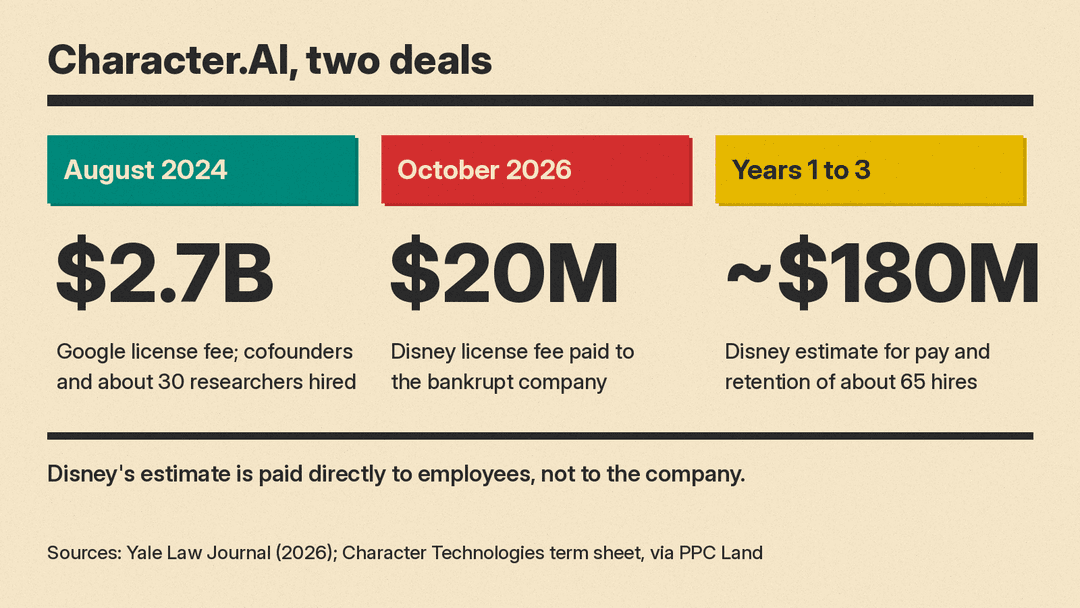
In August 2024, Google paid Character.AI $2.7 billion for a nonexclusive license to its technology and hired its cofounders and thirty of its researchers, according to a 2026 Comment in the Yale Law Journal that catalogs these deals. This month the company filed for Chapter 11. Disney is hiring most of the staff who were left and paying the estate $20 million for a copy of its code, while it estimates the people themselves will cost about $180 million in pay and retention over three years, as we reported on the filing. The app, its users' chats and its legal problems stay behind. If no other buyer appears, the company's own motion says, "Character's platform will be wound down," per PPC Land's reading of the filing.
That second deal is the clearest look yet at how the reverse acqui-hire ends. My argument is simple. The structure has become the default exit for AI startups that cannot win alone, and it works well for the buyer and for the people it hires. It works badly for everyone attached to the product: users, creditors, and the regulators who are supposed to look at deals of this size. It should be treated as what it functionally is, an acquisition, with the duties an acquisition carries.
The structure, and how common it is
In a reverse acqui-hire, a large company hires some of a startup's leaders and researchers and pays the startup a fee, usually for a nonexclusive license to its technology. There is no merger. The startup survives as a legally separate company, minus the people who made it valuable. The Yale Comment counts the major examples:
- Microsoft and Inflection, March 2024: most of a 70-person team hired, $620 million for a model license and $30 million to waive legal claims over the hiring.
- Amazon and Adept, June 2024: cofounders and 80 of 100 employees hired, $330 million for a license, plus a $100 million retention bonus for those who joined.
- Google and Character.AI, August 2024: $2.7 billion for a license, cofounders and thirty researchers hired.
- Amazon and Covariant, August 2024: $400 million for a license, founders and about forty employees hired.
- Meta and Scale AI, June 2025: $14.3 billion for a 49% stake, with Scale's CEO and top engineers joining Meta.
- Google and Windsurf, July 2025: $2.4 billion for a license, with the CEO, a cofounder and researchers joining DeepMind.
Disney's deal with Character.AI is the same shape, but it happened inside a bankruptcy court, which forced the terms into public view.
Who wins
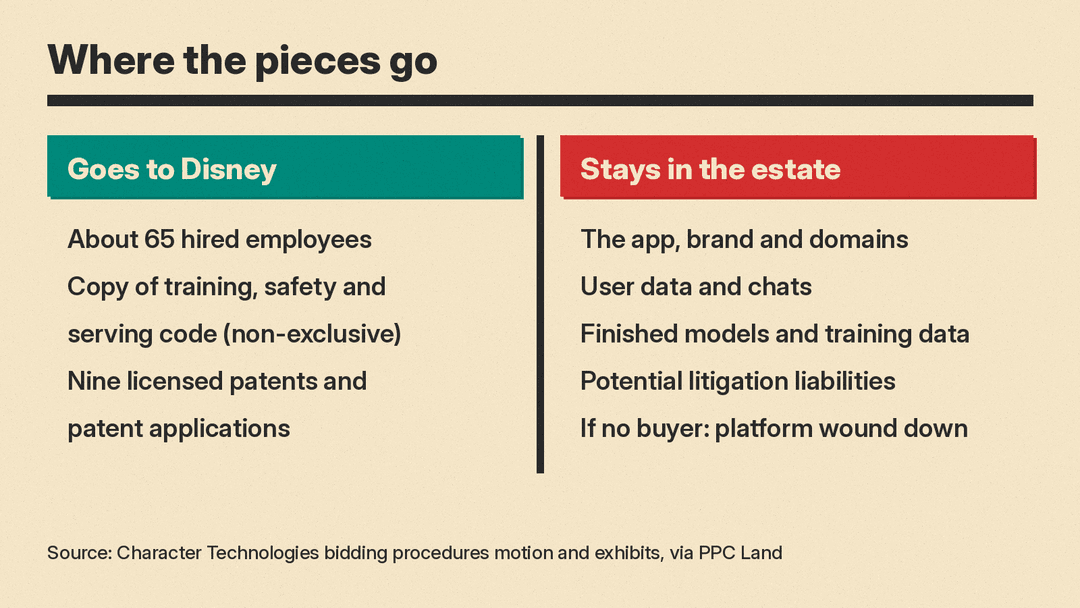
The buyer wins first. Disney gets an experienced engineering group plus a perpetual, nonexclusive license to the code behind Character.AI's post-training, safety and serving systems, and nine patents and applications. It does not take the app, the user data or the company's liabilities. The term sheet states that the parties "do not expect the Proposed Transaction to require any antitrust or other regulatory clearance," PPC Land reports.
The hired staff win too. The term sheet puts the annual pay of about 65 offered employees at roughly $60 million, with a $30 million retention pool on top. Character.AI also agreed not to enforce non-compete or confidentiality covenants against them and to release them from claims, including fiduciary duty claims.
In the earlier, healthier deals, investors often did fine. The Yale Comment notes that Microsoft's license fee gave Inflection's investors a return of 1.1 to 1.5 times, and that Adept's investors were expected to roughly recoup their money. That is the bargain these deals sell: a soft landing for everyone at the table.
Who loses
The people not at the table. Start with users. Character.AI told the court it has had about 163 million current and past users, according to PPC Land. Disney's license excludes "any consumer-facing applications," user data, user inputs and outputs, and the finished models. The engineers who built the product are leaving. The people who used it get a wind-down unless another bidder shows up. That is not likely: the motion, as PPC Land quotes it, says outreach by an earlier banker to 28 parties ran into the view that "the litigation and regulatory overhang on Character was too great."
Creditors and claimants are next. The term sheet says the employee pay "will not constitute consideration payable to the Company." So the estate's claimants share a $20 million license fee, while the much larger sum flows to the people who left. TechCrunch notes the company was sued by a mother who said her teenage son became obsessed with one of its chatbots before his death, and that it faces government investigations over child safety. I am not saying anyone built this deal to dodge those claims. The motion says committees of independent members ran it. But the effect does not depend on intent: the valuable part of the company walked out of the building, and the liabilities stayed inside.
Overhyped and underrated
Overhyped: the idea that these are just hiring decisions. Regulators who have looked closely disagree. When the UK's Competition and Markets Authority reviewed Microsoft and Inflection, it found the arrangement was a relevant merger situation under UK law, then cleared it on competition grounds on September 4, 2024. In the US, the FTC sought details on Amazon's Adept deal, and three senators urged the FTC and DOJ to act against the practice. Calling it hiring is a description of the paperwork, not of what changes hands.
Underrated: the orphaned user base. A companion chatbot holds some of the most personal data any app collects. The FTC already treats this category as sensitive: in September 2025 it sent 6(b) orders to seven companion chatbot companies, Character Technologies among them, asking how they use and share what users tell their chatbots. In the Disney deal, that data is the piece nobody is paying for, and its fate depends on whether another buyer bids for a troubled app by the November 20 deadline.
What should change
Three changes would fix most of this without banning anything.
- Review the substance. License-plus-hiring deals above a size threshold should be reviewed like acquisitions. The Yale Comment argues that Section 7 of the Clayton Act already reaches them, because the buyer acquires part of the startup's assets in its people. The CMA's Inflection decision shows a regulator can take that view and still clear a deal.
- Put users in the deal. Any buyer that hires the team running a consumer AI app should fund a plan for the people still using it: clear notice, data export, deletion on request, and a firm date. Disney's transition agreement already has its loaned staff supporting an "orderly wind down or transition." That should be a written commitment to users, not an operational detail.
- Price the shell honestly. Founders and boards agreeing to these deals should disclose, to their own users and creditors, what is left behind. A $2.7 billion license in 2024 and a $20 million license in 2026 for the same company show how fast the remainder can lose value.
The reverse acqui-hire is not going away. Talent is the scarce input in AI, and buyers will keep paying for it in the cheapest legal form available. That is fine. What is not fine is a structure in which the people who built a product and the companies that hire them leave with the value, and 163 million current and past users are left waiting on a bankruptcy auction. Character.AI's two deals show the whole cycle. The next one should not end the same way.
Sources
- Yale Law Journal: An Acquisition by Another Name: Reverse Acquihires Under the Clayton Act (2026)
- PPC Land: Disney budgets $180m for Character.ai staff, $20m for the bankrupt company
- TechCrunch: Disney agrees to hire the majority of Character.AI's workforce
- UK CMA: Microsoft / Inflection inquiry
- Reuters: FTC seeking details on Amazon deal with AI startup Adept
- Letter from Senators Wyden, Welch and Warren to the FTC and DOJ on AI competition
- FTC: FTC Launches Inquiry into AI Chatbots Acting as Companions
- llms.blog: Disney Budgets About $180M to Hire Most of Character.AI's Staff, Pays $20M for Its Tech
