
The first wired glasses running Google's Android XR are now on sale. XREAL AURA went up for order on October 28, 2026, with a launch price of $1,099 through the end of the year. It is a pair of see-through glasses that puts app windows in front of your eyes, with Google's Gemini assistant built in.
AURA is not a phone replacement. It is closer to a portable private monitor that you wear, with Gemini on board and a compute puck on a cable. Here is what it does, what it costs, and who it is for.
What XREAL AURA is
Google calls AURA "the first wired XR glasses powered by Android XR," the operating system Google built for headsets and glasses. XREAL makes the hardware. The companies had teased the glasses earlier in the year at Google I/O, TechCrunch reports.
The design has two parts:
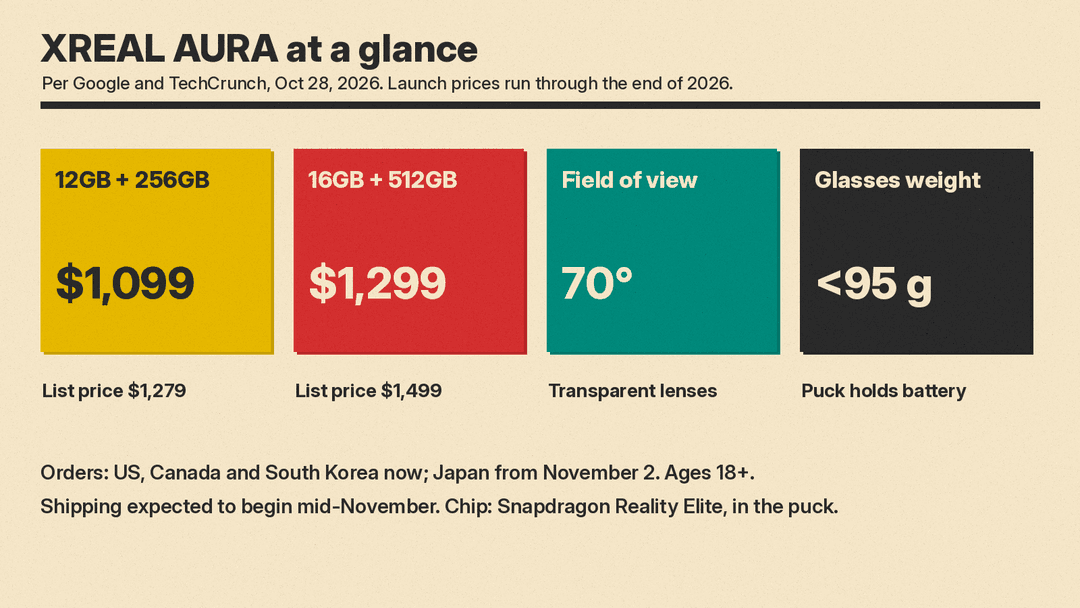
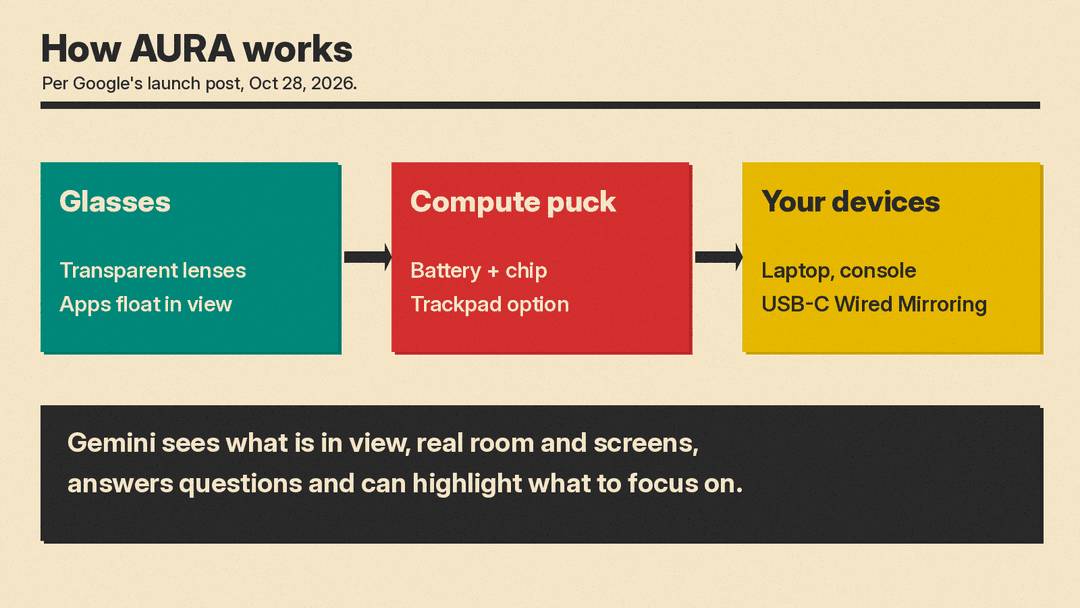
- The glasses. The lenses are transparent, so you see the real room with your own eyes while apps float in your view. Google says the glasses weigh under 95 grams and have a 70-degree field of view.
- A compute puck. A small box on a cable does the heavy work. It holds the battery and Qualcomm's new Snapdragon Reality Elite chip, which debuts on AURA. You can also use the puck as a trackpad.
Putting the battery and chip in your pocket keeps the glasses light. The tradeoff is a cable and a second device to carry. TechCrunch notes that Meta's display glasses are lighter, at 69 grams, but AURA's screen specs are stronger on paper. XREAL's spec sheet lists Sony Micro-OLED panels at 1920 x 1200 pixels per eye, up to 120 Hz and 1,050 nits peak brightness, a high-resolution camera with a privacy LED, two tracking cameras, Bose-tuned speakers and a 4,455 mAh battery in the puck. TechCrunch gives a 95-degree field of view, but Google and XREAL both say 70 degrees.
What Gemini does on the glasses
Gemini is the main AI feature. Google says Gemini on Android XR "understands what you're seeing and doing, both in the real world and on your screens," so you can ask about anything in view and get help across your apps.
Some examples from Google's launch post:
- Ask Gemini to tidy up your open windows, or brainstorm about the document you are looking at, including a mirrored laptop screen.
- Share your view, and Gemini can now highlight what to focus on, in the room around you or on your screen. Google says this works starting October 28.
- Ask about places while you browse Google Maps.
- Get stuck in a game, and ask Gemini to talk you through your next move without putting down the controller.
XREAL is also working with GameSir on a wireless gamepad with a dedicated Gemini key, plus a folding wireless keyboard, The Verge reports. Prices and dates for those accessories are not out yet.
Three ways people will use it
As a travel desk. You can open several apps at once, such as a browser, documents and a music app, and place them around you at any size. Pair a Bluetooth keyboard and mouse for a full desktop on a plane tray table or hotel desk. A feature called Wired Mirroring lets you plug in a laptop with a USB-C cable that supports video, and its screen shows up as a window you can move and resize. Google says no software install is needed. Because only you can see the display, Google pitches it for reading private documents in public.
As a private theater. Open YouTube, Google TV or another streaming app and put the screen wherever is comfortable. You can dim the lenses to fade out the room, and Google says they turn clear again when someone comes into view. New immersive titles arrive with AURA, including "Nevatars," co-directed by Andy Serkis and Josh Nelson Youssef, and the San Francisco Ballet's "Nutcracker." Google Photos is also getting a spatial gallery later this year that wraps your library around you.
As a big game screen. Android games from Google Play run on it, and you can mirror a PC or handheld console through USB-C. Google and XREAL say AURA launches with more than 150 apps made for XR, including new games such as Fallout Factions and Project Hail Mary: Journey Among the Stars.
Price, models and where you can buy it
As of October 2026, per TechCrunch and The Verge:
- 12GB RAM + 256GB storage: $1,099 launch price, normally $1,279.
- 16GB RAM + 512GB storage: $1,299 launch price, normally $1,499.
The launch prices last through December. Orders are open now in the US, Canada and South Korea, and open in Japan on November 2, with shipping expected to start in mid-November. The Verge reports broader availability next year. In the US you can order from xreal.com/aura or Best Buy. Google says AURA is for users 18 and older and needs setup and a compatible account.
The Verge points out that the price dropped before launch: XREAL had charged $1,279 for preorders last month. XREAL GM and spokesperson Ralph Jodice told The Verge that people who preordered at the old price will get the difference refunded automatically.
Why it matters
AURA is the first wired glasses to run Google's Android XR, which makes it an early test of the idea that Gemini belongs on your face, not only on your phone. Google is following its Android phone playbook here: it supplies the software and AI, and partners such as XREAL and Samsung build the hardware, TechCrunch notes.
The bet is that an assistant that can see your screen and your room is more useful than one you type into. AURA is a cautious version of that bet. It is wired, it needs a puck, and Google pitches it for work, movies and games.
For most people, $1,099 is a lot for a second screen. If you travel often, work on a laptop in tight spaces, or want a big private screen for games and films, AURA is worth a look. If you want light glasses for calls and quick questions while walking around, this is not that product. Two lighter AI glasses launched on October 27: Brilliant Labs Halo at $399, and Rokid Glasses 2 in China.
XREAL CEO Chi Xu told TechCrunch in May that building a smart glasses business is hard and that everyone is losing money. The Verge's Sean Hollister expects the price cut came because at $1,279 the glasses were going head to head with Meta's glasses.
