
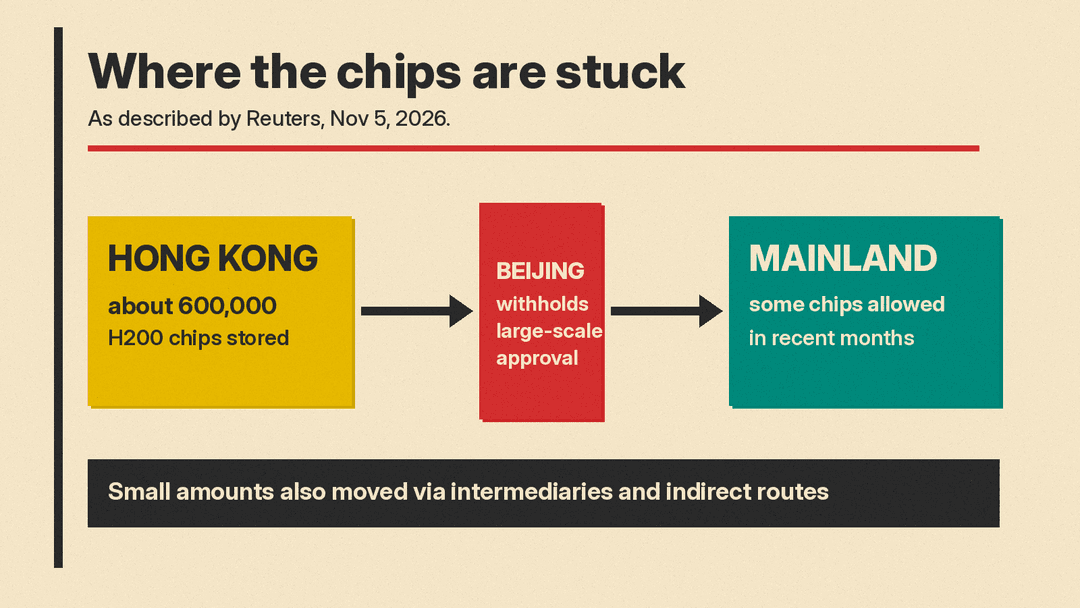
About 600,000 Nvidia H200 AI chips are sitting in Hong Kong, waiting for a green light from Beijing that has not come, Reuters reported on November 5, citing two people familiar with the matter. Reuters said the size of the stockpile had not been reported before. The chips are awaiting shipment to mainland China, Reuters said, as Beijing withholds approval for large-scale imports despite demand from Chinese technology firms.
Reuters said the US gave Nvidia permission last year to sell the H200 to approved Chinese customers. The hold-up it describes now is on Beijing's side.
What Reuters reported
According to the Reuters report, as carried by CNA:
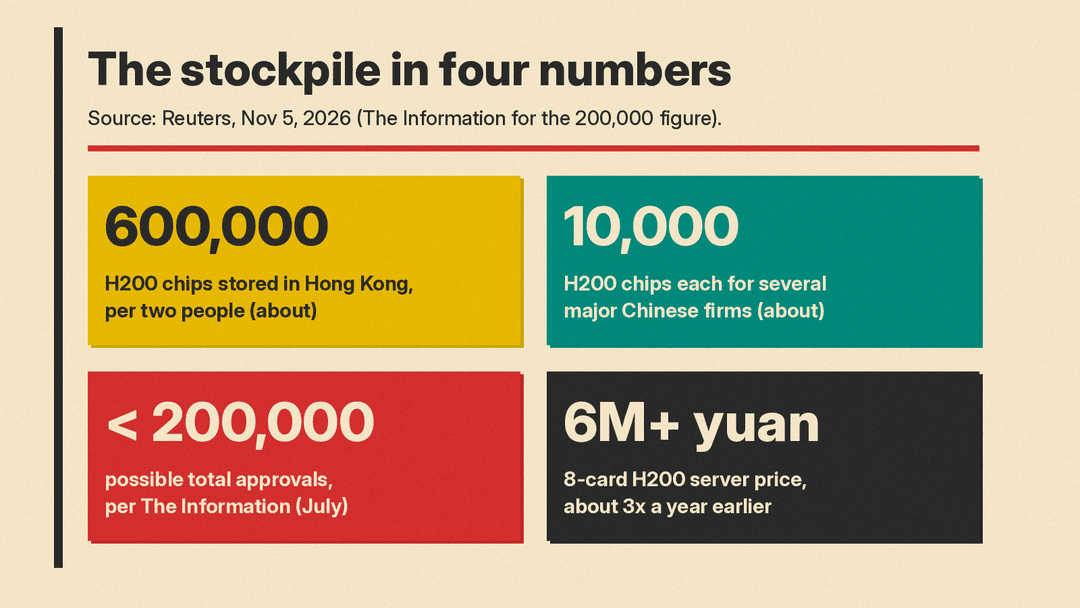
- About 600,000 H200 chips are stored in Hong Kong awaiting shipment to mainland China, two people said.
- China has allowed some of the chips to enter the country in recent months, three people said.
- "Several major Chinese internet companies have each obtained about 10,000 H200 chips in the past few months, one of the people said."
- Three people said small quantities of chips had been shipped via intermediaries and indirect routes, without specifying how many.
- Beijing has yet to approve large-volume imports into mainland China, the people said.
Reuters said China's Ministry of Industry and Information Technology and the National Development and Reform Commission did not respond to requests for comment. Nvidia, Alibaba, ByteDance, DeepSeek and Tencent also did not respond, it said.
Reuters gave its own reading of the standoff: "The size of the stockpile of H200 chips, which has not previously been reported, reflects Beijing's reluctance to increase reliance on US technology." It added that Chinese companies need Nvidia's advanced computing power to meet surging AI demand.
Why Chinese buyers still want the H200
The H200 is not Nvidia's newest chip. Reuters said it "has capabilities that Chinese alternatives have yet to match, making it useful for training AI models particularly when combined with Nvidia's software."
With authorised supply constrained, Reuters said, Chinese buyers have turned to intermediaries and indirect routes, which pushed up prices in the unofficial market. One person told Reuters that an eight-card H200 server was offered for more than 6 million yuan (about US$900,000) in mainland China by the end of October, about three times its price a year earlier. Servers built on Nvidia's newer Blackwell chips, which fall under US export controls, were offered for more than 20 million yuan apiece, the same person said.
China has its own push for local chips. We covered one example in October, when Iluvatar CoreX claimed its Tiangai 300 GPU matches the H200. Reuters did not cite that claim, and it said Chinese alternatives have yet to match the H200's capabilities.
How the rules got here
Reuters said the United States barred H200 exports to China before the Trump administration gave Nvidia permission last year to sell the chips to approved Chinese customers. The policy shift followed US-China trade negotiations.
The Next Web, summarizing Reuters, gave a fuller timeline. It said President Donald Trump allowed limited sales in December 2025, and that in January the US began reviewing H200 export licences for China case by case. Later that month, The Next Web said, Beijing approved a first batch of H200 imports for ByteDance, Alibaba and Tencent. "Since then, however, Chinese restrictions have kept Nvidia from selling all of the chips it is licensed to ship," it wrote.
Beijing's limits were reported earlier. Reuters cited a July report from The Information, which said Chinese officials had told companies including Alibaba, ByteDance and DeepSeek that they could receive permission to buy limited quantities of H200 chips for training AI models. The Information reported that total approvals could amount to fewer than 200,000 chips, and that Beijing wanted firms to prioritise Chinese processors for inference, the task of running AI models.
What it means for Nvidia
For Nvidia, H200 sales to China are small in its reported numbers. The Next Web said Nvidia's latest quarterly filing put H200 sales to China at less than 1% of its data centre revenue, and added: "It also took a $400m charge for unsold H200 stock and purchase commitments."
Chinese demand for other Nvidia products is still large. Reuters reported last month that ByteDance, Alibaba and Tencent had ordered more than 3 million Nvidia RTX Pro 5500 graphics cards, a less powerful export-compliant product, with a combined sticker price exceeding $35 billion.
In a separate China story earlier this month, the FT reported that Oracle dropped a Tencent chip lease.
A view from Hong Kong
On November 7, Taiwan's Central News Agency summarized an analysis in the Hong Kong Economic Times. As CNA reported it, the article said the chips held in Hong Kong have already been paid for and ownership has passed to the buyers. The article said Beijing is trading short-term computing needs for long-term technology self-reliance, and that Chinese buyers face premiums, financing costs and the risk that the chips lose value as they age. This is the newspaper's analysis, not a statement from Beijing.
Separate Nvidia news
The report lands in a busy week for Nvidia. On November 8, Nvidia's board said it opened an independent investigation into news reports that CEO Jensen Huang was the target of a foreign intelligence effort. In its statement, the board said it has "no reason to believe that either national security or NVIDIA secrets were compromised." Those reports are allegations, not findings; Reuters did not link the H200 stockpile to that review.
What to watch
Reuters did not say when, or whether, Beijing will approve large-volume imports. The open questions are simple: whether the Hong Kong stock moves into mainland China, and how much of it moves.
Sources
- Reuters via CNA: Nvidia chips pile up in Hong Kong as China withholds import approval
- Reuters via Investing.com: Exclusive, Nvidia chips pile up in Hong Kong
- The Next Web: Nvidia H200 chips pile up in Hong Kong as Beijing holds back
- Central News Agency (Taiwan): Hong Kong media analysis of the H200 stockpile
- Nvidia: Statement from Nvidia Board of Directors (November 8, 2026)
