

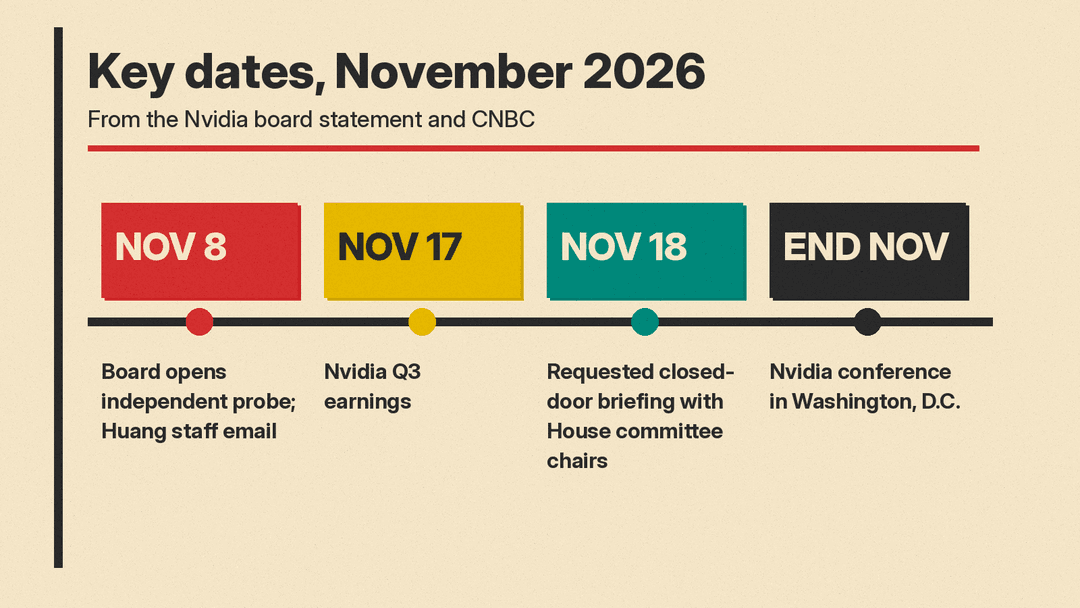
Nvidia's board has opened an independent investigation into reports that founder and CEO Jensen Huang was the target of a foreign intelligence effort. The board statement, posted on Nvidia's newsroom on Sunday, November 8, 2026, says a committee of independent directors, assisted by outside independent counsel, will oversee the review.
On the same day, Huang sent an email to staff in which he admitted an affair. He did not name the other person. CNBC published the full email. "I was unfaithful to my wife. My actions hurt her and our children. There is no excuse for what I did. I am deeply sorry," Huang wrote.
Nvidia told CNBC that Huang will stay on: "Today's news will not slow NVIDIA. Jensen is committed to continuing to lead NVIDIA as CEO without interruption."
What the board said
The board statement is short. Its main points, in the board's words:
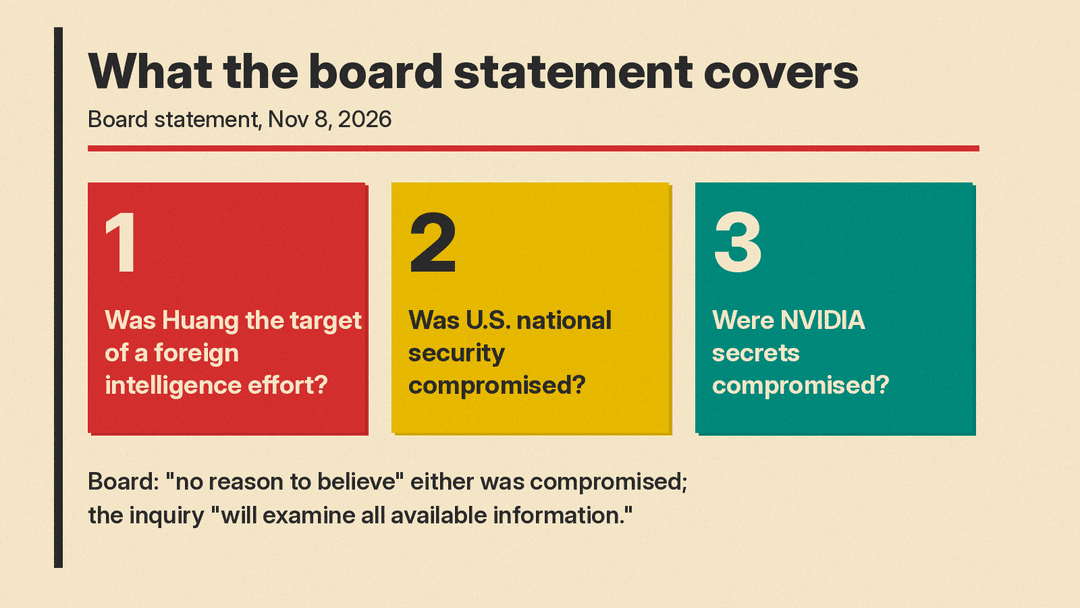
- The investigation follows "recent reporting that founder and CEO Jensen Huang has been the target of a foreign intelligence effort."
- "The Board prioritizes U.S. national and economic security, which is paramount to the interests of NVIDIA and its shareholders."
- "While the Board has no reason to believe that either national security or NVIDIA secrets were compromised, the Board's inquiry will examine all available information."
- "Jensen fully supports the review and has committed to cooperating with it."
- "The Board has confidence in Jensen and his leadership team and will provide further updates as appropriate."
The statement does not say how long the review will take, and it does not name the outside counsel.
What the reports allege
The allegations come from news reports, not from Nvidia. According to CNBC, reports in The New York Times and the Financial Times said U.S. intelligence agencies have expressed concerns that a woman named Alice Huang has been passing information to Beijing. CNBC says she is affiliated with Megaspeed, a cloud company and Nvidia customer.
TechCrunch describes her as a former executive at Singapore-based chip company Megaspeed, and notes that Jensen Huang's email did not name her. TechCrunch also reports that a memo circulating among U.S. policymakers earlier this year claimed she had been recruited by China's Ministry of State Security to spy on Nvidia's CEO.
These are allegations reported by the press. No charges are described in the sources we read. We could not find a public response from Alice Huang or Megaspeed in those reports.
Nvidia's earlier position
Nvidia had addressed the relationship before Sunday. TechCrunch reports that, in response to earlier reports, Nvidia said the pair's interactions were "not unusual" and that the company does not share classified information with customers.
CNBC adds a second thread: Megaspeed has been accused of helping restricted Chinese companies acquire Nvidia AI chips. CNBC says Nvidia representatives previously said Megaspeed had already been investigated for evading export controls.
What Huang said about security
Most of Huang's email is a personal apology. One paragraph addresses the national security reports: "Regarding the national security concerns raised in news reports, NVIDIA's Board of Directors has initiated an independent investigation. I support the investigation and will cooperate fully. I love our country and our company. I am committed to protecting NVIDIA and supporting America's national security. I am proud and grateful to be an American."
He closed by asking for privacy for his family: "My family bears no responsibility for my choices. I do. Please give them privacy."
Trump: "a fine person"
President Donald Trump commented on Sunday. According to Reuters, via Investing.com, Trump told reporters: "I have not spoken to him about it. I just know he's a fine person, but you never know what is going on." Trump added, "I hope everything's fine."
Trump also said, per Reuters, "I think he's an honorable guy," and that Huang had "done an amazing job for our country." Asked whether he would take Huang on his trip to Asia next week, Trump said: "I don't know, but I'd certainly take him." The Straits Times reports that, asked whether Huang should stay on as CEO, Trump said: "I think so. Oh yeah, sure."
Why this matters for AI
CNBC notes that Nvidia has become the center of a trade dispute between China and the U.S., as AI is seen as increasingly critical to national security. The U.S. restricts exports of Nvidia's most advanced AI chips to China, though it has approved exports of certain older, slower models. CNBC also notes that Huang has pushed for broader AI chip exports to China.
That is why a question about the CEO's contacts goes beyond one company. The board says its inquiry will examine all available information. Its stated starting point is that it has "no reason to believe" so.
What comes next
CNBC lists three near-term dates:
- November 17: Nvidia reports third-quarter earnings.
- November 18: three House Republican committee chairs asked Huang, in a letter sent Wednesday, to sit for a closed-door briefing with lawmakers on this date.
- End of November: Nvidia holds a major conference in Washington, D.C.
The board says it will give further updates "as appropriate." We will update this post when it does.
Update, November 9, 2026: Nvidia shares fell in Monday trading after the board announcement. Stock figures in that follow-up are timestamped and attributed; neither Huang nor Madison Huang faces charges in the reporting.
Sources
- Statement From NVIDIA Board of Directors (Nvidia Newsroom)
- Read Huang's email to his staff and statement from Nvidia's board (CNBC)
- Nvidia investigates CEO Jensen Huang's relationship with alleged Chinese spy (CNBC)
- Nvidia will investigate CEO Jensen Huang's relationship with possible Chinese spy (TechCrunch)
- Trump calls Nvidia's Huang 'honorable' (Reuters via Investing.com)
- Trump calls Nvidia's Jensen Huang 'fine' (The Straits Times)
