
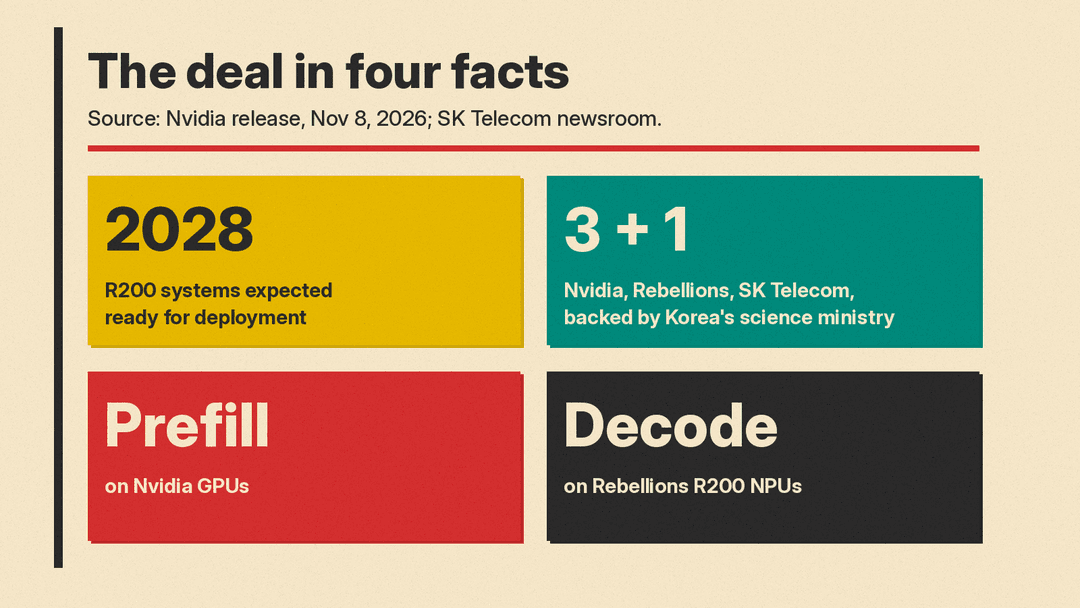
Nvidia, Korean chip startup Rebellions and SK Telecom said they will build server racks that put Nvidia GPUs and Rebellions' own inference chips side by side, joined by Nvidia's NVLink Fusion interconnect. Nvidia announced the collaboration on November 8, and SK Telecom said the three companies signed a memorandum of understanding at the NVIDIA AI Day Seoul event at COEX on November 9, Korea time. Korea's Ministry of Science and ICT backs the deal.
The plan has a long runway. Nvidia says Rebellions' R200 systems are expected to be ready for deployment in 2028. But the design choice is the interesting part: the GPU handles one half of each AI answer, and a Korean-designed chip handles the other half.
What was announced
Under the agreement, Rebellions will use NVLink Fusion to connect its next-generation Rebel R200 neural processing units (NPUs) to the Nvidia platform. It will build rack-scale systems on Nvidia's MGX rack architecture. SK Telecom plans to deploy those systems in its AI data center.
Nvidia lists the key points this way:
- The chip. The R200 is still in development. Nvidia describes it as optimized for low-latency and energy-efficient inference on frontier models, including multitrillion-parameter mixture-of-experts models.
- The link. Inside a rack, R200 NPUs will connect through NVLink scale-up networking, the same high-speed link Nvidia uses between its own GPUs.
- The rack. MGX reference designs support system development, and the MGX ecosystem gives Rebellions access to an established supply chain of original design manufacturers and component suppliers.
- The operator. SK Telecom brings data center operations, its own models including A.X K2, and public services under the government's "AI for All" project.
- The date. R200 systems are expected to be ready for deployment in 2028.
Prefill on GPUs, decode on NPUs
The most concrete technical detail is how the work gets split. The companies plan to develop an approach to disaggregated inference, which Nvidia describes as assigning different stages of AI response generation to the processor best suited to each task. Their planned work includes using Nvidia GPUs for prefill and Rebellions NPUs for decode, to improve inference throughput and power efficiency.
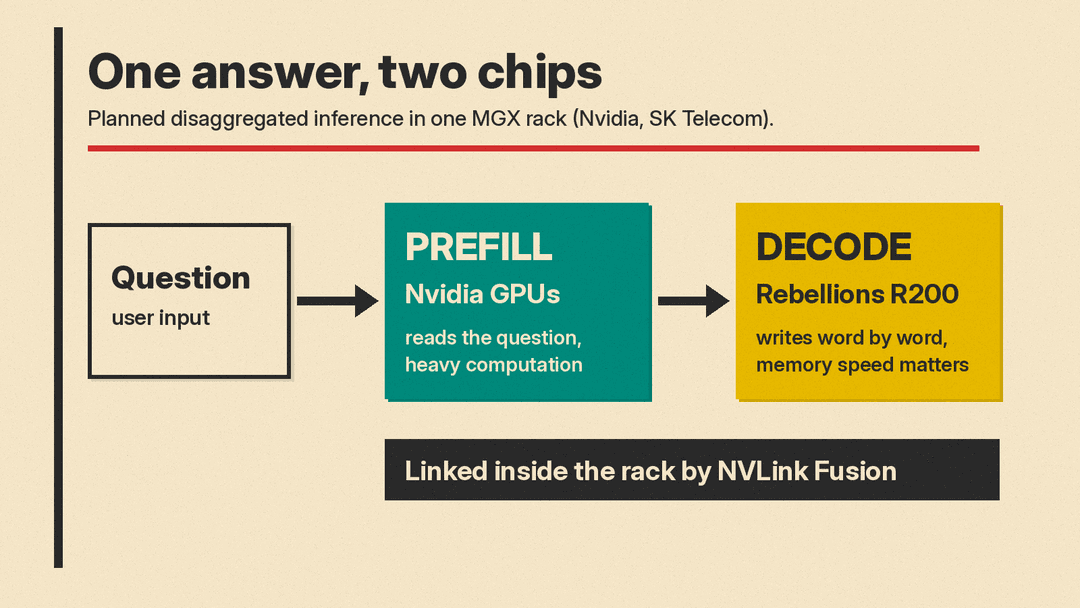
SK Telecom's announcement explains why the split makes sense. Prefill, the stage that reads and analyzes the user's question, needs a lot of computation, so a high-performance chip like a GPU has the edge. Decode, the stage that writes the answer one word at a time, depends less on raw computation and more on how fast the chip can pull the data it needs from memory. Our KV cache explainer covers why decode leans so hard on memory.
Splitting prefill and decode across different hardware is not unique to this deal. SambaNova announced Supermicro inference systems that pair Nvidia GPUs for prefill with SambaNova SN50 chips for decode, as we noted in our Supermicro quarterly results post. What is different here is that the custom chip plugs into Nvidia's own scale-up network rather than sitting beside it.
Why NVLink Fusion matters to Nvidia
NVLink Fusion is Nvidia's program for letting other companies' chips join its systems. In the release, Nvidia says it "extends NVIDIA's vertically integrated, horizontally open AI platform to custom XPUs," letting chipmakers combine specialized silicon with Nvidia's scale-up networking and infrastructure ecosystem. Yonhap describes the program as one that lets hyperscalers and custom chip designers integrate their own AI processors directly into Nvidia's rack-scale infrastructure.
The logic for Nvidia is that a custom chip inside an Nvidia rack still uses Nvidia networking, Nvidia rack designs and, in this plan, Nvidia GPUs for prefill. Jensen Huang framed it in those terms: "With NVLink Fusion, Korea's chipmakers can connect their custom ASICs to NVIDIA's AI factory platform, tightly coupling their processors with NVIDIA compute to run AI workloads."
The MGX part matters for operators too. Nvidia says the rack architecture lets GPU and NPU systems share data center design elements, including rack footprint, power delivery and cooling. For SK Telecom, that means a Korean chip does not need its own separate building plan.
Why it matters for Korea
For Korea, the deal is a route for local chips into data centers that already run on Nvidia. "This collaboration with NVIDIA marks a significant step forward, as it enables Korean-developed NPUs to enter the computing infrastructure market alongside NVIDIA," said Bae Kyung-hoon, Korea's Deputy Prime Minister and Minister of Science and ICT. He added that the government will also push cooperation with Nvidia on physical AI and securing GPU supply.
Nvidia says the ministry's support starts with Rebellions and SK Telecom. According to Yonhap, the ministry vowed to support local NPU developers so the collaboration could extend beyond Rebellions to other Korean NPU makers.
SK already has a stake in the outcome. Rebellions' backers, per the release, include Aramco, Arm, Kindred Ventures, KT, Mirae Asset Group, Samsung, SK Hynix and SK Telecom. Its current flagship is the Rebel100, an inference chip built on a chiplet architecture. The two companies have met before: in August, Bloomberg reported that Nvidia was in early talks with Rebellions about a possible tie-up.
What to watch
- The R200 itself. Nvidia and Rebellions gave no performance, memory or power figures for the R200. Until they do, the efficiency gains are a goal, not a result.
- The SK Telecom test. Maeil Business News reports SK Telecom will verify performance and stability in a real AI data center before it looks at service use and commercial potential. SK Telecom's own release says the same.
- More Korean chips. The ministry wants other local NPU makers to follow Rebellions onto NVLink Fusion.
- Timing. With deployment expected in 2028, this is a plan for the next hardware generation, not this year's buildout.
Sources
- NVIDIA Newsroom: NVIDIA, Rebellions and SK Telecom announce collaboration with NVLink Fusion
- SK Telecom Newsroom (Korean): SKT, Nvidia and Rebellions cooperate on Korean sovereign AI infrastructure
- Yonhap: Nvidia, SKT, Rebellions to jointly establish heterogeneous computing system for AI
- Maeil Business News: Rebellions to build AI infrastructure with NPUs and Nvidia GPUs
