
Google added two new systems to its eighth-generation TPU lineup on November 9, 2026: TPU 8tx and TPU 8i Max. Neither one is a new chip. Google says both are new systems, meaning new ways of packaging, networking and securing chips it already designed. Here is what each one does, and why the difference between a chip and a system matters.
What did Google announce?
In a Google blog post, Amin Vahdat, Google's SVP and Chief Technologist for AI and Infrastructure, said Google expanded its eighth-generation TPU portfolio with TPU 8tx and TPU 8i Max. Google says this is the first time it has introduced four TPU systems in a single year.
The first two arrived in April at Google Cloud Next. TPU 8t is built for large-scale training, and TPU 8i is built for real-time reasoning. Google says TPU 8t and 8i offer up to 2.7 times better training performance and 80% better inference price performance, respectively, versus its previous generation of TPUs.
Google also says TPUs are now "a rapidly growing business with nearly 100 customers," including frontier labs, trading firms, retailers and universities. Customers can also deploy TPUs directly into their own data centers. For a refresher on the hardware, see our plain-English guide to what a TPU is.
What is TPU 8tx?
TPU 8tx is optimized for secure and confidential inference, and Google says it is "also great for small-scale training." It is built for regulated enterprises and governments running frontier or proprietary models and autonomous agents alongside their most sensitive data.
Normally, data is encrypted when it is stored or sent over a network, but it has to be unlocked in memory while a computer works on it. Google says TPU 8tx is built on the same silicon as TPU 8t, paired with 5th Generation AMD EPYC CPU hosts, and builds security into the hardware layer. The goal is to keep sensitive data and model weights protected and isolated even while in active use.
AMD's press release describes how the work is split. In TPU 8tx systems, the EPYC CPUs manage workload orchestration, data preparation and high-throughput communication with the TPU accelerators. The system uses AMD Secure Encrypted Virtualization (SEV), which, together with the TPU, extends confidential computing protection beyond the CPU to connected accelerators. AMD calls TPU 8tx "the first cloud Tensor Processing Unit (TPU) system to deliver hardware-enforced confidential computing."
TPU 8tx also uses Boardfly, the low-latency network Google built for real-time reasoning. Google claims up to 2x lower latency compared to TPU 8t "with a near-zero performance penalty."
Google says this lets teams fine-tune models on private data, distill large models into smaller ones and train agents with reinforcement learning, all without moving sensitive data between separate clusters.
What is TPU 8i Max?
TPU 8i Max is built for what Google calls "the memory wall." When dozens of AI agents work across an entire software codebase or hours of video at once, Google says, memory bandwidth becomes the bottleneck. So Google took two TPU 8i chips and combined them onto a single package.
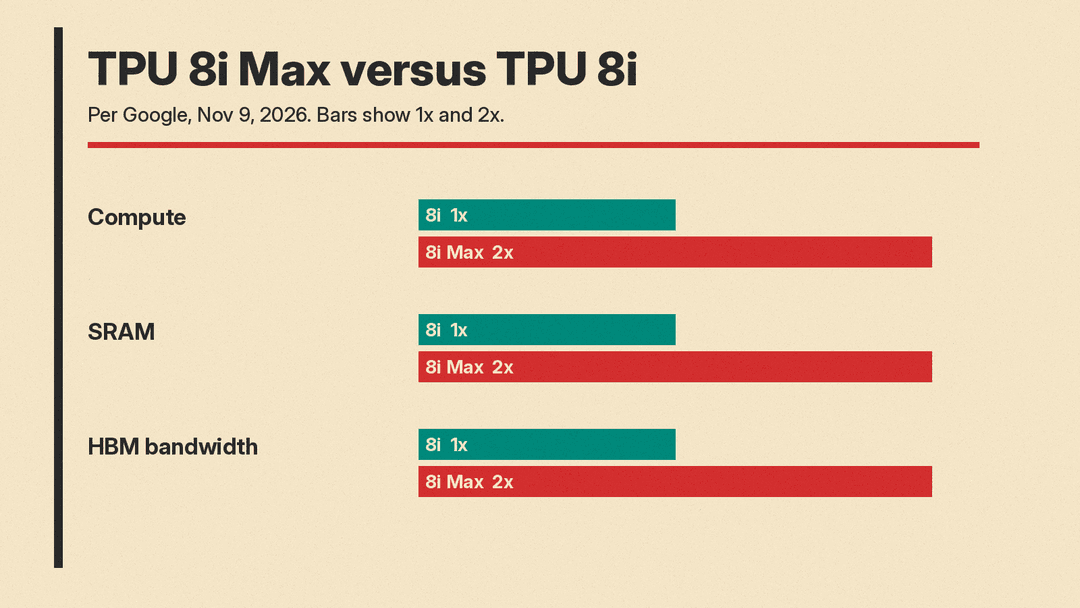
Google says TPU 8i Max delivers double the compute, double the SRAM and double the HBM bandwidth of TPU 8i. Google also says that because it fits twice the silicon within the existing rack footprint, data centers can deploy more computing power per square foot and per watt. Its role in the lineup is massive context windows and the highest compute density per rack.
Network World, reporting on a Google Cloud briefing, gives the numbers. TPU 8i Max has 384 GB of high-bandwidth memory (HBM), 33% more than TPU 8i, so memory capacity does not double. HBM bandwidth doubles to 17.2 TB per second, and on-chip SRAM doubles to 768 MB. Google's April post lists TPU 8i at 288 GB of HBM and 384 MB of SRAM, which matches those ratios.
Investing.com, summarizing Bloomberg's report, says long-context capabilities are particularly relevant for drug discovery, mathematical applications and coding tools.
Why a new system, not a new chip?
Vahdat told Bloomberg News, as summarized by Reuters, that TPU 8tx and 8i Max are not new chips but reconfigured versions designed to handle workloads customers have been asking for. DCD reports that Google describes them as "TPU systems" rather than chips.
Google's blog explains the difference. Designing a new chip is a multi-year process bound by physics and a long manufacturing cycle. A system is about how compute, networking and storage come together around the chip, including how they are packaged. Google says its modular approach lets it deliver specialized supercomputers "in a matter of months rather than years."
"This really follows the thesis that we have here at Google, which is that the future is going to be about specialization, and the upsides for specialization continue to be significant," Vahdat told Bloomberg, per Investing.com.
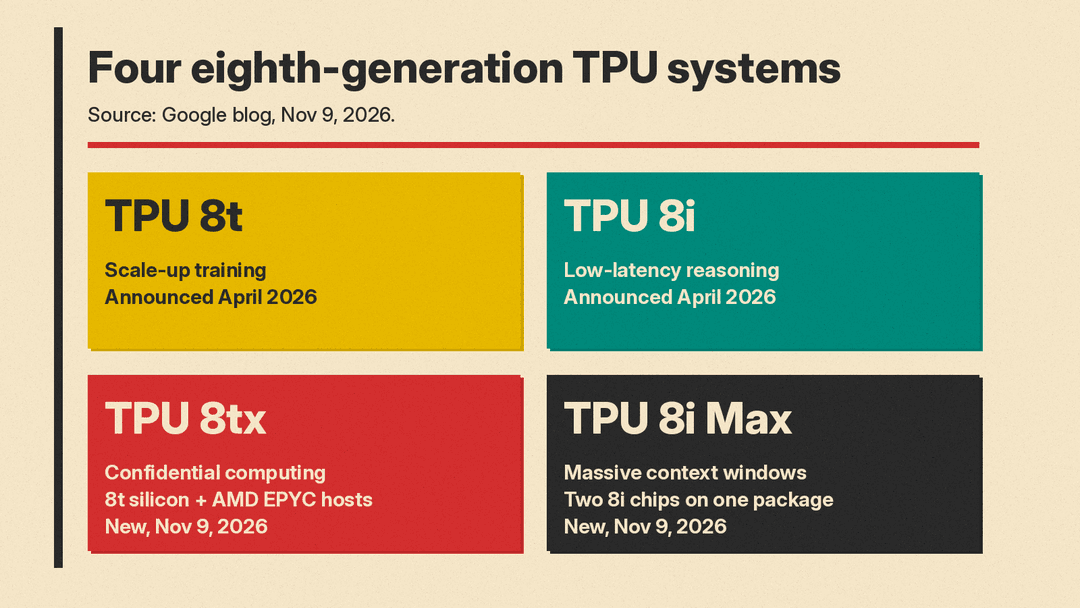
Google's own summary of the four roles: TPU 8t for scale-up training, TPU 8i for low-latency reasoning, TPU 8tx for confidential computing, and TPU 8i Max for massive context windows and the highest compute density per rack.
What software comes with them?
The same blog post lists several software updates:
- In October 2026, Google open-sourced TorchTPU, so PyTorch code and Hugging Face models run natively on TPUs. There are also TPU backends for the open-source inference engines vLLM and SGLang.
- A new open-source TPU agent suite, in preview, plugs into coding tools like Claude Code, Cursor and Google Antigravity to help with TPU onboarding and tuning.
- A new open-source XLA Serving Engine serves models in a low-latency C++ runtime across TPUs, GPUs and CPUs.
- Agent Compute Engine suspends idle agent sessions and shifts working memory off the chip in milliseconds.
- Google is open-sourcing TPU Sync, which it says cuts KV transfer latency and Time to First Token by more than 90%.
- Cloud Pathways is now generally available on Google Kubernetes Engine (GKE).
- GKE dynamic slicing is now generally available. Google says it cuts job startup times by up to 5x and speeds fault recovery by up to 4.5x.
Google said it would discuss the systems in a broadcast at 9 a.m. PT on November 9.
What Google did not say
The blog post gives no price, no availability date and no regions for TPU 8tx or TPU 8i Max. It does not say when customers can start using either system. Bloomberg reported that both systems launch in 2027, according to Techmeme's summary of the story. Google's blog does not confirm that timing.
Earlier TPU news on llms.blog includes Oracle adding Google TPUs to its cloud and reports that OpenAI plans to buy Google TPUs.
Sources
- Google: Our newest TPUs: 8tx and 8i Max, built for the agentic era
- Google: Our eighth generation TPUs (April 2026)
- AMD: AMD EPYC Expands Its Leadership at the Foundation of AI
- Reuters via StreetInsider: Google to introduce two variants of in-house chips, Bloomberg News reports
- Investing.com via StreetInsider: Google expands AI chip lineup
- DCD: Google expands eighth-generation TPU portfolio with two new TPU systems
- Network World: Google targets AI's next infrastructure bottlenecks with two new TPUs
- Techmeme: Bloomberg report summary, TPU 8tx and 8i Max launching 2027
