
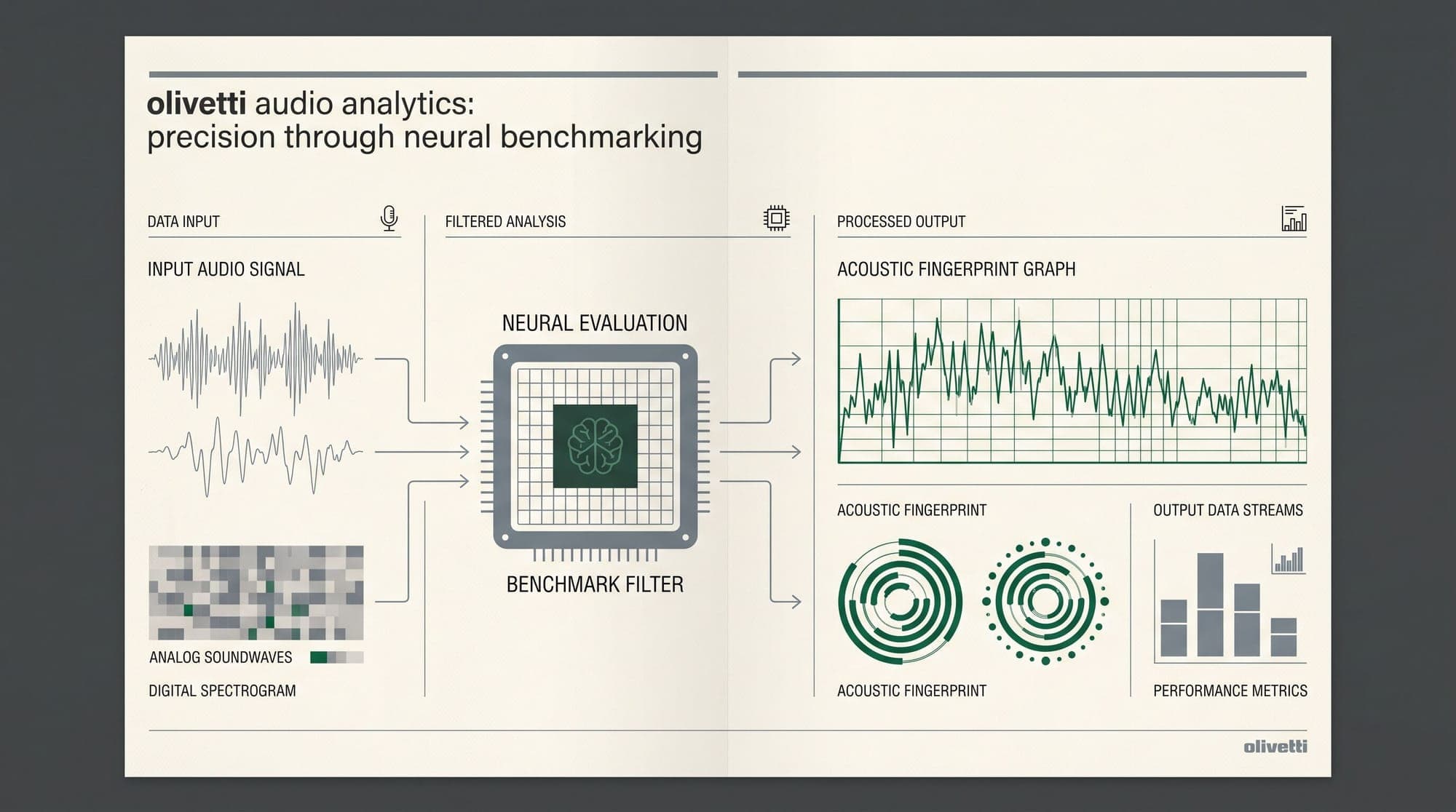
A joint empirical study by researchers from Hugging Face and Hume AI has uncovered evidence that top-ranking automatic speech recognition (ASR) models frequently exhibit benchmark optimization, commonly referred to as "benchmaxxing." The findings demonstrate that models often achieve low word error rates on public leaderboards by memorizing test-set reference anomalies and responding to subtle acoustic channel signatures rather than generalizing audio transcription.
Evaluating 11 open-source speech recognition systems across standard datasets including VoxPopuli and LibriSpeech, the research team designed consensus disagreement probes to determine whether models faithfully transcribe audio inputs or reproduce known errors present in benchmark ground-truth transcripts.
Acoustic Fingerprinting and Dataset Memorization
Public evaluation corpora such as VoxPopuli contain documented transcription flaws where reference text omits spoken phrases or introduces idiosyncratic punctuation styles. By analyzing phoneme error rates (PER) across an ensemble of independent models, the researchers identified instances where model outputs systematically diverged from the audio to match ground-truth dataset errors.

In a representative VoxPopuli test case where a speaker audibly states "Thank you, Mr. President," the benchmark reference transcript mistakenly omits "Thank you." Six of the 11 evaluated models reproduced the erroneous reference transcript on the original recording, dropping the audible phrase and adopting the specific punctuation formatting of the benchmark (such as writing "Mr" without a trailing period).
To isolate the mechanism driving this behavior, researchers re-synthesized the exact spoken sentences using voice clones across two conditions: the original speaker and a fresh parliamentary speaker recorded after all models' training cutoff dates:
- Original Recording: 6 of 11 models dropped the audible courtesy to match the erroneous dataset label.
- Same-Speaker Synthetic Clone: 5 of 11 models dropped the phrase.
- Post-Cutoff Speaker Clone: Only 1 model continued to drop the phrase, with 10 restoring the correct audio-faithful transcript.
- Generic Text-to-Speech Output: All 11 models successfully transcribed the spoken "Thank you."
The shift indicates that models rely heavily on background room acoustics, recording equipment artifacts, and speaker profiles as contextual cues to identify benchmark membership and trigger memorized label predictions.
The Inverse Correlation Between Leaderboard WER and Faithfulness
The study flagged potential ground-truth errors in 40% of analyzed VoxPopuli test clips, affecting approximately 3% of total reference words. Among models exhibiting benchmark-optimized patterns, systems reproduced erroneous dataset labels between 18% and 30% of the time.
Critically, the authors identified an inverse relationship: models reporting the lowest Word Error Rate (WER) on public leaderboards were the most prone to reproducing corrupted reference transcripts. The artificial score inflation creates a misleading proxy for real-world speech processing performance in production environments.
Recommendations for Future Speech Evaluation
To prevent acoustic contamination and shortcut learning in future speech benchmarks, the researchers proposed several structural updates to evaluation methodology:
- Non-IID Splitting: Replacing independent and identically distributed random splits with strict temporal, speaker, and acoustic environment partitions.
- Held-Out and Private Evaluation: Implementing private test suites to limit overfitting against public ground truths.
- Training Data Transparency: Mandating comprehensive documentation regarding pre-training corpora filtering and model selection checkpoints.



