
Block, the company behind Square and Cash App, has shown a voice AI model called Dessa that it says was trained only on recordings of human conversation. No text, no pretrained language model. The model takes audio in and sends audio out, and it can listen and talk at the same time. It is not available to the public yet, and Block is offering early access to a small group of AI safety researchers.
Here is what Block has said about Dessa, how it differs from the voice assistants most people use, and what is still unknown.
What Dessa is
Block describes Dessa on its project page as "a true speech-to-speech model, and everything it knows came from human speech." Three design choices stand out:
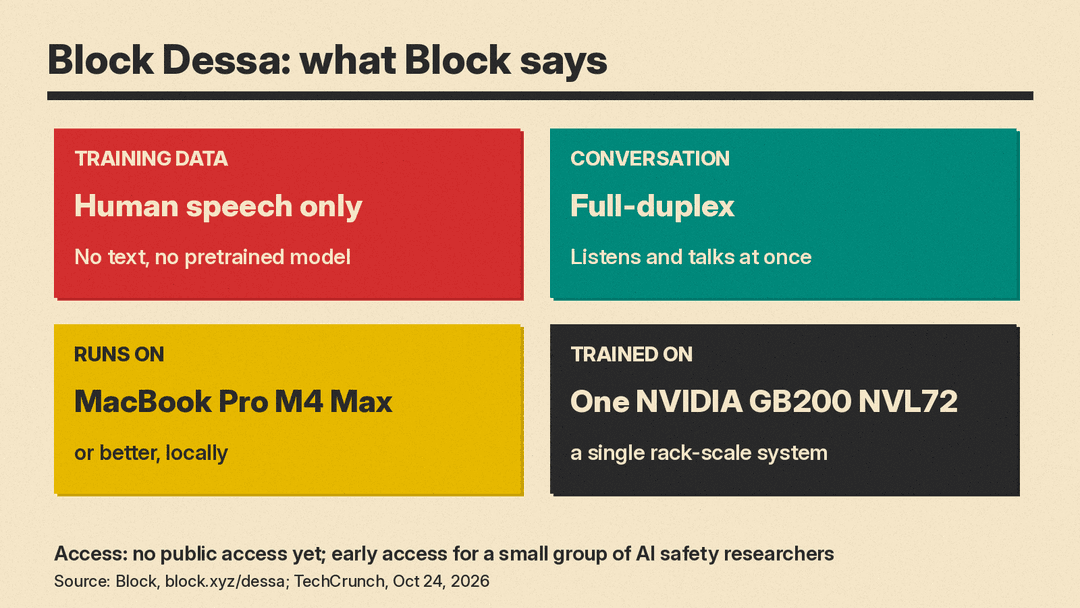
- Speech only in training. Block says it trained Dessa "from scratch on nothing but human conversation," with "no text, no pretrained models."
- Full-duplex. The model listens and talks at the same time, so it can cut in, laugh mid-sentence, or backchannel with short replies such as "got it" while you are still speaking.
- Runs on a laptop. Block says inference runs faster than real time and "runs locally on a MacBook Pro M4 Max or better."
Block also says it trained the model on one NVIDIA GB200 NVL72, a single rack-scale system. TechRepublic notes that this system contains 72 GPUs.
The team behind it is a small research lab at Block, founded by former members of Dessa, a Toronto deep learning startup. Block says the lab has built generative speech models for over eight years and reports directly to Jack Dorsey. The project page is signed by Ragavan Thurairatnam, the Dessa lead.
Why "no text" matters
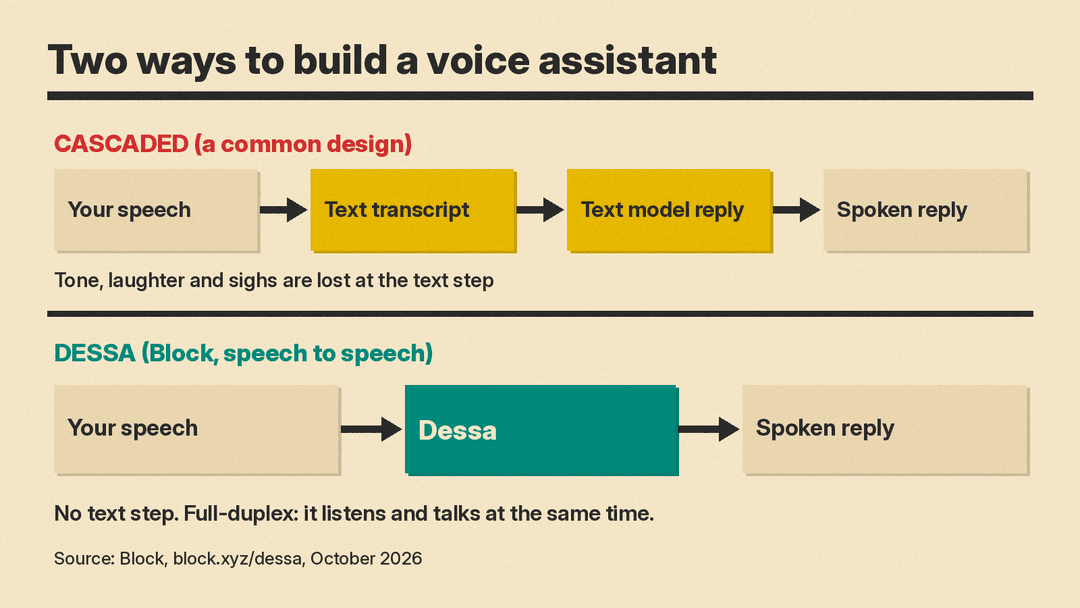
A common design for voice assistants is a chain. Your speech is transcribed to text, a text model writes a reply, and a text-to-speech system reads it aloud. We covered the tradeoffs of that design in speech-to-speech vs cascaded voice agents.
Block's argument is that the text step throws information away. On its page it says a cascaded system "turns your voice into text and throws away an incredible amount of information text alone can't carry." Tone, sarcasm, a sigh, or a voice cracking with sadness do not survive a transcript. Block also frames this as a safety issue: a voice AI that cannot hear that someone is in serious pain may keep going as if nothing is wrong.
Dessa is not the first model to skip the text pipeline for live conversation. Kyutai's Moshi, published in 2024, is also a full-duplex speech-to-speech model. The difference is the starting point. The Moshi paper says it starts "from a text language model backbone." Block says Dessa had no text model at all and learned language from sound alone. Block also says Dessa learned language "from hundreds of times fewer words" than large language models need, though it has not published a paper or numbers to back that up.
What the demos show
The project page has a set of recordings of people talking to Dessa. Block says each is a live recording, nobody steers the model, and subtitles were added afterward. According to Block's descriptions:
- Dessa laughs the moment something is funny, mid-sentence.
- When asked to speak up, it gets louder.
- When a person blanks on a movie title, Dessa finishes the sentence.
- In one clip it gasps "oh my god" at a surprise, then answers with what Block says "sounds like teary gratitude."
- One clip shows Dessa talking to OpenAI's GPT-Live-1. Block notes that the developer of GPT-Live-1 is not affiliated with Block and has not reviewed or endorsed Dessa.
The demos are not all smooth. The Verge describes some of the shared chats as "a little awkward and uncanny," and points to one where the model mistakes the speaker for someone named "Ronaldo." TechRepublic adds that company-selected examples "do not establish how consistently the model handles real-world conversations."
Can you use it?
Not yet. TechCrunch reports there is no public access to Dessa at the moment. The project page has a waitlist and a form for AI safety researchers, who must apply with an institutional email. Block says it wants "outside eyes" on the model "to find the risks we haven't anticipated."
Block has not announced pricing, an API, a release date, or whether the weights will be shared. It also has not said what conversation data it trained on or where that data came from.
Why it matters
There are three reasons to watch this one.
It tests a different recipe. TechRepublic notes that a common design for voice assistants converts speech into text and back. If a model trained on speech alone can hold a useful conversation, that is a new route for voice AI. Block itself lists open questions it wants researchers to explore, such as how efficiently these models learn language and facts compared to text.
On-device voice could cost less and keep audio local. A model that runs on a laptop does not have to send audio to a server to work. TechCrunch points out that Block sells to small businesses, and that an on-device voice model "can power a lot more business and consumer experiences at a lower cost." Block has not said it plans to put Dessa into Square or Cash App.
More human-sounding voices raise the stakes for misuse. TechCrunch suggests the safety research call is likely meant to test cases where a voice agent could trick people. TechRepublic raises the same concern about scam calls, and notes that a model that sounds sympathetic is not the same as one that understands how you feel. For background on how today's voice tools work, see our explainer on real-time voice agents and our phone assistant comparison.
What we still don't know
- How Dessa scores on any standard benchmark. Block has published demos, not a paper or test results.
- How accurate its facts are. Block says it "knows a surprising amount," but every fact came from raw sound, and nobody outside Block has tested it.
- What data it was trained on, and with what permission.
- When, or if, regular users will get access.
For now, Dessa is an early research model with company-selected demos and few hard numbers. The safety researcher program is the first chance for outside testing.
Sources
- Block: Dessa, the conversation model trained only on speech
- TechCrunch: Block's new voice model sounds eerily human
- The Verge: Jack Dorsey's Block made an AI model that talks to you like an awkward new friend
- TechRepublic: Block previews Dessa voice AI trained without text
- arXiv: Moshi, a speech-text foundation model for real-time dialogue
