
Evaluating large language models across context windows exceeding 32,000, 128,000, or 1,000,000 tokens presents a fundamental engineering challenge. A model's theoretical context window, defined by its positional embedding configuration and memory allocation, rarely matches its effective context window. In production environments, models frequently suffer from attention degradation, retrieval failure, and reasoning collapse long before reaching their maximum hardware sequence capacity.
Selecting the appropriate benchmark suite is necessary to validate whether a model can reliably extract facts, synthesize distributed evidence, and execute multi-step logic across enterprise document corpuses and agentic trace histories.
The Limitations of Single-Needle Retrieval (NIAH)
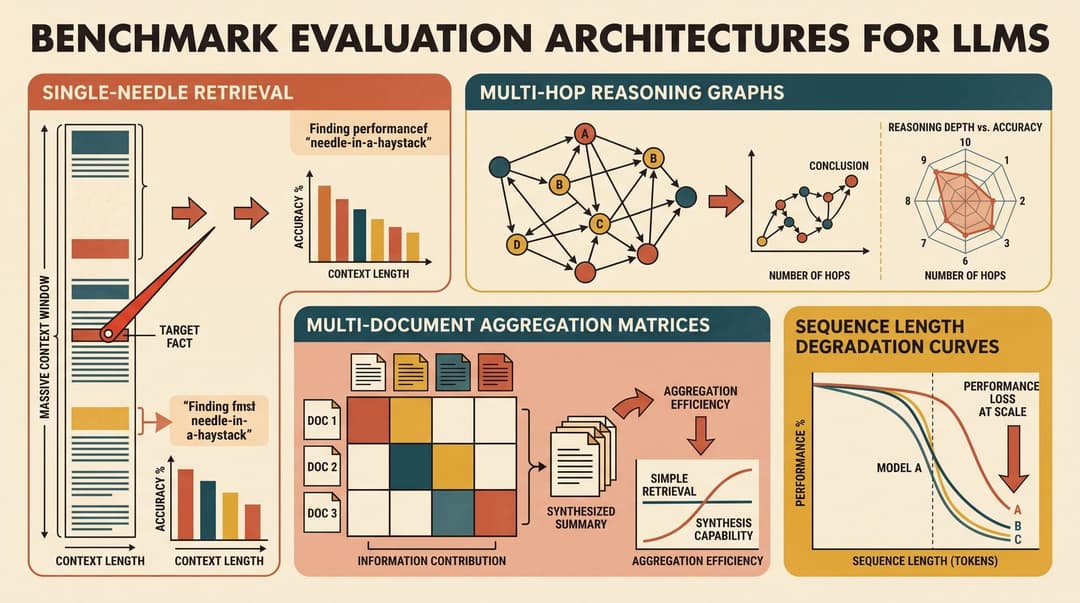
The Needle In A Haystack (NIAH) test, popularized by Greg Kamradt, established the initial standard for long-context validation. The methodology inserts a target key-value fact (the "needle") into arbitrary distractor text (the "haystack") across varied context depths (0% to 100%) and sequence lengths (e.g., 8K to 128K tokens).
While NIAH provides an intuitive visualization of retrieval accuracy across sequence depths, it evaluates only superficial associative recall:
- Isolated Key-Value Lookup: The query directly prompts for a distinctive string, allowing attention heads to latch onto lexical outliers without executing semantic reasoning.
- Absence of Semantic Competition: Haystacks composed of repeated sentences or generic prose fail to introduce adversarial distractors that share partial keys or conflicting entities.
- Zero Compositional Demand: NIAH does not test whether a model can combine multiple facts, track state mutations, or ignore stale information.
In practice, high performance on a vanilla NIAH evaluation is a necessary sanity check for rotary position embedding (RoPE) scaling and KV-cache addressing, but it is insufficient to prove production readiness.
RULER: Synthetic Stress-Testing Across Retrieval, Aggregation, and Tracing
To bridge the gap between simple lookup and operational capability, NVIDIA researchers introduced RULER (Hsieh et al., 2024). RULER expands synthetic evaluation into four distinct task categories comprising 13 parameterized tasks:
- Retrieval (S-NIAH, MQ-NIAH, MV-NIAH): Evaluates single-needle retrieval, multi-query associative recall, and multi-value extraction under controllable distractor densities and variable key-value types (words, numbers, UUIDs).
- Multi-Hop Tracing: Tests variable tracking and pointer-following chains where retrieving the final answer requires resolving intermediate assignments across the sequence.
- Aggregation: Requires aggregating distributed information across the context, such as identifying the most frequent words across noisy text blocks.
- Question Answering: Evaluates contextual question answering with synthetic distractor sentences designed to create lexical collisions.
RULER demonstrates that while many open-weights and proprietary models achieve near-100% accuracy on single-needle NIAH at 32K or 128K tokens, their accuracy on multi-hop tracing and query-aware aggregation drops sharply beyond 16K to 32K tokens.
BABILong: Multi-Hop Reasoning at Scale
While RULER generates synthetic tokens, the BABILong benchmark (Kuratov et al., NeurIPS 2024) evaluates complex reasoning by embedding the classic 20 bAbI reasoning tasks into extensive background text from the PG19 book corpus.
BABILong scales sequence lengths from 4,000 tokens up to tens of millions of tokens, testing fundamental algorithmic operations:
- Fact Chaining and Induction: Requiring the model to connect facts separated by tens of thousands of tokens of literary narrative.
- Positional and Spatial Tracking: Maintaining sequential entity state across arbitrary narrative distances.
- Deductive and Inductive Logic: Testing multi-step deduction where intermediate premises are distributed non-contiguously.
Because BABILong uses natural language background text rather than synthetic noise sentences, it stresses the self-attention mechanism's ability to maintain high signal-to-noise ratios when distinguishing operational facts from relevant-looking narrative prose.
LongBench and LongBench v2: Realistic Multi-Task Evaluation
Synthetic benchmarks isolate specific failure modes, but enterprise workloads involve heterogeneous document formats, codebases, and domain-specific questions.
LongBench
Introduced by Bai et al. (2023), LongBench is a bilingual, multi-task benchmark covering 21 tasks across 6 core operational categories:
- Single-Document QA: NarrativeQA, Qasper, MultiFieldQA.
- Multi-Document QA: HotpotQA, 2WikiMultihopQA, MuSiQue.
- Summarization: GovReport, QMSum, MultiNews.
- Few-Shot In-Context Learning: SAMSum, TREC, TriviaQA.
- Synthetic Tasks: Passage Count, Passage Retrieval.
- Code Completion: LCC, RepoBench-P.
With average context lengths between 8K and 32K tokens, LongBench measures practical degradation on real-world datasets using standard metrics including F1, ROUGE-L, and Code BLEU.
LongBench v2
To prevent models from exploiting superficial lexical patterns and short-range shortcuts, Bai et al. (2024) developed LongBench v2. Context lengths range from 8K to 2M words, featuring challenging questions that require deep reasoning across full documents.
LongBench v2 eliminates questions solvable by simple search or passage retrieval tools, ensuring that success requires global synthesis rather than local pattern matching.
Complementary Frameworks: L-Eval and InfiniteBench
Additional specialized benchmarks provide targeted insight into specific long-context properties:
- L-Eval (An et al., 2023): Standardized evaluation suite featuring 20 subtasks across 508 documents and over 2,000 human-annotated QA pairs (up to 200K tokens). L-Eval incorporates Length-Instruction-Enhanced evaluation and LLM-as-a-judge scoring to assess open-ended synthesis.
- InfiniteBench (Zhang et al., ACL 2024): Specifically targeted at sequences exceeding 100K tokens, InfiniteBench features 12 tasks across English and Chinese spanning dialogue, mathematical computation, code debugging, and synthetic retrieval.
Production Failure Modes in Long-Context Serving
Benchmarking across these suites reveals three primary architectural bottlenecks during inference:
- Attention Diffusion and Softmax Dilution: As sequence length scales, standard softmax attention distributes probability mass across an increasing number of non-salient tokens, lowering the relative weight assigned to critical keys.
- Quantization Degradation: Serving 128K+ sequences often requires compressing the KV cache to FP8, INT8, or INT4 formats. Lower-precision caching frequently introduces subtle drift that disrupts multi-hop pointer tracing while leaving single-needle recall intact.
- Position Embedding Saturation: Positional interpolation methods (such as YaRN, LongRoPE, and NTK-aware scaling) prevent catastrophic perplexity spikes, but they compress high-frequency positional representations, impairing the model's ability to discriminate fine-grained token ordering at high sequence depths.
Comparative Overview
- Needle In A Haystack (NIAH): Single-fact retrieval; synthetic repeated text or essays; scalable from 4K to 1M+ tokens; exact match or substring containment; best used as a baseline sanity check for KV cache and RoPE integrity.
- RULER: Multi-needle retrieval, variable tracing, and aggregation; synthetic key-value pairs with configurable distractors; parameterized up to 128K+ tokens; exact match and aggregation accuracy; best for automated CI/CD regression testing of effective context size.
- BABILong: Multi-hop reasoning and algorithmic logic (bAbI suite); natural language books (PG19); scalable from 4K to 10M+ tokens; exact match accuracy; best for stress-testing deductive chaining across extreme context depths.
- LongBench / LongBench v2: Multi-task comprehension, multi-doc QA, summarization, and code; real-world documents, books, and code repositories; 8K to 2M tokens; task-specific F1, ROUGE-L, Code BLEU, and accuracy; best for real-world enterprise workload evaluation.
- L-Eval / InfiniteBench: Open-ended synthesis and ultra-long multi-domain processing; real-world and synthetic corpora; 3K to 200K+ tokens; Length-Instruction-Enhanced LLM judging and exact match; best for evaluating document synthesis and long-context dialogue.
Implementation Guide for Evaluation Pipelines
For engineering teams deploying long-context models into production, evaluation should follow a tiered verification protocol:
- Tier 1 (Smoke Test): Execute a 10x10 NIAH depth-versus-length sweep to verify that serving engines, RoPE configurations, and KV cache kernels function without index corruption.
- Tier 2 (Effective Window Validation): Run RULER across target sequence increments (16K, 32K, 64K, 128K) to determine the exact sequence threshold where multi-hop and aggregation performance drops below production thresholds.
- Tier 3 (Domain Realism): Evaluate domain-specific subsets of LongBench v2 or BABILong matching your application profile (such as multi-document legal synthesis or repository-wide code comprehension).
Sources
- Needle In A Haystack Repository (Gregory Kamradt)
- RULER: What's the Real Context Size of Your Long-Context Language Models? (arXiv:2404.06654)
- BABILong: Testing the Limits of LLMs with Long Context Reasoning-in-a-Haystack (arXiv:2406.10149)
- LongBench: A Bilingual, Multitask Benchmark for Long Context Understanding (arXiv:2308.14508)
- LongBench v2: Towards Deeper Understanding and Reasoning on Realistic Long-Context Multitasks (arXiv:2412.15204)
- L-Eval: Instituting Standardized Evaluation for Long Context Language Models (arXiv:2307.11088)
- InfiniteBench: Extending Long Context Evaluation Beyond 100K Tokens (arXiv:2402.13718)
