
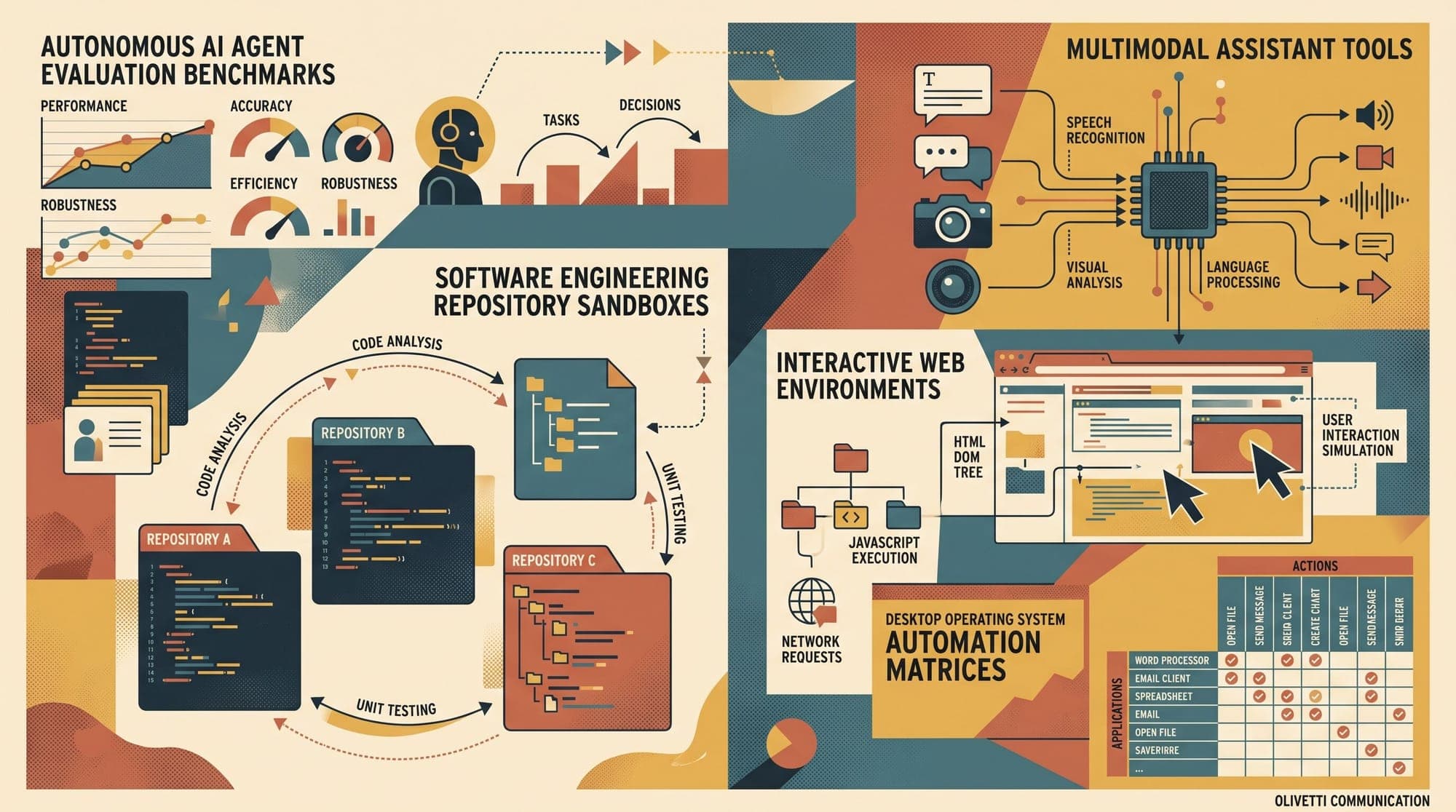
Evaluating autonomous AI agents requires a fundamental departure from static language model evaluation. While benchmarks like MMLU, GSM8K, and HumanEval measure single-turn next-token prediction on fixed prompts, they fail to evaluate the closed-loop failure modes of autonomous agents. Real-world agents must formulate multi-step plans, execute tool calls, ingest dynamic environment feedback, recover from syntax and runtime errors, and mutate external state across long interaction trajectories.
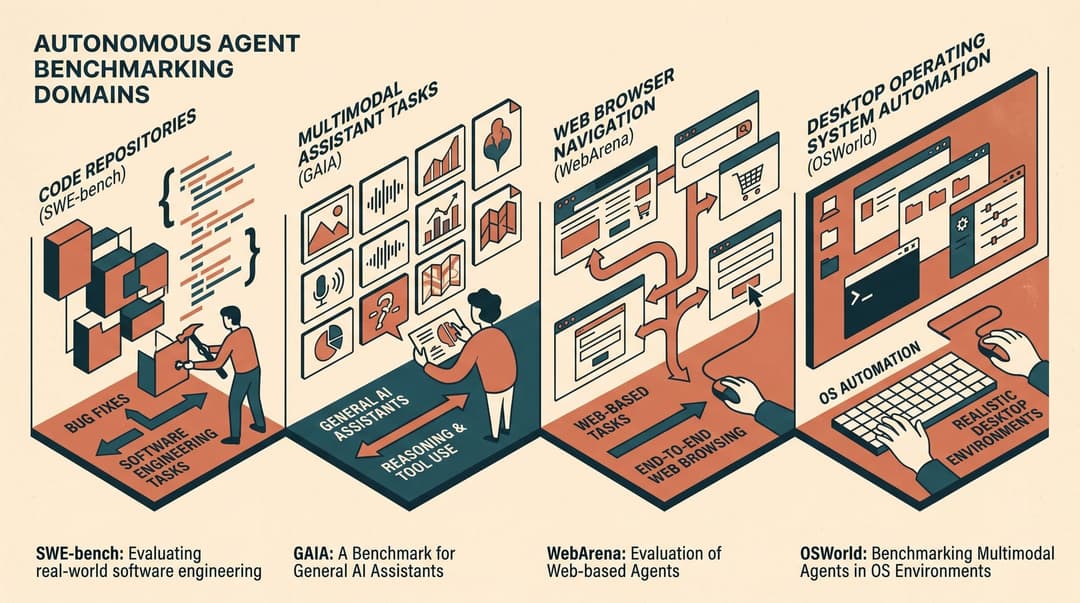
To establish reliable engineering baselines for autonomous systems, the AI research community has developed execution-based benchmark suites across four distinct operational domains: software engineering, multimodal tool assistance, browser navigation, and operating system control.
The Shift to Dynamic Execution-Based Evaluation
Static question-answering benchmarks suffer from severe limitations when applied to autonomous agents:
- Absence of Environmental Feedback: Static benchmarks cannot test an agent's ability to interpret terminal error outputs, debug failing assertions, or inspect intermediate state mutations.
- Inflexible Action Paths: Pre-scripted path validation penalizes valid alternative strategies that achieve the correct end state through different tool sequences.
- Data Contamination: Static text datasets rapidly leak into pre-training corpora, inflating apparent reasoning performance without reflecting operational autonomy.
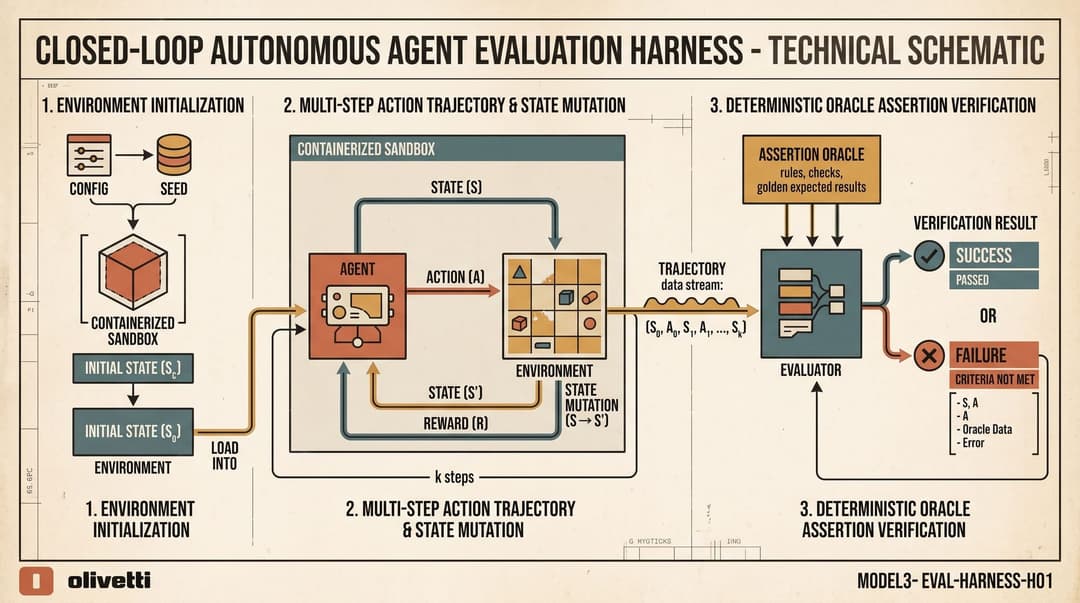
Modern agent evaluation frameworks solve these issues by deploying isolated sandbox environments where an agent's success is determined by deterministic oracle assertions evaluated against the mutated system state.
1. SWE-bench: Repository-Level Software Engineering
Introduced by Jimenez et al. (ICLR 2024), SWE-bench evaluates whether an AI agent can resolve end-to-end software engineering problems sourced from real-world GitHub issues.
Architecture and Mechanics
- Task Formulation: The agent receives a real GitHub issue description (problem statement) and the corresponding repository state at the commit preceding the fix. The agent must locate relevant source files, draft code modifications, and generate a unified git patch.
- Dataset Scale: The full benchmark comprises 2,294 tasks across 12 popular Python repositories (including django, sympy, pytest, matplotlib, and scikit-learn).
- Evaluation Harness: For each instance, the benchmark spins up a dedicated Docker container, checks out the repository, applies the agent's generated patch, and runs the repository's test suite.
- Oracle Verification: Success is verified using two test sets:
FAIL_TO_PASS(unit tests that failed before the fix and must pass after applying the patch) andPASS_TO_PASS(existing tests that must remain passing to prevent regressions).
SWE-bench Lite and SWE-bench Verified
To manage evaluation latency and benchmark cleanliness, two standardized subsets are widely used:
- SWE-bench Lite (300 tasks): A filtered subset of self-contained tasks designed to reduce Docker build times and execution costs while preserving discriminative signal.
- SWE-bench Verified (500 tasks): Developed collaboratively by OpenAI and the SWE-bench team, this subset was human-audited by professional software engineers to remove under-specified problem descriptions, ambiguous issue prompts, and over-constrained unit test suites that caused false negatives.
2. GAIA: General AI Assistant Multimodal Reasoning
Developed by Mialon et al. (Meta FAIR, Hugging Face, AutoGPT; ICLR 2024), GAIA (General AI Assistants) tests general-purpose assistant capabilities across multimodal file analysis, web research, and tool use.
Architecture and Mechanics
- Philosophy: GAIA targets tasks that are conceptually straightforward for human evaluators (achieving a 92% human success rate) but require complex multi-step tool composition for AI systems.
- Task Structure: The dataset comprises 466 curated questions paired with diverse multimodal artifacts, including spreadsheets (.xlsx, .csv), PDF documents, audio files, images, and web URLs.
- Complexity Tiers:
- Level 1 (166 tasks): Requires 1 to 5 reasoning steps and no more than one external tool.
- Level 2 (218 tasks): Requires 5 to 10 steps, combination of multimodal inputs, and multiple tool interactions.
- Level 3 (82 tasks): Complex arbitrary sequences requiring long-horizon planning, arbitrary web navigation, multimodal parsing, and mathematical calculations.
- Oracle Verification: GAIA relies on quasi-exact string, numerical, or comma-separated list matching. Answers are designed to be unambiguous and factually verifiable without requiring an LLM judge.
3. WebArena: High-Fidelity Web Browser Automation
Introduced by Zhou et al. (CMU; arXiv 2023), WebArena evaluates autonomous agents performing multi-step tasks across real-world web applications.
Architecture and Mechanics
- Self-Hosted Sandboxes: WebArena provides fully functional, standalone web applications deployed across isolated Docker containers, including:
- E-commerce: Saleor storefront.
- Software Development: Self-hosted GitLab instance.
- Social Forum: Postmill (Reddit clone).
- Content Management: OpenStreetMap and Wikipedia mirrors.
- Task Suite: 812 high-level human-annotated intents spanning information seeking, site navigation, and state-modifying actions (such as configuring user permissions or completing checkout flows).
- Observation and Action Spaces: Agents interact via Playwright or BrowserGym, receiving accessibility (a11y) trees, raw HTML DOM trees, or viewport screenshots, and emitting browser actions (clicks, keypresses, select options, navigation).
- Oracle Verification: Functional correctness is verified via programmatic state assertions, including database state queries, backend API responses, downloaded file comparisons, and DOM element inspections.
4. OSWorld: Multimodal Desktop Operating System Control
Introduced by Xie et al. (HKU; NeurIPS 2024), OSWorld evaluates multimodal agents executing open-ended computer tasks across real desktop operating systems (Ubuntu, Windows, and macOS).
Architecture and Mechanics
- Full OS Environment: Unlike web-only or terminal-only benchmarks, OSWorld places agents in full desktop operating system environments with desktop GUI applications (LibreOffice, Chrome, VLC, GIMP, VS Code) and system utilities.
- Task Suite: 369 diverse tasks derived from real-world daily workflows spanning cross-application operations, file management, system administration, and GUI data manipulation.
- Input and Observation Primitives: Agents receive screen pixel screenshots, accessibility trees, and system logs, and issue raw OS-level mouse and keyboard actions (click, double click, drag, type, shortcut hotkeys) or bash commands.
- Oracle Verification: OSWorld uses custom execution-based evaluation scripts executed inside the virtual machine after task termination, validating filesystem contents, SQLite configuration databases, application runtime states, and UI render trees.
Architectural Comparison of Agent Benchmarks
Understanding the operational trade-offs across these benchmark suites is essential when configuring CI/CD evaluation harnesses:
Target Domain and Operational Scope
- SWE-bench / Verified: Real-world software engineering bug fixes and feature additions across complex Python codebases.
- GAIA: General assistant workflows, multi-step multimodal document analysis, web search, and data aggregation.
- WebArena: Web browser navigation, form completion, and interactive state modification across self-hosted web applications.
- OSWorld: Full desktop operating system automation, cross-application workflows, GUI grounding, and system administration.
Observation Space
- SWE-bench / Verified: File tree listings, text search (grep/ripgrep), file contents, bash terminal outputs.
- GAIA: Text prompts accompanied by attached files (PDF, XLSX, CSV, audio, images) and live web search results.
- WebArena: Accessibility (a11y) tree representations, HTML DOM structures, and viewport screenshots.
- OSWorld: Desktop screen screenshots, OS accessibility trees, and terminal stdout/stderr streams.
Action Primitives
- SWE-bench / Verified: Shell commands, file edits (patch/write), linting and test execution tools.
- GAIA: Python code execution, web search APIs, calculator calls, file extraction utilities.
- WebArena: Browser primitives (click, type, scroll, select, hover, goto_url, press_key).
- OSWorld: Mouse movements, clicks, drags, keyboard keystrokes, application launches, bash commands.
Oracle Verification Methodology
- SWE-bench / Verified: Deterministic unit test pass/fail status (
FAIL_TO_PASSandPASS_TO_PASStest suites). - GAIA: Deterministic exact match on normalized ground-truth string, integer, or float answers.
- WebArena: Programmatic verification of database state, backend server APIs, URL paths, and DOM element states.
- OSWorld: Programmatic VM evaluation scripts asserting on filesystem artifacts, application configs, and OS state.
Infrastructure Complexity and Setup Overhead
- SWE-bench / Verified: High. Requires Docker daemon, isolated container builds per repo/commit, and Python runtime dependencies.
- GAIA: Low. Requires tool execution runtime (Python interpreter + web search API); no heavy infrastructure.
- WebArena: High. Requires multi-container Docker Compose cluster hosting 5 independent web services and databases.
- OSWorld: Very High. Requires virtual machine virtualization (QEMU/KVM or cloud instances) with graphical desktop servers.
Key Engineering Challenges and Failure Modes
Benchmarking autonomous agents in production reveals several architectural bottlenecks:
1. Harness Scaffolding Sensitivity
Agent performance varies drastically depending on the scaffolding harness wrapping the foundation model. On SWE-bench, pairing the same LLM with different scaffolds (e.g., raw prompt vs. SWE-agent ACI vs. OpenHands) can swing resolve rates by 15 to 25 percentage points. Scaffolding design (history compression, tool definitions, error recovery hints) is as critical as underlying model intelligence.
2. Flaky Oracles and Evaluation Flakiness
Dynamic environments introduce non-deterministic evaluation failures:
- Network Latency and Live Web Drift: Benchmarks relying on live internet endpoints suffer from site changes and rate limiting. WebArena mitigates this by self-hosting all targets, while GAIA requires robust network caching.
- Asynchronous GUI Renders: In OSWorld and WebArena, evaluating UI state before animations complete or background workers finish writing to databases causes false negative failures.
- Over-Constrained Test Suites: In unverified software benchmarks, gold test suites often assert on internal implementation details rather than functional requirements, rejecting valid patches.
3. Metric Variance: Pass@1 vs. Pass^k
Single-pass success (pass@1) measures average capability but hides reliability issues. In production systems, engineering teams increasingly measure pass^k (the probability that an agent succeeds consistently across all consecutive independent trials). Models scoring 70% on pass@1 often drop below 30% on pass^3, highlighting vulnerability to non-deterministic trajectory divergence.
Practical Recommendations for Production Agent Evals
For organizations building internal agent evaluation pipelines:
- Adopt Verified and Curated Subsets for Fast Feedback: Run automated pull-request CI gates against SWE-bench Verified or GAIA Level 1 and 2 before running full test suites.
- Prioritize Self-Hosted, Deterministic Sandboxes: Avoid live external web dependencies in CI/CD. Use containerized local services (following WebArena's architecture) to ensure reproducible network and database states.
- Decouple Model Intelligence from Harness Design: Standardize tool interfaces (such as Model Context Protocol or BrowserGym) to benchmark model updates independently of scaffolding logic changes.
- Log Full Trajectory Artifacts: Persist complete interaction trajectories (tool inputs, stdout outputs, screenshot frames, cost, and latency) to enable automated failure clustering and error budget analysis.
Sources
- SWE-bench: Can Language Models Resolve Real-World GitHub Issues? (ICLR 2024 / arXiv:2310.06770)
- SWE-bench Verified: Human Validation of Software Engineering Benchmarks (OpenAI / SWE-bench Team)
- GAIA: A Benchmark for General AI Assistants (ICLR 2024 / arXiv:2311.12983)
- WebArena: A Realistic Web Environment for Building Autonomous Agents (arXiv:2307.13854)
- OSWorld: Benchmarking Multimodal Agents for Open-Ended Tasks in Real Computer Environments (NeurIPS 2024 / arXiv:2404.07972)
- SWE-agent: Agent-Computer Interfaces Enable Automated Software Engineering (NeurIPS 2024 / arXiv:2405.15793)
