
Large language model deployment in high-concurrency production environments is governed primarily by memory bandwidth and hardware economics. In standard autoregressive decoding, memory traffic dominates computation: for every token generated, every parameter of the model must be loaded from GPU High Bandwidth Memory (HBM) into SRAM and tensor cores. Serving a 70-billion parameter model in 16-bit precision requires at least 140 GB of VRAM solely for model weights, necessitating multi-GPU tensor parallelism across multiple high-end accelerators such as NVIDIA A100 or H100 SXM GPUs.
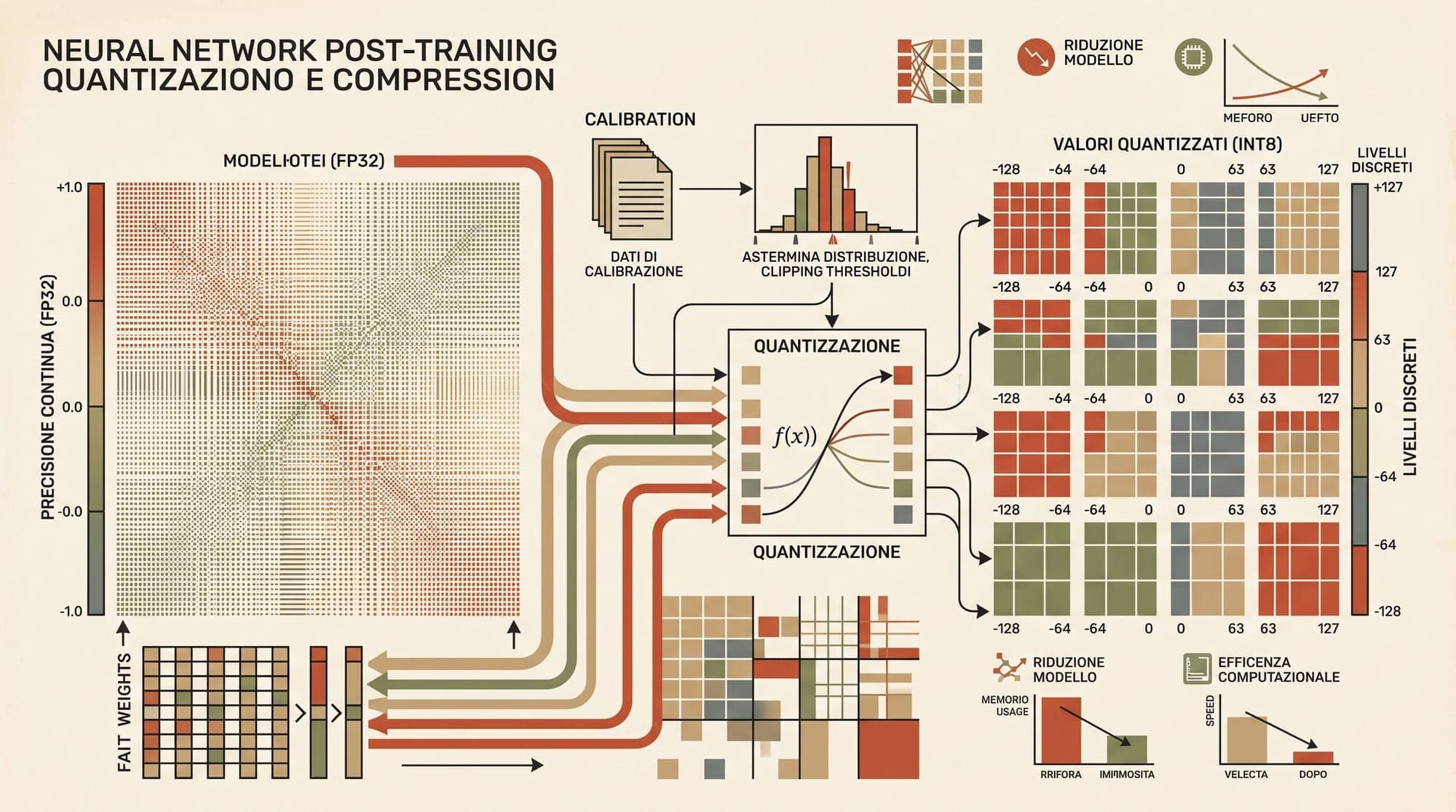
Post-training quantization (PTQ) addresses these operational constraints by compressing model weights (and optionally activations) after pre-training and supervised fine-tuning, without requiring computationally expensive full-parameter retraining. By reducing numerical precision from 16-bit floating point (FP16 or BF16) to 8-bit or 4-bit representations, engineering teams can achieve a 2x to 4x reduction in memory footprint, fit larger models onto smaller GPU footprints, and substantially increase generation throughput.
However, the tooling landscape for generating and serving quantized checkpoints has historically been fragmented across incompatible formats, disparate kernel runtimes, and contrasting algorithmic philosophies. This analysis examines the four primary production PTQ toolkits in the modern AI ecosystem: AutoAWQ, AutoGPTQ, bitsandbytes, and llm-compressor. We evaluate their underlying mathematical mechanics, calibration profiling requirements, kernel execution backends, and serving economics across production inference engines like vLLM and SGLang.

The Quantization Spectrum: Weight-Only vs. Weight-Activation vs. FP8
Before evaluating individual toolkits, it is critical to distinguish the execution regimes in low-precision serving:
- Weight-Only Quantization (W4A16 / W8A16): Model weights are stored in 4-bit or 8-bit integer formats in GPU HBM. During linear layer computation, weights are dynamically dequantized into 16-bit floating point registers before executing standard FP16 GEMM (General Matrix Multiply) operations with 16-bit activations. This approach optimizes memory-bandwidth-bound autoregressive decoding at low to moderate batch sizes, but provides minimal compute acceleration for compute-bound prefill phases.
- Weight-Activation Quantization (W8A8 / INT8): Both weights and layer input activations are quantized to 8-bit integers. Matrix multiplications are executed directly on native INT8 Tensor Cores via integer GEMM operations (such as CUTLASS or CuBLASLt kernels). This accelerates both prefill and decode compute throughput, but requires careful outlier management because activation channels can exhibit extreme dynamic range variance.
- FP8 Mixed Precision (W8A8 FP8): Leverages native 8-bit floating point representations (E4M3 and E5M2) supported on NVIDIA Ada Lovelace, Hopper, and Blackwell architectures. FP8 preserves dynamic range better than INT8 and allows direct execution on FP8 Tensor Cores with static or dynamic per-tensor/per-token scaling factors.
AutoAWQ: Activation-Aware Saliency and Fast Quantization
AutoAWQ implements Activation-aware Weight Quantization, introduced by Lin et al. (MIT HAN Lab, MLSys 2024).
Mathematical Foundations and Saliency Search
The foundational premise of AWQ is that weights in transformer layers are not uniformly important to model performance. By analyzing input activation distributions, the authors observed that preserving the top 1% of salient weight channels drastically reduces quantization degradation.
Rather than implementing mixed-precision hardware storage (which introduces structural execution inefficiency on modern SIMD hardware), AWQ applies a per-channel scaling factor to protect salient weights. The optimization problem minimizes the output error of each linear layer:
where is the unquantized FP16 weight matrix, represents input activations cached from a small calibration dataset, and denotes uniform grid quantization (e.g., INT4 with group size 128). The search space for is parameterized as , where is the per-channel activation magnitude and is optimized via grid search.
Calibration and Production Characteristics
- Calibration Efficiency: AWQ does not compute second-order derivatives or inverse Hessians. Consequently, calibration is exceptionally fast, requiring only 128 to 512 forward-pass sequences from a generic corpus (such as The Pile or WikiText). Calibration typically completes within 5 to 15 minutes for a 70B parameter model.
- Generalization Robustness: Because AWQ does not overfit weights to reconstruct specific activation targets, the resulting checkpoints generalize reliably across diverse downstream domains, instruction-following tasks, and multimodal inputs.
- Kernel Support: AutoAWQ exports checkpoints compatible with fused GEMM, GEMV, and Marlin kernels, which deliver high decoding throughput in vLLM, SGLang, and Hugging Face Text Generation Inference (TGI).
AutoGPTQ: Second-Order Error Compensation via Optimal Brain Surgeon
AutoGPTQ provides the open-source implementation of GPTQ, established by Frantar et al. (IST Austria, ICLR 2023).
Algorithmic Mechanics and Inverse Hessian Updates
GPTQ adapts the classical Optimal Brain Surgeon framework to generative transformers. Given a linear layer , GPTQ quantizes the columns of weight matrix sequentially while updating the remaining unquantized weights to compensate for the introduced quantization error.
For a column index , the quantized column is computed, and the unquantized remainder is adjusted using the inverse Hessian matrix :
To scale this to billion-parameter architectures, GPTQ processes weights in blocks (typically 128 columns) using lazy batch updates and Cholesky stabilization.
Calibration and Production Considerations
- Precision at Low Bitwidths: By explicitly compensating for layer-wise output error, GPTQ retains lower perplexity than naive round-to-nearest (RTN) methods at aggressive compression levels (such as 3-bit and 4-bit).
- Act-Order Sensitivity: The
--act-order(or desc-act) heuristic quantizes columns in descending order of activation variance. While this improves accuracy on small models (7B and 13B), it complicates group-wise quantization scales and historically degraded inference kernel throughput due to index permutation overhead. - Calibration Overfitting: Because GPTQ explicitly minimizes calibration-set reconstruction error, selecting an unrepresentative calibration corpus or insufficient sequence length can lead to out-of-domain performance drops.
- Kernel Execution: AutoGPTQ supports ExLlamaV1/V2 and Marlin FP16xINT4 kernels, providing near-optimal memory bandwidth saturation during token decoding.
bitsandbytes: NF4, Double Quantization, and Zero-Calibration Workflows
Developed by Tim Dettmers and the BitsAndBytes Foundation, bitsandbytes pioneered low-bit accessibility in PyTorch through LLM.int8() (NeurIPS 2022) and QLoRA (NeurIPS 2023).
Algorithmic Architecture
- 4-bit NormalFloat (NF4): NF4 is an information-theoretically optimal quantile quantization data type for normally distributed neural network parameters. Unlike uniform integer grids, NF4 distributes 16 discrete bins so that each bin contains an equal expected number of parameter values under a zero-mean Gaussian distribution .
- Double Quantization (DQ): Standard block quantization stores a 32-bit floating-point scale factor for every block of 64 parameters. Double Quantization treats these scale factors as inputs to a second 8-bit FP8 quantization stage with a block size of 256, reducing the quantization constant memory footprint from 0.5 bits/param to 0.127 bits/param.
- Vector-Wise Outlier Decomposition: In 8-bit mode (LLM.int8()), coordinate channels where activations exceed a threshold are extracted into a separate 16-bit matrix multiplication, while the remaining 99.9% of channels are computed in INT8.
Production Trade-Offs
- Zero Offline Calibration:
bitsandbytesquantizes model weights on the fly duringfrom_pretrained(..., load_in_4bit=True)without requiring a pre-generated calibration dataset or offline optimization pass. - Serving Latency Bottleneck: While
bitsandbytesis the undisputed industry standard for Parameter-Efficient Fine-Tuning (PEFT/QLoRA), it is not optimized for high-throughput production serving. Its runtime kernels dynamically unpack 4-bit weights into 16-bit registers on standard CUDA cores, incurring higher computational latency compared to fused Marlin or Tensor Core integer GEMM implementations.
llm-compressor: Unified compressed-tensors and Native Engine Integration
Developed by Neural Magic and the vLLM Project, llm-compressor represents the modern convergence of quantization toolkits for production LLM serving.
Architecture and Format Standardization
Historically, serving teams maintained separate conversion pipelines for AutoGPTQ, AutoAWQ, and AutoFP8, each outputting custom checkpoint layouts with incompatible tensor key mappings. llm-compressor addresses this fragmentation by building directly on top of the open compressed-tensors specification.
Checkpoints generated by llm-compressor are stored as standard Hugging Face SafeTensors accompanied by structured quantization metadata, allowing direct zero-conversion loading into vLLM, SGLang, and PyTorch.
Supported Algorithms and Execution Paradigms
llm-compressor unifies multiple compression algorithms within a declarative modifier configuration:
- W4A16 Weight-Only (GPTQ and AWQ): Supports Marlin and Machete kernel export for high-performance weight-only decoding.
- W8A8 INT8 (SmoothQuant and GPTQ): Applies SmoothQuant (Xiao et al., ICML 2023) feature migration, mathematically transferring difficult activation outliers into weight matrices via per-channel scaling factors , enabling stable INT8 Tensor Core matrix operations.
- FP8 (W8A8 Dynamic/Static): Implements static per-channel weight scaling and dynamic per-token activation scaling for NVIDIA Hopper and Ada Lovelace GPUs.
- 2:4 Structured Sparsity: Integrates SparseGPT to prune 50% of weights into hardware-accelerated 2:4 sparse patterns, composable on top of quantization schemes.
Architectural and Execution Profile Comparison
The following breakdown summarizes the technical characteristics of each toolkit:
AutoAWQ
- Primary Precision Targets: W4A16, W8A16 (Weight-Only).
- Core Algorithm: Activation-aware per-channel grid search ().
- Calibration Requirement: Minimal (128 samples, 5 to 15 minutes for 70B).
- Primary Serving Kernels: Marlin, GEMV, AutoAWQ CUDA.
- Export Artifact Format: SafeTensors with custom AWQ metadata.
- Ideal Production Use Case: Fast offline export of 4-bit models with strong out-of-domain robustness.
AutoGPTQ
- Primary Precision Targets: W4A16, W8A16, W3A16 (Weight-Only).
- Core Algorithm: Sequential column quantization with inverse Hessian compensation.
- Calibration Requirement: Moderate (128 to 512 samples, context-length dependent).
- Primary Serving Kernels: Marlin, ExLlamaV2, Triton.
- Export Artifact Format: SafeTensors with GPTQ schema.
- Ideal Production Use Case: Extreme weight-only compression (3-bit/4-bit) where domain data is well-matched to calibration.
bitsandbytes
- Primary Precision Targets: NF4/FP4 (W4A16), INT8 with outlier separation.
- Core Algorithm: Information-theoretic quantile quantization (NF4) and Double Quantization.
- Calibration Requirement: None (Zero-shot dynamic loading).
- Primary Serving Kernels: bitsandbytes CUDA / CuBLASLt.
- Export Artifact Format: Standard HF weights (quantized dynamically at load time) or serialized BNB checkpoints.
- Ideal Production Use Case: QLoRA fine-tuning, developer prototyping, and local single-user inference.
llm-compressor
- Primary Precision Targets: FP8 (W8A8), INT8 (W8A8), W4A16, 2:4 Structured Sparsity.
- Core Algorithm: Multi-algorithm suite (SmoothQuant, GPTQ, SparseGPT, RTN).
- Calibration Requirement: 256 to 512 samples for activation/Hessian profiling.
- Primary Serving Kernels: vLLM Marlin, CUTLASS INT8/FP8, Machete, FlashInfer.
- Export Artifact Format: Native
compressed-tensorsSafeTensors. - Ideal Production Use Case: Production high-concurrency clusters on vLLM and SGLang targeting FP8 or INT8 W8A8.
Serving Economics and Hardware Allocation Strategy
Selecting a quantization toolkit directly impacts infrastructure costs, server sizing, and request latency profiles:
1. Hardware Footprint Reduction
- 70B Parameter Baseline (FP16 / BF16): Requires ~140 GB VRAM for weights alone. A production deployment requires at least 2x NVIDIA A100 (80GB) or H100 (80GB) GPUs using Tensor Parallelism (TP=2).
- 70B Parameter in W4A16 (AutoAWQ / AutoGPTQ / llm-compressor): Weights occupy ~38 GB to 42 GB VRAM. The model fits entirely on a single A100 (80GB) or H100 (80GB) GPU with over 35 GB remaining for PagedAttention KV cache allocation, cutting hardware infrastructure costs by 50%.
- 70B Parameter in FP8 / W8A8 (llm-compressor): Weights occupy ~70 GB VRAM. On an H100 GPU with FP8 Tensor Cores, serving achieves up to 2.2x compute speedup during dense prefill alongside substantial decoding throughput gains.
2. Prefill vs. Decode Bottlenecks
- Memory-Bound Workloads (Low Concurrency, Long Output): In workloads where time-to-first-token (TTFT) is secondary to inter-token latency (ITL) at batch size , 4-bit weight-only quantization via AutoAWQ or llm-compressor (Marlin kernel) delivers near-maximum memory bandwidth efficiency.
- Compute-Bound Workloads (High Concurrency, Large Prefill): In enterprise RAG and document summarization with large input contexts (16K+ tokens) and high concurrent batching (), weight-only quantization stalls on FP16 Tensor Core arithmetic. Implementing W8A8 INT8 (via SmoothQuant) or native FP8 through
llm-compressorengages integer and FP8 Tensor Cores, doubling compute throughput.
Decision Framework: Choosing the Right Production Toolkit
For machine learning operations and infrastructure engineering teams, the optimal tool choice depends on target hardware and deployment objectives:
- For QLoRA Fine-Tuning and Low-Cost Training: Use bitsandbytes. Its NF4 precision format and gradient integration remain the gold standard for adapting models on limited GPU resources.
- For Rapid 4-Bit Weight-Only Deployment: Use AutoAWQ. Its activation-aware channel protection yields fast calibration times, excellent zero-shot generalization across novel domains, and first-class Marlin kernel support in vLLM.
- For Dedicated Production vLLM / SGLang Serving: Use llm-compressor. It provides the most future-proof path by standardizing on
compressed-tensors, supporting native FP8 and W8A8 SmoothQuant workflows, and unlocking full hardware utilization across modern GPU architectures.
Sources
- Lin et al. (2024). AWQ: Activation-aware Weight Quantization for On-Device LLM Compression and Acceleration. MLSys 2024. arXiv:2306.00978
- Frantar et al. (2023). GPTQ: Accurate Post-Training Quantization for Generative Pre-trained Transformers. ICLR 2023. arXiv:2210.17323
- Dettmers et al. (2023). QLoRA: Efficient Finetuning of Quantized LLMs. NeurIPS 2023. arXiv:2305.14314
- Dettmers et al. (2022). LLM.int8(): 8-bit Matrix Multiplication for Transformers at Scale. NeurIPS 2022. arXiv:2208.07339
- Xiao et al. (2023). SmoothQuant: Accurate and Efficient Post-Training Quantization for Large Language Models. ICML 2023. arXiv:2211.10438
- Frantar and Alistarh (2023). SparseGPT: Massive Language Models Can Be Accurately Pruned in One-Shot. ICML 2023. arXiv:2301.00774
- Neural Magic & vLLM Project. LLM Compressor: Faster Inference with vLLM via Unified Model Compression. Red Hat Developers & GitHub
- vLLM Project. compressed-tensors: Unified Format for Compressed Model Weights. GitHub



