LLM Guardrails and Safety Firewalls in Production: Comparing NeMo Guardrails, Guardrails AI, Llama Guard 3, and Lakera Guard
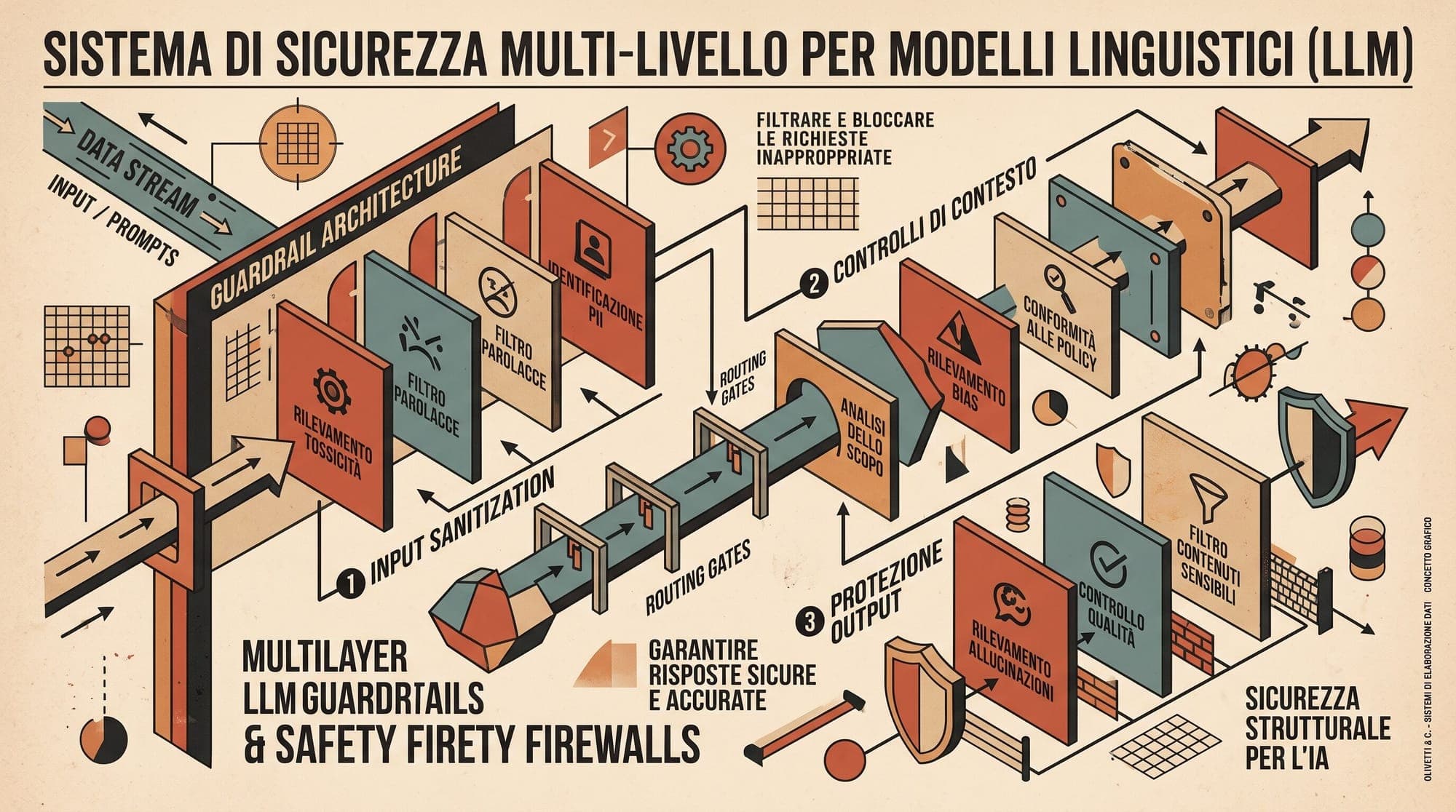
Deploying large language models into enterprise production environments exposes applications to adversarial manipulation, prompt injection, data exfiltration, and non-deterministic schema violations. Early production deployments often relied on monolithic system prompts or basic keyword blocklists. However, modern production architectures treat guardrails as an independent, multi-layered security and validation subsystem.
The central engineering challenge in production guardrails is balancing safety rigor against system latency and user experience. Synchronous pre-inference safety checks directly increase Time to First Token (TTFT). Synchronous post-inference checks can break real-time streaming interfaces. Furthermore, overly restrictive guardrails introduce high false-positive rates that degrade application utility.
Four primary architectural paradigms have emerged to address these challenges:
- Programmable Conversational Flow Control: Represented by NVIDIA NeMo Guardrails, which uses state-machine logic to enforce conversational boundaries.
- Deterministic Output and Schema Validation: Represented by Guardrails AI, which enforces programmatic constraints and structured data contracts.
- Open-Weights Safety Classifiers: Represented by Meta's Llama Guard 3, which applies autoregressive model evaluation across standardized safety taxonomies.
- Specialized Edge Security APIs: Represented by Lakera Guard, which provides low-latency, dedicated classifier endpoints focused on prompt injection and adversarial attacks.
Each framework targets a distinct boundary in the inference lifecycle. Understanding their internal mechanics, latency profiles, and failure modes is necessary for designing an efficient defense-in-depth architecture.
NVIDIA NeMo Guardrails: Programmable Dialog State and Multi-Stage Rail Pipelines
NVIDIA NeMo Guardrails operates as a programmable policy engine and orchestration proxy sitting between user requests and backend foundation models. Rather than treating safety as an isolated pass-or-fail classification, NeMo models human-AI interactions as an event-driven state machine written in its domain-specific language, Colang (with support for Colang 1.0 and Colang 2.0).
Pipeline Interception Stages
NeMo structures safety enforcement across five discrete execution boundaries:
- Input Rails: Intercepts the raw user prompt before model dispatch. Executes intent classification, topical boundary checks, and input jailbreak detection.
- Dialog Rails: Directs the conversational trajectory. If a user query attempts to divert the system away from approved topics (e.g., asking a customer service bot for political opinions), the dialog rail short-circuits the interaction and returns a predefined canonical response without querying the foundation model.
- Retrieval Rails: Evaluates retrieved chunks in Retrieval-Augmented Generation (RAG) pipelines for relevance, toxicity, and indirect prompt injection before context injection.
- Execution Rails: Intercepts tool calls and API parameters generated by agents to verify permission boundaries before execution.
- Output Rails: Verifies generated completions for factual hallucination against reference context, sensitive data leakage, and content safety.
+---------------+      +-------------------+      +------------------+
| Inbound User  | ---> |   Input Rails     | ---> |   Dialog Rails   |
| Prompt        |      | (Injection/Topic) |      |  (State Machine) |
+---------------+      +-------------------+      +------------------+
                                                           |
                                                           v
+---------------+      +-------------------+      +------------------+
| Outbound User | <--- |   Output Rails    | <--- | Foundation Model |
| Response      |      | (Fact/PII Check)  |      |  (vLLM / SGLang) |
+---------------+      +-------------------+      +------------------+
Technical Evaluation and Performance Overhead
According to NVIDIA technical benchmarks, NeMo provides high flexibility for complex dialog branching and multi-turn policy enforcement. Colang 2.0 introduces asynchronous event handling and granular Python action hooks, allowing teams to wire custom enterprise databases and moderation microservices directly into the flow.
However, NeMo's primary architectural bottleneck is multi-call latency accumulation. When configured to use auxiliary LLMs for intent classification and fact-checking, each rail layer introduces an independent inference step. While simple embedding-based semantic matching executes in under 50ms on GPU infrastructure, chained LLM evaluations can push total request overhead past 1.0 to 2.5 seconds if not strictly optimized with small local models (such as Nemoguard 8B or lightweight embedding routers).
Guardrails AI: Deterministic Structure, Pydantic Integration, and Reask Mechanics
While NeMo focuses on conversational control, Guardrails AI addresses output structural reliability and semantic data integrity. It wraps LLM calls with declarative validation pipelines built around Pydantic schemas and the Reliable AI Markup Language (RAIL) specification.
Core Architecture and the Guard Object
At the center of the framework is the Guard instance, which intercepts outputs from LLM providers (such as OpenAI, Anthropic, or self-hosted vLLM instances). Developers declare validation rules either via Pydantic model field metadata or modular validators pulled from the open-source Guardrails Hub.
The framework supports two validation classes:
- Deterministic Validators: Zero-overhead programmatic checks executing locally in CPU memory (e.g., JSON schema adherence, regex pattern matching, valid SQL abstract syntax trees, and cryptographic PII detection).
- Neural / Model-Based Validators: Semantic checks that invoke lightweight embedding models or local classifiers (e.g., toxicity scorers, toxic language filters, and hallucination provenance checks against source text).
from pydantic import BaseModel, Field
from guardrails import Guard
from guardrails.hub import ValidRange, ToxicLanguage

class FinancialExtraction(BaseModel):
    account_id: str = Field(description="Alphanumeric account identifier")
    transaction_amount: float = Field(
        validators=[ValidRange(min=0.01, max=1000000.0, on_fail="reask")]
    )
    risk_summary: str = Field(
        validators=[ToxicLanguage(threshold=0.5, on_fail="fix")]
    )

guard = Guard.for_pydantic(output_class=FinancialExtraction)
validated_output = guard(llm_api="gpt-4o", prompt="Extract financial details...")
Failure Handling: Fix, Filter, Refrain, and Reask
Guardrails AI provides explicit programmatic primitives for handling validation failures:
- Filter: Silently removes offending fields or array items that fail validation.
- Fix: Programmatically amends the output using deterministic heuristics (e.g., stripping invalid characters or replacing toxic tokens).
- Refrain: Aborts the generation and substitutes a fallback default value.
- Reask: Automatically constructs a corrective prompt describing the exact validation failure and sends it back to the LLM for a localized repair iteration.
Operational Trade-Offs
For applications requiring strict structured outputs, Guardrails AI prevents corrupted JSON payloads from breaking downstream transactional systems. Deterministic validators execute with sub-5ms CPU latency. However, enabling the reask corrective loop introduces non-deterministic latency spikes; an automatic retry doubles total token consumption and roughly doubles end-to-end response times.
Meta Llama Guard 3: Standardized Taxonomy and Autoregressive Safety Classification
Meta's Llama Guard 3 is an open-weights instruction-tuned classifier model designed specifically for LLM input and output moderation. Trained on top of Llama 3.1 architectures, Llama Guard 3 maps safety violations against the standardized MLCommons AI Safety taxonomy.
Architecture and Hazard Taxonomies
Llama Guard 3 is distributed in both 8B and 1B parameter configurations. It operates as an autoregressive text-to-text model: the user prompt or model response is formatted inside a standardized templating harness alongside explicit policy category definitions.
The model evaluates content across 14 standardized hazard categories, including:
- S1 (Violent Crimes): Incitement or instructions for violence.
- S2 (Non-Violent Crimes): Financial fraud, theft, and property destruction.
- S3 (Sex-Related Crimes): Exploitative and non-consensual sexual content.
- S4 (Child Sexual Exploitation and Abuse): Immediate strict refusal.
- S5 (Defamation): Malicious false factual claims against individuals.
- S6 (Specialized Advice): Unqualified medical, legal, or financial counseling.
- S7 (Privacy / PII): Disclosure of confidential private data.
- S8 (Intellectual Property): Direct copyright infringement.
- S9 (Indiscriminate Weapons / CBRN): Chemical, biological, radiological, or nuclear weapons synthesis.
- S10 (Hate Speech): Discrimination and slurs targeting protected groups.
- S11 (Suicide and Self-Harm): Encouragement or instructions for self-harm.
- S12 (Sexual Content): Explicit adult material.
- S13 (Cybersecurity / Malware): Vulnerability exploitation, ransomware, and denial-of-service scripts.
- S14 (CBRN Weapons): Critical infrastructure attacks.
When evaluated, the model outputs either a single token string safe or a structured multiline response:
unsafe
S13
Latency Profiles and Serving Economics
Unlike static lookup tables or small embeddings, Llama Guard incurs the computational overhead of an autoregressive generative pass. Empirical benchmarks compiled in academic evaluations (such as the ArXiv Guardrails Benchmark study) show that running Llama Guard 3 8B synchronously before and after foundation model generation introduces between 500ms and 1.5 seconds of additional latency on NVIDIA A100/H100 infrastructure.
The release of Llama Guard 3 1B significantly improves serving economics. With a quantized memory footprint under 2GB VRAM, the 1B variant can be co-served alongside primary LLM inference workers via vLLM or SGLang, delivering sub-100ms classification passes on modern GPUs.
Lakera Guard: Dedicated Edge Embeddings and Real-Time Injection Defense
Lakera Guard represents the dedicated security API paradigm. Rather than running a full generative model or maintaining complex dialog trees, Lakera deploys specialized neural classifiers and embedding spaces trained continuously against active red-teaming datasets and adversarial jailbreak corpora.
Targeted Threat Vectors
Lakera Guard specializes in detecting complex adversarial input patterns that frequently bypass generic safety classifiers:
- Direct Prompt Injections: Adversarial instructions attempting to override system instructions (e.g., prefix injection, persona adoption, roleplay subversion).
- Indirect Prompt Injections: Poisoned payloads embedded inside third-party web content, customer support emails, or RAG documentation that attempt to hijack autonomous agent execution.
- Token Smuggling and Obfuscation: Attacks encoded via Base64, ROT13, Unicode manipulation, or Markdown image rendering exploits designed to bypass keyword filters.
- PII and Sensitive Data Leakage: Detection and masking of credit card numbers, social security identifiers, and internal corporate credentials.
Performance and Production Trade-Offs
The primary technical advantage of Lakera Guard is speed. Optimized classification heads evaluate input text in 25ms to 50ms, making it suitable for inline, synchronous pre-inference filtering without visibly impacting Time to First Token.
The operational tradeoff is external SaaS dependency. While Lakera offers containerized deployment options for high-compliance enterprise environments, default cloud API usage introduces outbound network round-trips and third-party data processing considerations. Furthermore, Lakera focuses strictly on security and threat mitigation; it does not handle conversational state management or output JSON schema enforcement.
Architectural Comparison Matrix
| Framework | Primary Enforcement Layer | Architecture Type | Default Deployment | Latency Impact (p50) | Key Strengths | Core Limitations | | :--- | :--- | :--- | :--- | :--- | :--- | :--- | | NVIDIA NeMo Guardrails | Conversational State, Input/Output Rails | Event-Driven State Machine (Colang DSL) | Open Source (Self-Hosted Python/GPU) | 50ms - 1500ms (Config-dependent) | Multi-turn dialog control, tool execution gating, customizable flows | High configuration complexity; latency multiplies with LLM judges | | Guardrails AI | Structured Output, Data Schema Contracts | Python Validation Engine (Pydantic / RAIL) | Open Source / Managed Hub | <5ms (Deterministic) / 100-300ms (Neural) | Robust JSON validation, automated reasks, 50+ Hub validators | Reasks double token costs; not designed for dialog flow control | | Meta Llama Guard 3 | Input / Output Content Moderation | Autoregressive LLM Classifier (1B / 8B) | Open Weights (Self-Hosted vLLM / Ollama) | 80ms (1B) / 600ms - 1200ms (8B) | Standardized MLCommons taxonomy, high semantic safety accuracy | Autoregressive latency overhead; requires GPU VRAM allocation | | Lakera Guard | Inbound Prompt Injection, Jailbreaks, PII | Specialized Neural Classifier & Embeddings | SaaS API / Enterprise Container | 25ms - 50ms | Rapid TTFT preservation, continuous threat feed updates | Outbound API dependency; no schema or dialog state capabilities |

Production Blueprint: Composing a Multi-Layer Defense-in-Depth Pipeline
In enterprise production architectures, treating guardrails as a choice between mutually exclusive tools leads to either severe latency degradation or critical security blind spots. High-throughput production systems compose these tools across distinct asynchronous and synchronous execution stages.
Incoming Request
      │
      ▼
[ Stage 1: Synchronous Edge Sanitization (Sub-5ms) ]
  • Regex PII masking
  • Token length & entropy checks
  • Known malicious hash blocklist
      │
      ▼
[ Stage 2: Synchronous Input Firewall (25-50ms) ]
  • Lakera Guard / Fast Neural Classifier
  • Direct & Indirect Prompt Injection Detection
      │
      ▼
[ Stage 3: Conversational Orchestration & State Tracking ]
  • NeMo Guardrails (Colang State Machine)
  • Topic boundary verification & Tool access gating
      │
      ▼
[ Stage 4: Primary Model Generation & Speculative Streaming ]
  • Foundation Model (vLLM / SGLang)
  • Raw tokens stream immediately to client
      │
      ├───────────────────────────────┐
      │ (Streaming Token Stream)       │ (Asynchronous Output Tap)
      ▼                               ▼
[ Client Interface ]            [ Stage 5: Async Moderation & Schema Check ]
                                • Guardrails AI (JSON Schema / AST)
                                • Llama Guard 3 1B (Taxonomy Moderation)
                                      │
                                      ▼
                                (If Unsafe: Send Out-of-Band Abort / Disconnect)
1. Synchronous Edge Sanitization (Sub-5ms)
Before hitting any neural network, incoming requests pass through local CPU-based deterministic filters. High-entropy token patterns, oversized payloads, and standard regex-based PII patterns (such as credit card numbers or API keys) are sanitized or rejected immediately.
2. Fast Input Firewalling (25ms to 50ms)
The sanitized prompt passes through a specialized injection classifier (such as Lakera Guard or a local ONNX Prompt Guard model). If a prompt injection or jailbreak attempt is identified, the request is terminated before consuming compute on the primary generative model.
3. Conversational State and Tool Gating (NeMo Guardrails)
For agentic workflows, NeMo Guardrails verifies that the user query remains within authorized business domains and enforces permissions on agent tool calls (execution rails).
4. Speculative Streaming with Asynchronous Safety Tap
To maintain sub-second Time to First Token and smooth real-time text streaming, production systems should avoid blocking output delivery behind slow autoregressive moderation models. Instead:
- The foundation model streams tokens directly to the client interface.
- In parallel, generated chunks are piped asynchronously to an output moderation tap running Guardrails AI (for schema verification) and Llama Guard 3 1B (for content safety).
- If the asynchronous validator flags an unsafe violation or data leakage mid-stream, the server terminates the WebSocket/SSE connection, purges the client view, and injects a standard safety refusal.
This hybrid architecture ensures deterministic schema integrity and robust adversarial defense while keeping pre-inference latency penalties under 50 milliseconds.
Sources
- NVIDIA NeMo Guardrails Open-Source Repository: https://github.com/NVIDIA-NeMo/Guardrails
- NVIDIA NeMo Guardrails Colang 2.0 Developer Guide: https://docs.nvidia.com/nemo/guardrails/configure-guardrails/colang
- NVIDIA Technical Blog: Measuring the Effectiveness and Performance of AI Guardrails: https://developer.nvidia.com/blog/measuring-the-effectiveness-and-performance-of-ai-guardrails-in-generative-ai-applications
- Guardrails AI Documentation and Core Concepts: https://guardrailsai.com/guardrails/docs/concepts/guard
- Guardrails AI GitHub Repository: https://github.com/guardrails-ai/guardrails
- Meta Llama Guard 3 Model Card and Safety Weights: https://huggingface.co/meta-llama/Llama-Guard-3-8B
- MLCommons AI Safety Taxonomy and Benchmarks: https://mlcommons.org/standards/ai-safety/
- Lakera AI Production Security and Threat Intelligence: https://www.lakera.ai/
- ArXiv Empirical Safety and Latency Benchmark Analysis: https://arxiv.org/html/2504.00441v2