
Inception released Mercury 3 on October 19, a diffusion language model that the startup says beats GPT-6 Luna and Claude Haiku 5.5 "across a range of benchmarks" while running 4 to 8 times faster. The benchmark claims come from Inception's own testing, and the launch is the company's case that text diffusion, a different way of generating language, can compete with the standard approach on real work and not only on speed.
What Inception announced
The Inception launch post lists these headline numbers:
- Speed: 1,068 tokens per second on NVIDIA GPUs.
- Context: 1M tokens, up from 260K for Mercury 2.5.
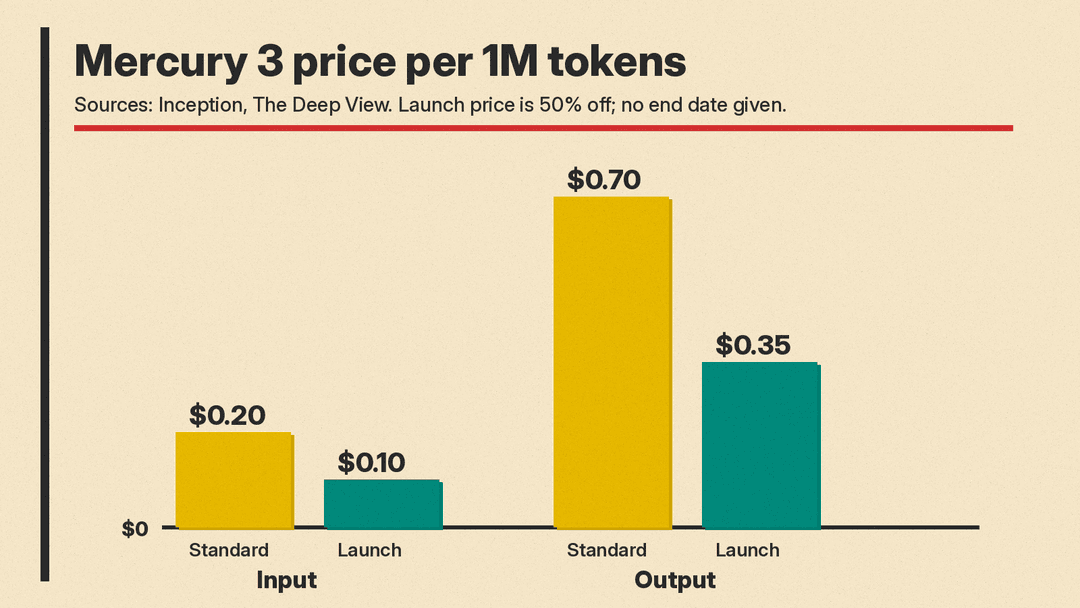
- Price: $0.20 per million input tokens and $0.70 per million output tokens. At launch it is 50% off, at $0.10 input and $0.35 output, and cached tokens are 90% off the input price.
- Scale: "more than 40x larger than Mercury 1," with intelligence across standard benchmarks up 3x from Mercury 1 (mini), the company says.
Mercury 3 is available on the Inception API Platform and through OpenRouter, Baseten and Vercel, and it is OpenAI API compatible. New API keys come with 100 million free tokens, according to the Inception models page. That page also says Mercury 2 and Mercury 2.5 are no longer available to new users, and existing customers with usage before October 19 keep access until November 15, 2026.
How a diffusion LLM differs
Most chat models are autoregressive. They write one token at a time, each based on the ones before it. As The Deep View explains, Mercury instead generates and refines many tokens at once, which makes better use of GPU parallelism. Diffusion is already common in image and video models. Inception's bet is that it also scales for text, and its post puts it plainly: "The scaling laws that drove progress in autoregressive models hold for diffusion too."
Inception has not said how many parameters Mercury 3 has, The Deep View reports. The Deep View also reports that Inception used swarms of Mercury 3 agents for self-improvement work that it says increased the model's overall speed by 16% beyond the team's own upgrades.
Price and positioning
The Deep View compares the launch price with Haiku 5.5 and GPT-6 Luna and says it is the same on input and a 35% discount on output. That comparison uses the 50% launch discount. Inception has not said how long the discount lasts, though CEO Stefano Ermon told The Deep View the company is working on changes that could make the launch price permanent.
The Deep View argues Mercury 3 is Inception's flagship and that speed, more than cost, is the main selling point. Inception's models page describes its models' quality as "comparable" to GPT-6 Luna (medium) and Claude Haiku 5.5 (medium). For context on those rivals, see our Claude Haiku 5.5 explainer, the GPT-6 model guide and our LLM API pricing comparison.
Early customer results
The launch post quotes early-access partners, and the numbers are their own:
- TinyFish AI says Mercury 3 completed 50% of 50 live Mind2Web navigation tasks in its web-agent harness, "significantly more than GPT-6.1-Sol."
- Octen AI, which says a five-second answer "feels broken" on smart glasses, reports a median generation time of 0.9 seconds and a median end-to-end response time of 2.2 seconds in its Sense API tests.
- RevisionDojo says hints, marked answers and definitions "now come back in about a second."
- Lorikeet says that in early testing, Mercury 3 "beat other models on latency while also performing higher on evals and in production."
What developers say
The Hacker News launch thread had 256 points and 91 comments when we checked on October 21. Reactions were mixed on speed. One user, ilitirit, wrote: "It was quite slow at first, but now I'm getting around 300-400tps. Still nowhere near 1000tps." Another, snake_doc, wrote that "at least in Openrouter, deepseek v4.1 flash via together/baseten/fireworks still beat mercury 3 on latency and intelligence."
Others were more upbeat. UncleOxidant wrote, "If their benchmarks are to be believed they've made some real progress," and later added that it was "actually pretty good so far" on a repo. Some wanted weights: SillyUsername wrote, "I've been waiting on an open weights model like this one, still no dice." The launch post lists chat, API and partner access, and does not mention downloadable weights.
Why it matters
Inception's pitch is that agents wait on the model at every step and that search and support apps need answers in seconds, so speed is the fix. The benchmark and partner figures are the company's own, and one user's report of 300 to 400 tokens per second suggests real-world speed can fall short of the headline number. If independent tests confirm the quality claims, diffusion becomes a serious option for apps where latency matters more than top-tier reasoning.
