
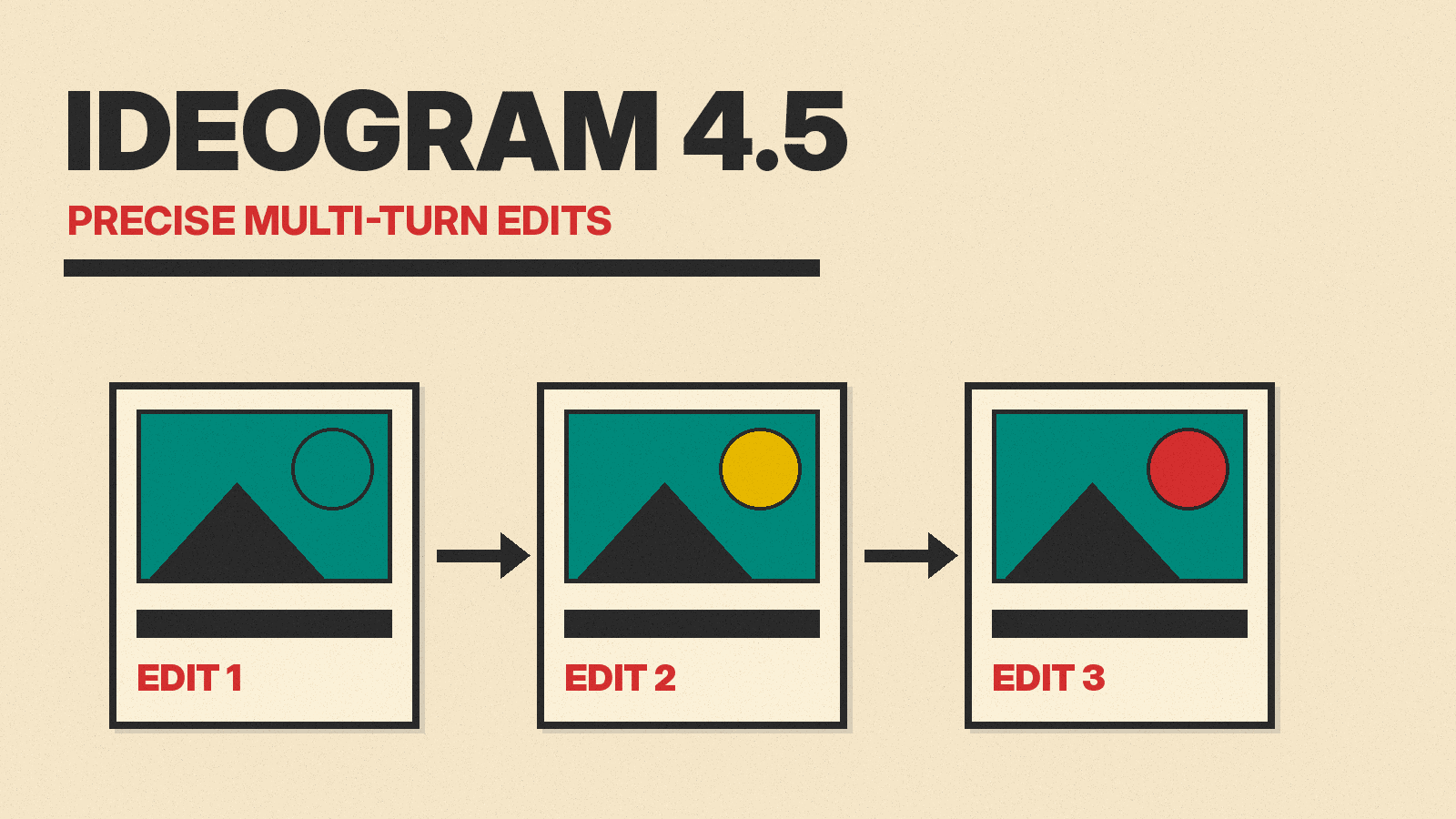
Ideogram says that with each edit, leading image models introduce artifacts, pixel shifts and color changes. Ideogram 4.5 is its answer. Ideogram calls it "the most precise edit model" and says it "eliminates artifact buildup, making multi-turn editing possible."
The model went live on September 30, 2026, according to the company's launch post on Reddit. It sits in the Ideogram app, Ideogram's MCP connection and the API, and it runs in four quality modes at native 2K resolution. Ideogram also says open weights are coming soon, but it has not given a date.
What Ideogram 4.5 is for
Ideogram says it has always led on typography and text rendering. Version 4.5 moves the focus to editing an image you already have, one step at a time, while the parts you did not ask to change stay as they were.
The model page lists the kinds of edits it targets:
- Color and lighting changes
- Text modification
- Product photography
- Interior design
- Architecture
- Restoring old photos
- Sketch to image
- Style reference
- Reframe
- Depth to image
In its LinkedIn announcement, Ideogram gives practical examples. You can recolor a product or relight a whole scene, and the company says shadows, reflections and highlights update to match while the composition stays the same. You can edit stylized text in place or translate it into another language while the design stays intact. You can take one photo of a room and swap furniture, finishes and color palettes while the architecture stays put.
Why multi-turn editing matters
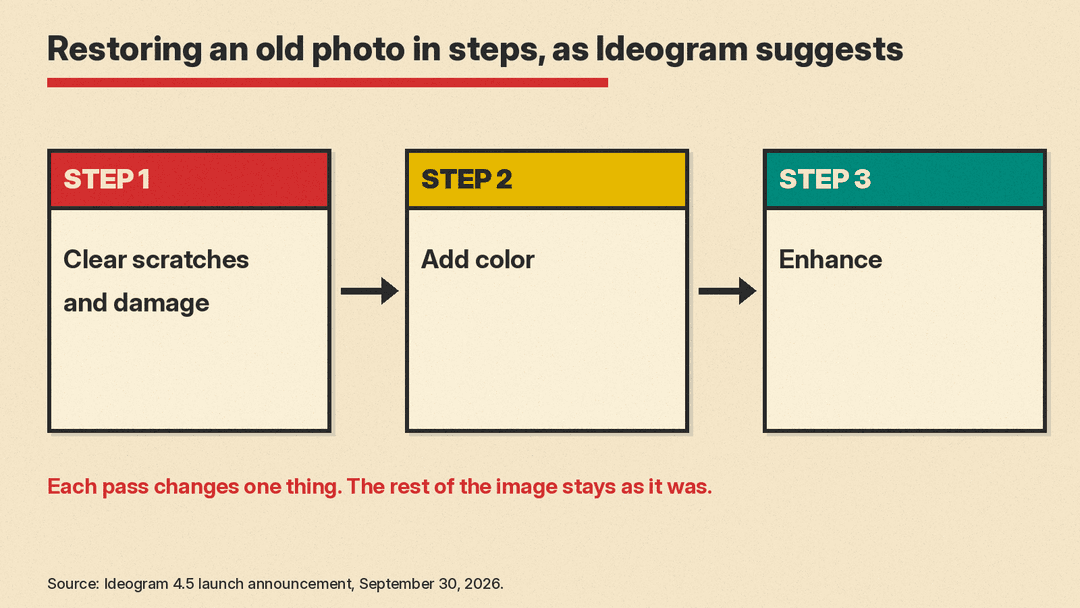
The restoration example shows the idea. Ideogram suggests fixing an old photo in stages: clear the scratches and damage first, then add color, then enhance. In the company's words, "trying to fix everything in one prompt rarely works." Splitting the job into separate edits lets you check each step before moving on.
That only works if each pass leaves the rest of the image alone. Ideogram published side-by-side comparisons of the same chain of edits on Ideogram 4.5, GPT Image 2.5 Sunburst, Nano Banana Pro and Nano Banana 2. The company says the GPT Image and Nano Banana outputs "become unusable within a few edits" while its own model stays clean. Those are Ideogram's own tests, not an independent benchmark, so treat them as a vendor claim until outside reviewers repeat them. For how GPT Image 2.5 and Nano Banana compare on other tasks, see our GPT Image 2.5 vs Nano Banana 2.1 comparison.
The same logic applies to commercial work. Ideogram notes that keeping products accurate in AI images is hard, and argues that changing one thing at a time while the product stays exact makes a full campaign easier to build. For a marketer, that could mean taking one product shot through several colorways or several lighting setups without the product itself changing between versions.
Editing large images
Ideogram says 4.5 can edit high-resolution images without downsizing them. Its model page shows a 4,016 by 6,016 pixel source image (24.2 megapixels) where only a selected region changes. The model preserves the edges of the edited crop so it can be stitched back into the original, which Ideogram pitches for close-ups and large-format print.
The API documentation explains the limits behind this. Editing a whole image is capped at 4,194,304 pixels, the area of a 2048 by 2048 square, so a larger image comes back scaled down. To edit a 4K or 8K image at full resolution, you set a context window that confines the edit to one region. Only that region changes, and the rest of the image comes back untouched at its original size.
Two ways to use it through the API
Developers get two endpoints:
- Generate creates a new image from a prompt and up to five optional reference images. Per the generate docs, the prompt can be natural language or a structured JSON prompt. A "magic prompt" setting rewrites and expands natural-language prompts by default, and can be switched off to keep your exact wording. Uploaded images can be up to 25MB each, in JPEG, PNG or WEBP.
- Precise Edit changes part of an existing image and returns it at the same width and height as the input. You can add a mask, where black marks the area to edit and white the area to keep.
Ideogram's Reddit post describes the difference simply: precise edit "is tuned to preserve everything outside your change, so you can keep chaining," while generate plus edit "gives the model room to reimagine."
Pricing
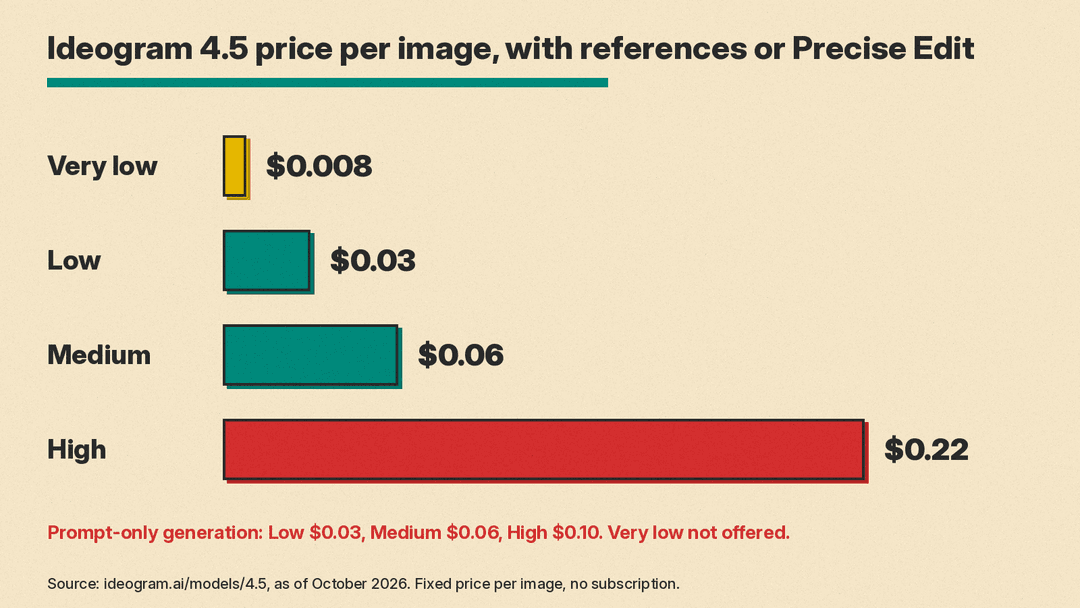
Ideogram charges a fixed price per image. It does not change with prompt length, the number of reference images or the output resolution, and no subscription is needed. These are the rates on the model page as of October 27, 2026:
- Very low: not available for prompt-only generation; $0.008 for generation with references and for Precise Edit
- Low: $0.03 in every mode
- Medium: $0.06 in every mode
- High: $0.10 for prompt-only generation; $0.22 for generation with references and for Precise Edit
Where you can use it
Beyond the Ideogram app (pick 4.5 in the model selector) and the API, Ideogram lists a long set of launch partners. The LinkedIn announcement names Superscale AI, Picsart, Creative Fabrica, Luminal, Arena, Runware, FLORA, Krea, Runway, Pika, fal, ComfyUI, Magnific, Gamma, Luma and Design Arena.
Limits to know
Ideogram is upfront about where the model works best: chains of targeted edits such as recoloring, relighting, text changes and swapping objects. Its launch post warns that "large add-then-remove edits give the model more to redraw, so expect more change there." In practice, small and specific requests should hold up better than sweeping ones.
The other open question is the open-weights release. Ideogram says it is coming soon, but there is no date, license or model size yet. Until it ships, Ideogram 4.5 is a hosted model only.
Why it matters
Ideogram is not the only company pitching precise edits. Krea, for example, launched Krea 3, which IT Brief describes as an image editor for commercial teams; our Krea 3 explainer covers its speed, pricing and API. Ideogram's pitch is precision across many turns: keep refining over as many turns as you need, and the rest of your image "stays intact," its model page says. The flat per-image pricing, starting below one cent, makes that claim low-cost to test on your own images.
