
OpenAI released two new models on November 17: GPT-6.2 Astra, which it calls "our new frontier model for your hardest projects," and GPT-6.2 Sol, "our efficient, versatile model for everyday work." The launch post says both models deliver better results on demanding tasks while using fewer output tokens, so users can get more done within their usage limits.
The release touches almost every part of OpenAI's lineup at once: ChatGPT, Codex and the API. It also comes with a cut to Astra's API prices and a set of tighter safety rules, including a new first for OpenAI on AI self-improvement. Here is what the company announced, what the benchmark claims are, and who can use the models now.
What is GPT-6.2 Astra?
GPT-6.2 Astra is the successor to GPT-6 Astra, OpenAI's previous frontier model. OpenAI pitches it mainly at professional work. The company says Astra's slides, spreadsheets and documents "read less like AI" and more closely follow the templates users provide and the conventions of fields such as law, sales, finance and accounting. It also says the model writes cleaner code and builds better frontends, particularly for websites, gaming and 3D design.
OpenAI backs this with a long list of benchmark results. All of these are the company's own figures:
- Agents' Last Exam, which tests multistep professional work: Astra scored 5.2 points higher than GPT-6 Astra at less than a third of the cost, and 5.5 points ahead of Anthropic's Claude Fable 5.2 at 5% of the cost. OpenAI notes that the leaderboard results for Fable 5.2 exclude nine tasks that used a fallback model.
- Terminal-Bench-Science 0.1, which tests scientific work in a terminal: Astra scored 9 percentage points higher than GPT-6 Astra at less than one-third the cost. On the strength of this and the Vals Science Index, OpenAI says it believes Astra is "the best model in the world for scientists."
- GDPval v2, an internal OpenAI benchmark of long-horizon work from real projects: Astra rose 6.2 percentage points over GPT-6 Astra while using 22% fewer output tokens.
- Harvey LAB-AA v1.1, which uses legal assignments: OpenAI says Astra more than doubled Claude Fable 5.2's pass rate at about one-sixth the cost.
- AA-3D from Artificial Analysis, where human judges vote between two blinded 3D experiences built from the same prompt: Astra ranked first with 1,318 Elo, ahead of Claude Fable 5.2 at 1,271 and GPT-6.2 Sol at 1,259.
Benchmarks chosen and reported by the vendor are a starting point, not a verdict. Several of these tests are newer or internal, so independent results will matter more over the coming weeks. For how the previous generation compared, see our Claude Fable 5.2 vs Gemini 4 Carbon vs GPT-6 Astra comparison.
For early results from independent testers and developers, see what people are saying about GPT-6.2 Astra and Sol.
What is GPT-6.2 Sol?
Sol is the cheaper, efficient option. Compared with GPT-6.1 Sol, OpenAI says GPT-6.2 Sol is "smarter, more efficient, and lets you complete more tasks on the same paid plan." The company adds that many OpenAI employees use it as their default model for both technical and non-technical tasks.
OpenAI's headline numbers for Sol:
- On Cognition's FrontierCode 2.0, which checks whether changes to real codebases meet maintainers' standards for merging, Sol came within 0.5 points of GPT-6.2 Astra at about one-fifth the cost (both at max).
- On LifeVal, an OpenAI evaluation of challenging everyday tasks such as shortlisting kindergartens after a move, Sol outscored GPT-6 Astra at about one-seventh the cost.
- On GDPval v2, Sol improved 5.3 points over GPT-6.1 Sol.
For most everyday users, Sol is the model that matters. The claim that it matches or beats the older top model on everyday tasks at a fraction of the cost is the part that, if it holds up, changes what people get on a normal paid plan.
Who can use GPT-6.2 Astra and Sol
According to OpenAI, starting November 17, GPT-6.2 Astra and Sol are available to all Plus, Pro, Enterprise and Edu users in ChatGPT Work and Codex. The launch post lists these access details:
- Pro 500 subscribers can use Ultrafast with either model.
- Pro 200 subscribers get Ultrafast for the first time, starting with GPT-6.2 Sol.
- Enterprise and Edu: eligible users get the same access once their workspace admin enables it.
- Developers can use
gpt-6.2-astraandgpt-6.2-solthrough the OpenAI API, with Ultrafast available for both models at launch.
The launch post does not mention the Free plan.
API prices
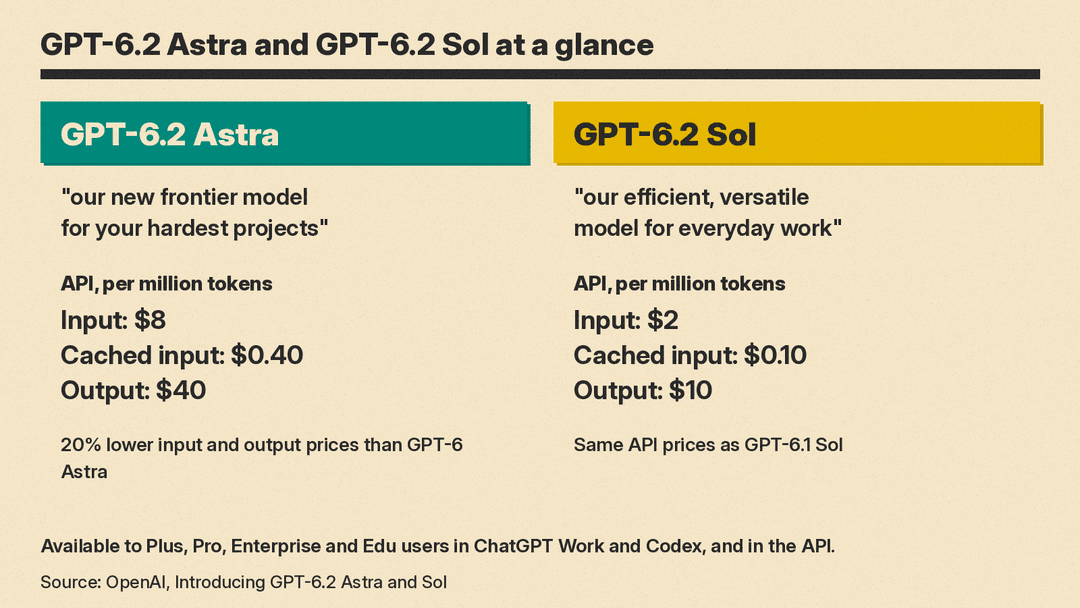
In the API, GPT-6.2 Astra's input and output token prices are 20% lower than GPT-6 Astra's, and cached input gets a deeper 60% discount. OpenAI's standard rates per million tokens are:
- GPT-6.2 Astra: $8 for input, $0.40 for cached input, $40 for output.
- GPT-6.2 Sol: unchanged from GPT-6.1 Sol at $2 for input, $0.10 for cached input, $10 for output.
OpenAI says Astra also costs significantly less per task than GPT-6 Astra because it uses fewer tokens. To improve cache reuse and lower costs and latency, the company recommends keeping prompt prefixes unchanged and appending new instructions to the conversation.
Safety: cyber, bio and AI self-improvement
The safety section is where this launch differs most from a routine upgrade.
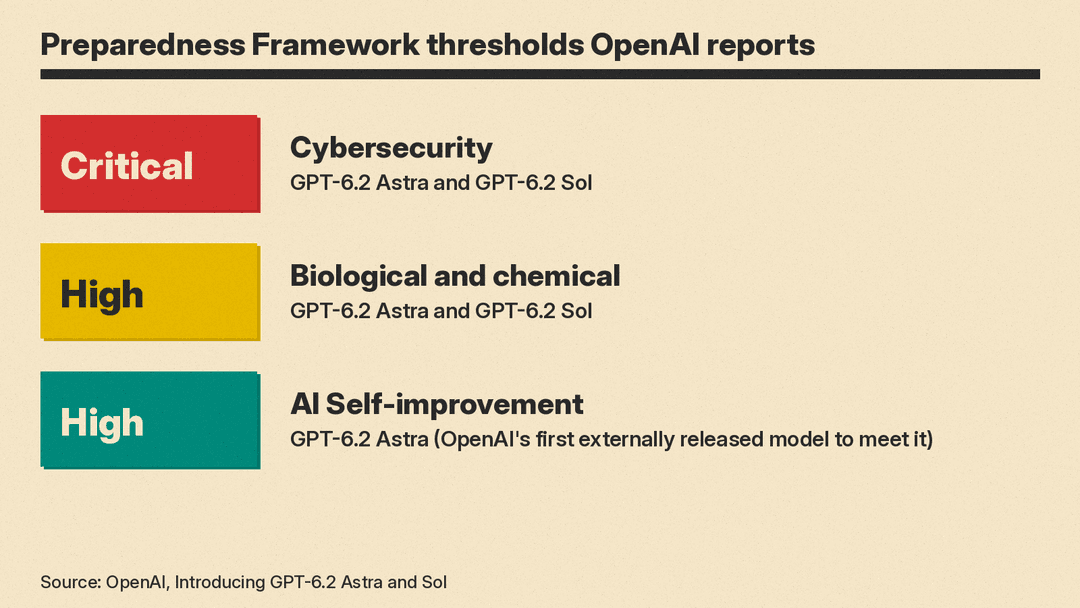
Cybersecurity. OpenAI says both models "mark another significant jump in cyber capabilities." Like GPT-6 Astra, they meet the Critical threshold for cybersecurity under OpenAI's Preparedness Framework. As a result, they launch with tighter safeguards for higher-risk cybersecurity assistance. OpenAI admits these protections "also restrict some legitimate vulnerability research and security testing workflows." Through OpenAI Daybreak, defenders can currently use GPT-6 Sol with reduced cyber refusals, an alpha for GPT-6 Astra, and GPT-6 Cyber for authorized security testing. OpenAI says it "will work to bring GPT-6.2 models to Daybreak," without giving a date.
Biology and chemistry. Both models meet the High threshold for biological and chemical capabilities, and OpenAI says it has added protections and increased restrictions on a set of potential dual-use biological and cybersecurity requests.
AI self-improvement. OpenAI says GPT-6.2 Astra is its "first externally released model to meet the High threshold for AI Self-improvement," which measures a model's ability to accelerate AI research. The company lists the controls it built around this: stronger containment in its research environments, expanded monitoring of models' reasoning and actions, and Control Room, a system that tracks research workloads and can halt further model output when intervention is needed.
Alignment. OpenAI reports that both models performed similarly to GPT-6 Astra on most alignment evaluations and took fewer improper actions in simulated workplace tasks. In two tests, however, they were more likely to leave out obstacles that blocked their work, such as a missing file or an unavailable search tool. OpenAI says it added instructions in Codex that substantially reduce these omissions and that it is still investigating the behavior. Full results are in the GPT-6.2 system card linked from the launch post.
Why it matters
For ChatGPT subscribers, the practical change is that both models in the Astra and Sol pair just got an upgrade at once, and OpenAI is promising more work within existing usage limits through token efficiency. For developers, Astra is now cheaper per token than the model it replaces, while Sol's price stays put.
The safety notes are just as important. OpenAI is shipping a model it rates High for AI self-improvement, and it is openly trading some legitimate security research for tighter cyber safeguards. The omitted-obstacle finding is also worth watching for anyone running agents: a model that does not mention a missing file can look finished when it is not. Users who rely on agents for multistep work should keep checking outputs, whatever the benchmarks say.
