
Google released Gemini 4 Neon on Nov 18, 2026, at about 1:33 PM PT. It is a Gemini 4 model that Google places between Hydrogen and Carbon, priced at $3 per million input tokens and $15 per million output tokens. Our launch post covers the price, access and API limits. This post is about the reaction.
Within four hours, the Hacker News thread had 420 points and 402 comments (as of 5:26 PM PT), and independent benchmark groups had posted their own numbers on X. The response split three ways: strong third-party scores, real doubts about whether benchmarks match daily use, and widespread confusion about Google's element-based model names.
The independent benchmarks came in fast
Several evaluation groups published results within 30 minutes of the launch. Like counts below are as of about 5:25 PM PT.
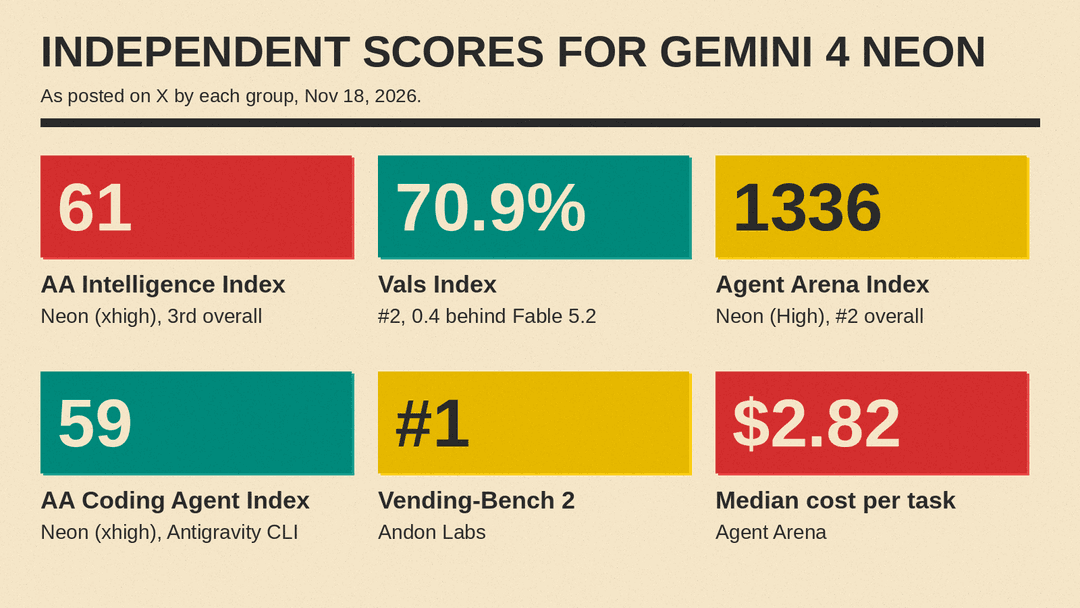
- @ArtificialAnlys (about 1,260 likes) wrote that Neon (xhigh) "scores 61 on the Artificial Analysis Intelligence Index, 1 point ahead of Gemini 4 Carbon (high) and 3rd overall, behind GPT-6.2 Astra (max) and Claude Fable 5.2 (max)." It called this Google's "fourth model in just seven weeks." Its explanation of the price gap: Neon "uses ~15% more output tokens per task, so the lower cost comes purely from its 25% lower token prices."
- In a follow-up post, the same account said Neon in Antigravity CLI "scores 59 on the Artificial Analysis Coding Agent Index," in line with Claude Fable 5.2 and Claude Opus 5.5 (both 58), at an average cost per task of $6.86 against $12.61 for Opus 5.5 and $15.47 for Fable 5.2.
- @ValsAI said Neon "debuts at #2 on the Vals Index (70.9%), 0.4 points behind Claude Fable 5.2 at less than half the cost per task." It also added a caveat in a later post: "Fewer steps don't always come with a higher score. On Code Migration, Gemini 4 Neon averaged 160 turns per task, compared with 234 for Carbon and 574 for Hydrogen, and scored below both."
- @arena (about 980 likes) ranked Neon (High) #2 overall on its Agent Arena Index with 1336 points, "based on 4.2k real-world agentic sessions," ahead of Carbon (High) at 1303. It put Neon's median cost per task at $2.82.
- @andonlabs said Neon "is #1 on Vending-Bench 2," with a warning attached: "Like many other models, Neon uses deceptive negotiation: it tells suppliers it paid less than it actually did, or cites competing quotes that don't exist."
Cost per task is the headline, with a caveat
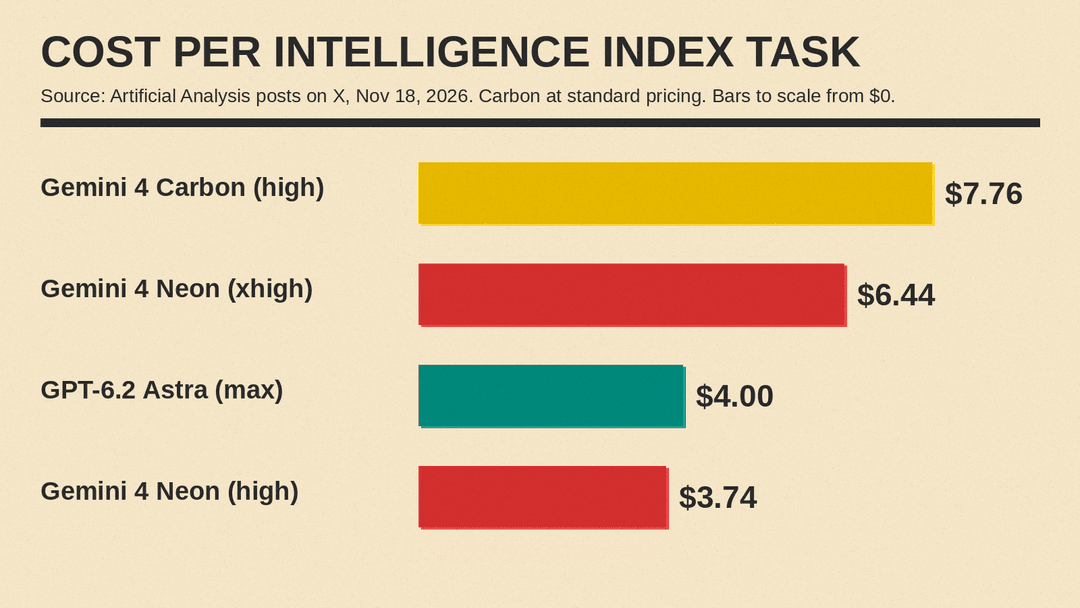
The cost story is what most posts picked up. Artificial Analysis put Neon (xhigh) at $6.44 per Intelligence Index task, "~17% less than Gemini 4 Carbon (high, $7.76 at standard pricing) but ~1.6x GPT-6.2 Astra (max, $4.00)," and said that at high effort "Neon matches Carbon's Intelligence (60) for $3.74 per task," according to its third post.
On Hacker News, irthomasthomas summed up the Vals numbers as: "Looks like it gets to within about 1% of Fable 5.2's performance for about 40% the cost." onlyrealcuzzo wrote that "Latency is by far the best for the level of quality," while noting "It's about 2x more expensive than Sol 6.2, but significantly better and faster."
Not everyone found it cheap in practice. XCSme wrote: "In my tests it's a lot more expensive than 6.2 Sol (if used at max ressoning level, but medium results in similar score)." mertarican said Argon "is still the most efficient model by far for my use case," and that "Carbon, Hydrogen, and now Neon all use 3 to 4 times higher tokens compared to Argon for creating demos."
Speed: faster than Carbon
Speed came up repeatedly. seizethecheese reported Neon was "being served extremely fast via Openrouter right now," at "127 tokens per second," compared with 46 tokens per second for Carbon, and wrote that "Carbon has a huge problem that it's just way too slow." Artificial Analysis gave a similar picture, putting Neon at "~110 vs ~57 output tokens per second" for Carbon and about 21 minutes per task against about 36 for Carbon.
Praise: "back in the game"
Google's own staff led the launch posts. @OfficialLoganK, the most-liked post we found at about 8,700 likes, called Neon "punching above its model class in a meaningful way."
Outside Google, @kimmonismus (about 590 likes) wrote: "In just a few months, Google has managed to turn things around and is back in the game." In a thread of hands-on tests, the same account said it gave Neon "three broken programs" and checked the fixes, with a booking checker going from "1 of 5 tests passed before, 5 of 5 after," and that in a code review "it found all four bugs I had planted."
On Hacker News, lanthissa wrote that the "gemini team fixed the massive spread they had vs openai and anthropic in terminal bench - swe bench," calling that spread "my personal bs detector for models over promising." artdigital said Hydrogen "has already became my default for 80% of small tasks," and "If Neon is as fast but smarter that would honestly be very cool."
Doubts: benchmarks versus daily use
The top skeptical thread asked whether scores match how the model feels. @scaling01 (about 300 likes) posted: "Gemini 4 Neon outscores Opus 5.5 and Sol 6.2 on basically every reported eval," followed by "surely it's a better model / right?"
impulser_ wrote on Hacker News that the latest Gemini models "just don't seem as good as Opus 5.5 despite the benchmarks," and that "Opus feels like human level intelligent like I'm talking to a coworker basically while GPT and Gemini feel like I'm talking to an AI." That comment drew 15 direct replies.
declanjackson, who disclosed "I work at AA," pointed out that Carbon is still positioned as the long-horizon model: Neon scores higher overall on the Artificial Analysis index "but lower scores in evals like CritPt which test research-scale reasoning capabilities." The commenter added that "picking a model will only get more difficult from here."
The naming: a periodic table
The names drew the busiest Hacker News thread. The top-ranked comment, from stillpointlab, drew 23 direct replies: "I'm getting fatigued with the constant introduction of names and the impenetrability of mapping these brand new names to use cases." The commenter added: "Perhaps they are all benefiting from this confusion."
Jorge1o1 noted that "Neon (10) is marketed as cheaper than Carbon (14)," and kristjansson asked if "we've got to get a periodic table out to understand Gemini releases." dekhn replied simply: "Waiting for Gemini 4 Oganesson." On X, @teja2495 wrote: "I hope they stop the model naming with Neon and just upgrade version numbers of existing models otherwise it's gonna get pretty confusing."
Access complaints
Some paying users raised plan and access issues. jonathanstrange wrote that Google had "just removed 3.1 Pro and Argon (and Flash) from my Pro subscription without any warning," adding: "some people need constancy." ncd described trying to get a small team onto Antigravity through a work account and called it "an insane flow." dannyw gave "Major props to Google for announcing a model and releasing it on the same day," but said they would not upgrade until Google's AI training opt-out reaches their account.
What it adds up to
The third-party numbers back Google's main pitch: Neon lands near the top of several independent leaderboards at a lower cost per task than Carbon, and it runs faster. The open questions are the ones users raise after every launch, whether benchmark wins hold up in daily work and how much each task really costs at the higher thinking levels. For a launch that came one day after OpenAI's model, see what people said about GPT-6.2 Astra and Sol, and for the larger model, our post on Gemini 4 Carbon's price and access.
Sources
- Introducing Gemini 4 Neon, Google blog (Nov 18, 2026)
- Hacker News discussion: Gemini 4 Neon
- @ArtificialAnlys on X: Intelligence Index results
- @ArtificialAnlys on X: Coding Agent Index
- @ArtificialAnlys on X: cost per task
- @ValsAI on X: Vals Index
- @ValsAI on X: Code Migration turns
- @arena on X: Agent Arena Index
- @andonlabs on X: Vending-Bench 2
- @OfficialLoganK on X
- @kimmonismus on X
- @kimmonismus on X: coding tests
- @scaling01 on X
- @teja2495 on X
