
Google opened pre-orders on Nov 12, 2026 for new intelligent eyewear collections, glasses with Gemini built in. Google says the frames were "made in collaboration with Gentle Monster, Warby Parker, and Samsung." Pre-orders are open now, and the glasses go on sale in stores and online on December 10.
The launch post, by Shahram Izadi, VP and GM of XR at Google, came with a second post on privacy for wearers and bystanders. In that post, Google says bystanders in its research "noted concerns about being filmed without their knowledge."
The two collections and prices
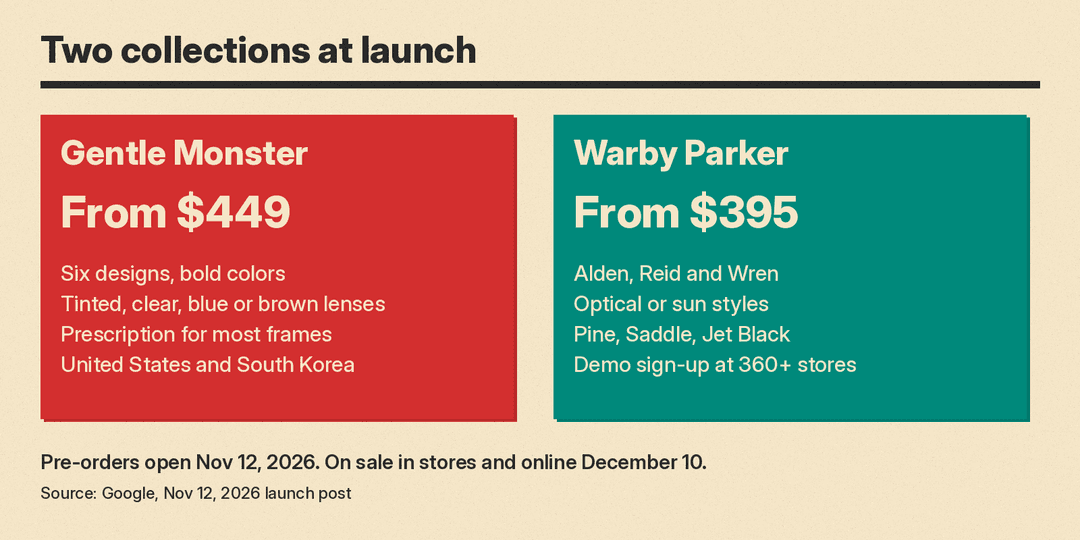
- Gentle Monster: six designs "in bold colors," including dark red, pink, gray and yellow, with tinted, clear, blue or brown lenses. Google says prescription options are available for most frames. Starting at $449. Google says this collection "will be available in the United States and in South Korea."
- Warby Parker: three styles named Alden, Reid and Wren, in optical or sun versions, in Pine, Saddle and Jet Black. Starting at $395, "with a wide range of prescription, width, and lens options." The collection is on warbyparker.com, and Google says buyers can sign up for a guided demo at "more than 360 Warby Parker retail locations."
Hands-on demos are also at select Gentle Monster, Warby Parker and Google Store locations. More details are at glasses.google.
Hardware
Google gives these figures:
- Frames weighing "around 41 grams."
- A battery that lasts "up to nine hours." A footnote says this "varies by use, configuration, settings and other factors."
- A charging case that can recharge the frames "up to seven times," with the same footnote.
- A 12-megapixel ultra-wide camera with HDR processing, image stabilization and spatial audio capture.
- Open-ear speakers, and directional microphones that Google says help Gemini focus on your voice.
- A physical power switch, so you can wear them as regular glasses.
What Gemini does on the glasses
You say "Hey Gemini" or tap the frames. Google's examples: learn the story behind a street mural, ask for a recommendation from a bookshelf, or look at an event poster to check your Calendar. You can also ask Gemini to add what you are looking at to a grocery list or remind you where your next meeting is.
Other features Google lists:
- Turn-by-turn Google Maps directions in your ear.
- Real-time speech translation from Google Translate, "with automatic language detection across more than 70 languages," when you ask Gemini.
- Music from YouTube Music, Spotify or Apple Music, and audiobooks on Audible.
- Messages and phone calls, hands-free.
- Guided Vision, which gives spoken descriptions for people who are blind or have low vision. Google's footnote says Guided Vision "is AI and can make mistakes" and is "not intended for navigation, safe-travel guidance, obstacle detection, or safety-critical tasks."
- Aira Explorer, which streams the camera feed to a trained human visual interpreter.
The launch post describes help through the speakers, the camera and your phone. It does not mention a display in the lenses. If you want to know how Gemini voice chat works on a phone first, see our Gemini Live explainer.
The privacy rules
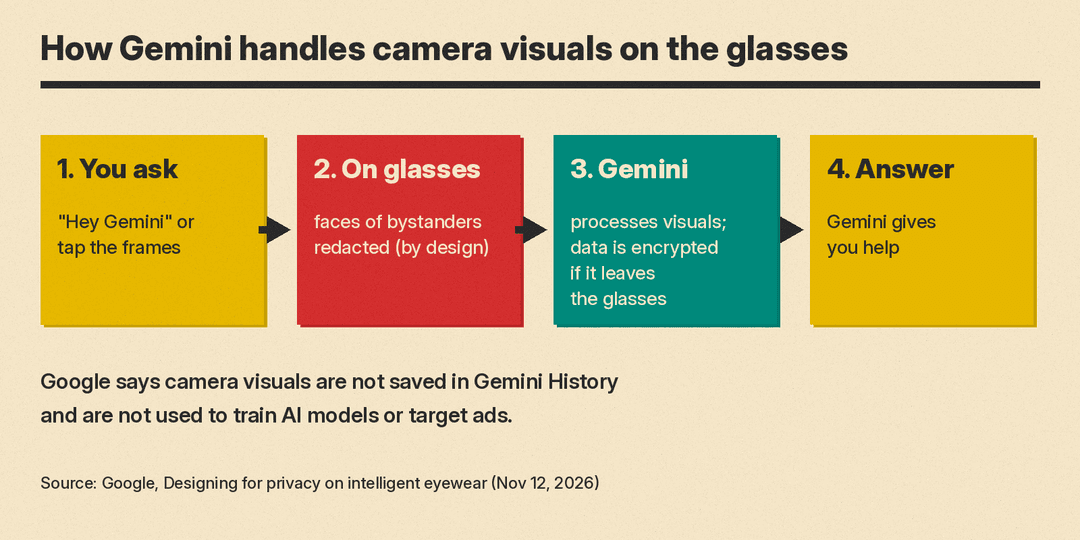
The privacy post splits protections into two groups: for the wearer, and for people nearby.
For the wearer, Google says:
- Camera visuals from Gemini on glasses are not saved in your Gemini History, and are not used to train AI models or target ads.
- Data stored on the glasses is encrypted, and data that leaves them, for example for processing on your phone or in the cloud, is encrypted in transit.
- Google says it is bringing Private AI Compute to the glasses "coming soon." It is not part of the launch list.
- Apps must ask permission before they use the camera for the first time, and you can grant or revoke camera and mic access per app.
- Your text chats are still saved in Gemini History. You can review or delete them, and you choose in settings whether chat text is used to improve generative AI models.
For bystanders, Google says:
- An outward-facing LED lights up when you take a photo or video for your gallery. If the light is covered or tampered with, "sensors are designed to detect that and prevent photos or videos from being taken."
- The glasses are "designed to automatically redact bystanders' faces before Gemini processes the visuals."
Note the wording. Google says the glasses are "designed to" do these things. It does not give test results for face redaction or the light sensor.
Google also sets rules across its services. Users must agree not to record others without permission, not to record in sensitive places, and not to cover the light. Google says breaking these rules violates its Terms of Service and "a user's ability to use the glasses may be disabled." Google Shopping and Google Ads policies do not allow "the promotion of products and services that disable or hide recording indicator lights on smart glasses." Google Play policies prohibit apps from using the camera for "social live-streaming or real-time facial identification," and from changing the behavior of the outer indicator light. The Google Safety Center has more.
Limits to check before you pre-order
The footnotes on the launch post hold the limits most buyers will hit first:
- Accounts: the glasses are "only available for use with Google accounts from the United States and South Korea" and need "a compatible 18+ Google Account."
- Phones: Pixel 7 series and above on the Android 17 September 2026 update or later; Galaxy S, Galaxy S FE, Galaxy Z Fold, Flip and Fold Ultra series on One UI 9.0 or higher; iPhone 13 Pro and above.
- iPhone gaps at launch: Guided Vision and Aira only work with a compatible Android phone, and Audible is Android only. Guided Vision and Aira "may require subscription or membership."
Why it matters
This puts Gemini on a face-worn camera sold through two eyewear brands, at prices from $395. Earlier Android XR hardware, such as the XREAL AURA, was a wired headset. These are everyday frames sold through optical stores. Gemini also came to cars this week through Apple CarPlay. For the glasses, Google pairs the launch with written privacy rules for both wearers and bystanders. Independent checks of the LED and face redaction can only start once the glasses ship on December 10.
