
The UK government says it will legislate to limit non-compete clauses in employment contracts. The move lands squarely on Google DeepMind, one of the country's most prized tech employers, as The Times of India put it. Some of its London staff have reportedly been barred from joining rivals for up to 12 months after they leave, and many spend that time on garden leave, paid by Google to do nothing.
Here is what was announced, what is still open, and why it matters for DeepMind and the labs hiring away from it.
What was announced
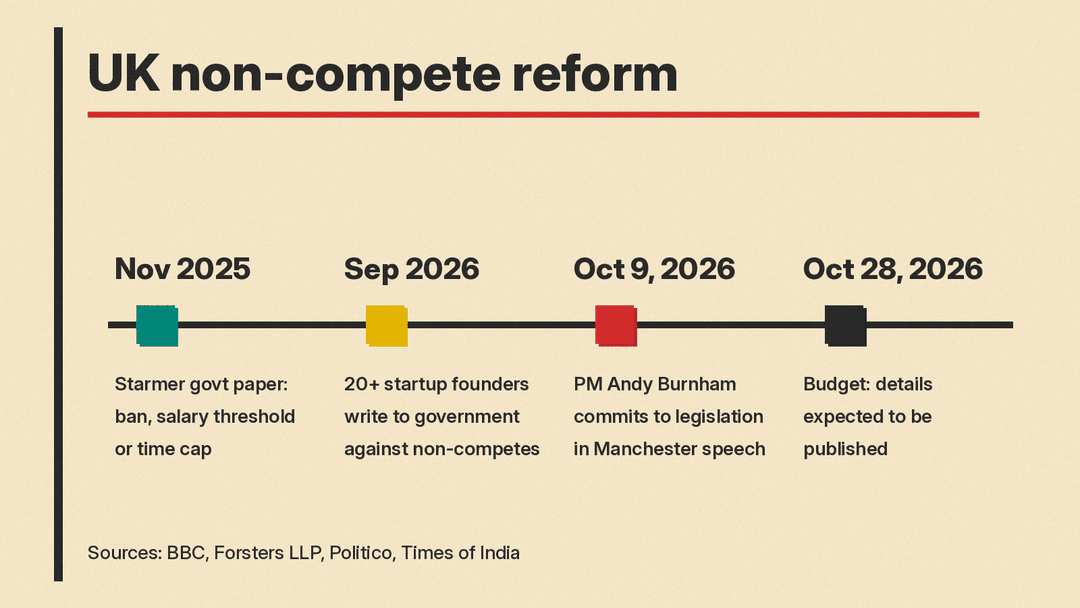
Prime Minister Andy Burnham told the Innovation Nation Summit in Manchester on October 9 that the use of non-compete clauses had "gone too far" and was holding innovative UK companies back, the BBC reported. He said the government would press ahead with legislation so the clauses can "no longer be a barrier" to hiring, and said their use stops workers from joining other companies or founding their own, adding: "I think that's a drag on innovation."
The government's transcript of the speech records the commitment in full: "I can confirm today we will legislate to make sure that non-compete clauses will no longer be a barrier to hiring for our most promising startups and scaling firms."
He called the goal a possible "Bosman ruling for the innovation sector", a reference to the 1995 court ruling that changed the football transfer market in Europe.
According to the BBC, research cited by the government estimates that about 5 million jobs in Britain are covered by non-competes, which typically last around six months.
What is still open
Burnham did not say how far the restrictions will go. The options on the table date back to a working paper the Starmer government published in November 2025. Forsters, a London law firm, lists them:
- an outright ban, or a ban below a set salary threshold
- a statutory limit on how long a non-compete can last, for all companies or based on company size
- a combination of these
Before the speech, Politico reported, citing six people with knowledge of the discussions, that the government planned to announce a full or partial ban. Two of the six said it would stop short of backing a specific option at this stage and would work out the details with industry.
The BBC says the government is expected to publish details alongside the Budget on October 28. Forsters notes that any reform needs primary legislation, so nothing changes overnight.
The scope may also go beyond non-competes. In the speech, Burnham also said the government will "bring forward options to address the wider use of restrictive practices", which Forsters says some read as a possible move against long notice periods and garden leave. AI minister Kanishka Narayan said on X that the government will look at practices such as excessive notice periods, according to The Times of India.
How DeepMind uses non-competes
Business Insider, citing four former employees, reported in April 2025 that the length of a DeepMind non-compete has depended on a person's seniority and how critical their work is. Six months was common, including for engineers working on Gemini, while some senior researchers got a full year. Google has said its contracts are in line with market standards and that it uses non-competes selectively.
The same report recalls that former DeepMind director Nando de Freitas, now a vice president at Microsoft AI, said last year that DeepMind employees contacted him every week asking how to escape their notice periods and non-competes.
There is a twist. Paid garden leave is the obvious substitute for a non-compete, because an employer can keep someone on payroll and out of the market during a long notice period. Human Times, writing on Industry Slice, reported that Google DeepMind has extended garden leave for UK staff on sensitive projects from six to twelve months. If the final rules cover only non-competes and not notice periods, that route stays open. This is why the "other restrictive practices" line in Burnham's speech matters as much as the headline.
Why the timing matters for Google
The reform lands during a run of senior exits from DeepMind, as listed by The Times of India:
- John Jumper, the Nobel laureate who co-led AlphaFold, is moving to Anthropic but is not expected to start until next year, a delay that lines up with UK cooling-off periods
- Gemini researchers Jonas Adler and Alexander Pritzel have left for Anthropic
- Noam Shazeer joined OpenAI after more than two decades at Google
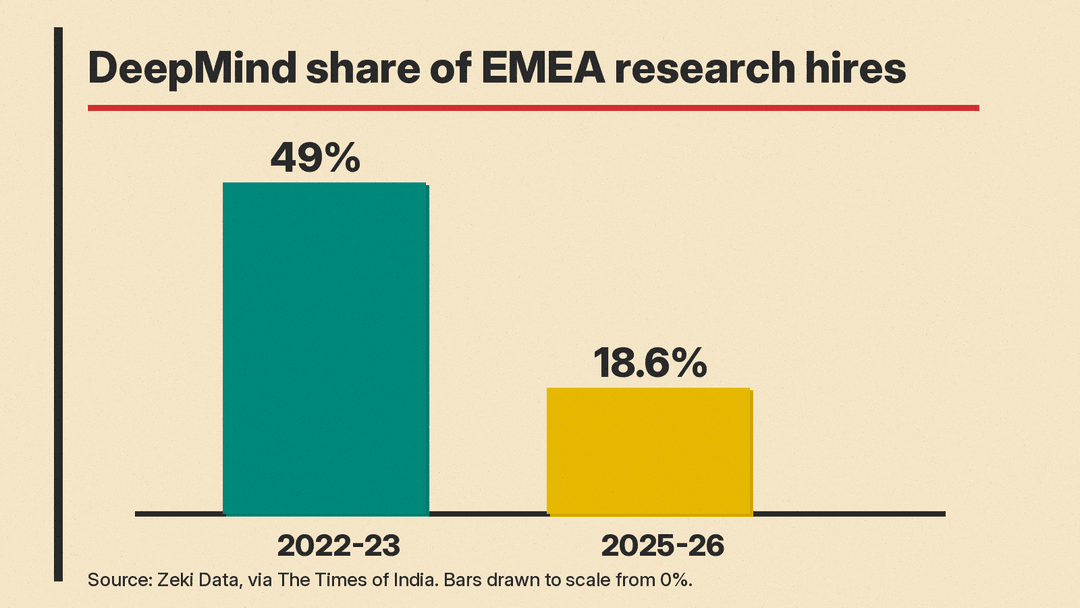
The report also cites figures from Zeki Data, a UK firm, showing DeepMind's share of research hires across Europe, the Middle East and Africa fell from 49% in 2022-23 to 18.6% in 2025-26, with Anthropic the top destination for those who left.
Anthropic, OpenAI and Meta are all hiring aggressively in London, the report says. For those labs, shorter or unenforceable non-competes would mean new hires from DeepMind could start months sooner. For Google, the clauses slow how quickly rivals can put former DeepMind researchers to work. Non-competes also shape AI hiring deals: in the term sheet for Disney's proposed hiring of about 65 Character.AI staff, Character.AI agreed not to enforce non-compete covenants against them.
Who is for it and who is against it
The push picked up last month when more than 20 UK startup founders wrote to the government saying non-competes, long notice periods and enforced garden leave undermine innovation, Politico reported. The Times of India says the letter came from Inherent Labs, an AI startup founded by former DeepMind staff. Founders and investors often point to California, which does not enforce non-competes, as having an edge in hiring.
Employer groups disagree. The Recruitment and Employment Confederation warned the BBC against "sweeping" changes, saying the clauses play a "vital role" in protecting commercially sensitive information and client relationships. The Times of India reports that TheCityUK, a financial services lobby group, opposed a ban earlier this year. The previous Conservative government ruled out a total ban after employers said it could reduce investor confidence or lead companies to restrict how they share information internally, according to the BBC.
Forsters adds a legal point that often gets lost: UK courts already enforce non-competes only when they protect a legitimate interest, usually confidential information, and go no further than needed. Restrictions longer than 12 months are not generally regarded as enforceable in employment. Critics argue the clauses still have a chilling effect even when a court might not uphold them.
What to watch
- October 28 Budget. Whether the government picks a full ban, a salary threshold or a time cap, and whether notice periods and garden leave are in scope.
- DeepMind contracts. Whether Google shifts further toward long paid notice periods, as Human Times reported it already has for some sensitive projects.
- Existing contracts. Whether new rules reach contracts already signed, or only new ones. That decides whether people now sitting out cooling-off periods see any change.
For London's AI labs, the outcome decides how quickly talent can move between DeepMind and its rivals. For DeepMind, it could weaken a retention tool at a time when it is losing senior researchers.
Sources
- BBC News: Burnham promises to curb non-compete rules in job contracts
- The Times of India: UK to scrap the non-compete rule that kept Google DeepMind researchers on paid year-long breaks
- Politico: UK plans to announce ban on workers' non-compete clauses in push for growth
- Forsters LLP: Prime Minister announces intention to limit the use of non-competes
- Human Times on Industry Slice: Employers prepare gardening leave as non-competes tighten
- GOV.UK: PM speech at the Innovation Nation Summit, 9 October 2026
- GOV.UK: Reform of non-compete clauses in employment contracts, working paper
- Business Insider: Google DeepMind's Weapon in the AI Talent War: Aggressive Noncompetes
