
Google DeepMind has released AlphaGenome 2, a new version of its DNA sequence model. DeepMind says it predicts how DNA sequences and their variations affect specific human cell types, not only broad tissues. The model is available now for non-commercial research through the AlphaGenome API, and in private preview for commercial research.
The announcement, dated November 11, 2026, is signed by Adam Gayoso, Natasha Latysheva, Pushmeet Kohli and Žiga Avsec. DeepMind also published a preprint research paper with the full methods and benchmarks.
What AlphaGenome 2 does
Nearly every cell in the body carries the same DNA. A heart muscle cell and an immune cell still switch different genes on or off. Small changes in DNA, called variants, can change which genes a cell switches on, and DeepMind calls this "a key driver of human traits and disease."
The first AlphaGenome, launched last year according to DeepMind, predicted how variants affect molecular activity across broad tissues. DeepMind later added AlphaGenome Atlas, which it describes as a platform with predictions for all 9 billion possible single-letter changes in the human genome.
AlphaGenome 2 zooms in from tissue averages to individual cell types and cell states. DeepMind says this lets researchers predict variant effects "in disease-relevant cells that would be missed in broad-tissue models," and in cell and disease states the model has not seen before.
A conditional model
The architecture change is the main technical shift. According to DeepMind, the first model took a million-letter DNA sequence and predicted results for thousands of experiments across many tissues at once. DeepMind says that parallel approach "spread the model's capacity thin."
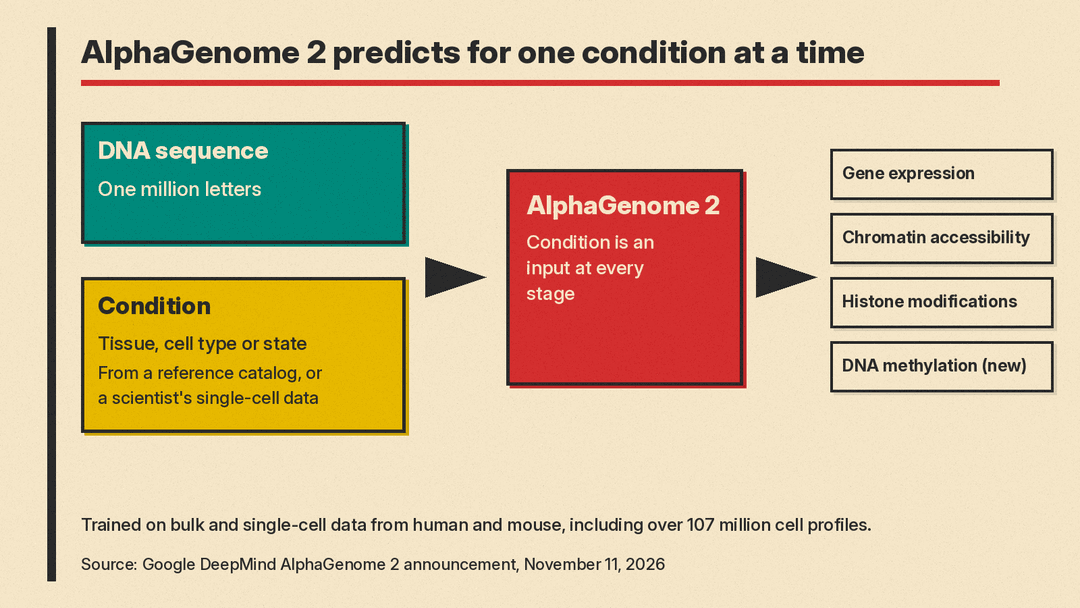
AlphaGenome 2 is a conditional model. It predicts DNA effects for one condition at a time, where a condition is a tissue, a cell type or a cell state. The target condition is an input at every stage of the model, next to the million-letter DNA sequence. A scientist can pick the condition from a reference catalog of cell types, or generate one from their own single-cell experiment with a cell encoder.
DeepMind lists these other changes:
- Training data: bulk and single-cell data from human and mouse samples, including over 107 million individual cell profiles. Elsewhere in the post, DeepMind describes this as more than 100 million profiles across 68 tissues.
- Outputs: the same core readouts as the first model (gene expression, histone modifications and chromatin accessibility), plus DNA methylation, which DeepMind calls "a widely requested readout."
- Filling gaps: if a scientist provides one measurement, such as single-cell gene activity, the model can predict unmeasured ones, such as chromatin accessibility. DeepMind says this can help researchers pick which experiments to run next.
- New cell states without retraining: scientists can upload single-cell RNA-seq data from "just a few dozen cells" to condition the model on a state it has not seen.
DeepMind's reported results
All results below come from DeepMind's announcement and paper. We have not seen independent tests yet.
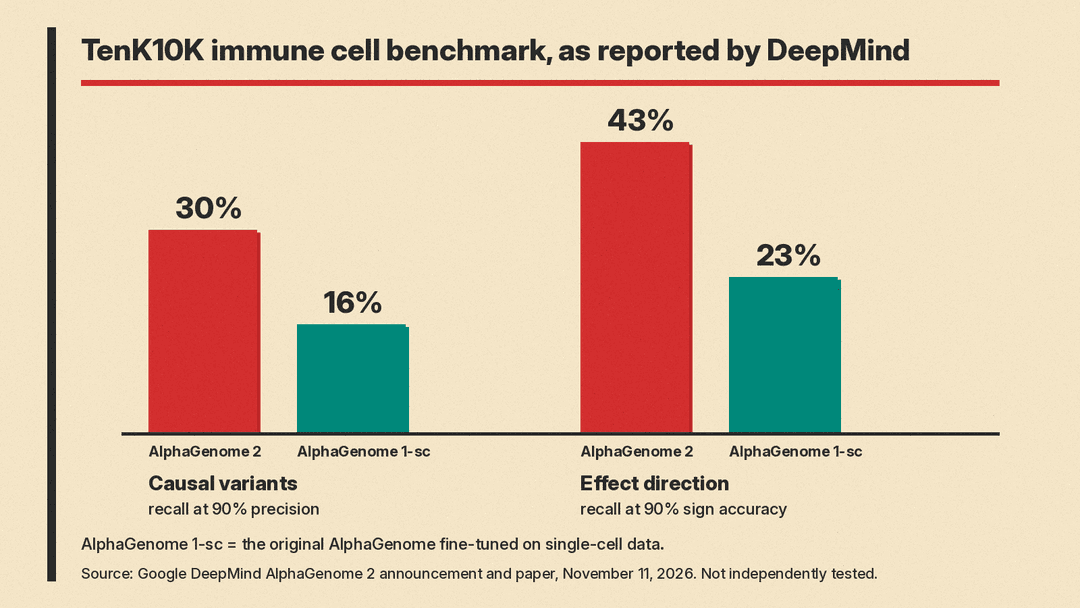
- On the TenK10K dataset, a single-cell map of 28 primary immune cell types, DeepMind says AlphaGenome 2 found nearly twice as many causal variants as the original AlphaGenome fine-tuned on single-cell data. The paper gives recall at 90% precision of 30% versus 16% for causal variants, and recall at 90% sign accuracy of 43% versus 23% for the direction of a variant's effect on a gene. DeepMind says AlphaGenome 2 also beat other specialized tools on these tests.
- DeepMind says the model computationally reproduced a published finding that a variant in a distant regulatory switch drives inflammatory bowel disease (IBD) risk by overactivating the ETS2 gene in gut immune cells called macrophages.
- On unseen data from a COVID-19 mRNA vaccine study, DeepMind says the model told vaccine-activated T cells apart from resting ones. It also says the model predicted that a variant linked to severe COVID-19 disrupts gene activity more strongly in the activated state.
Precomputed scores for disease variants
Genome-wide association studies (GWAS) link broad stretches of DNA to traits and diseases. Finding the exact variant, gene and cell type is harder. DeepMind says it precomputed AlphaGenome 2 predictions for trait-associated variants across "hundreds of human cell and tissue conditions," so researchers do not need to run large computations themselves.
DeepMind says the scores help pinpoint likely variants and cell types for traits "ranging from height to type 2 diabetes." It also says the model extends enhancer-gene mapping to primary human cell types, such as brain astrocytes. DeepMind notes that lab CRISPR screens mostly use lab-grown cell lines, so these wiring maps are often missing for cells in the body.
The post quotes two outside scientists. Professor Sarah Teichmann, co-founder of the Human Cell Atlas consortium, said: "What makes AlphaGenome 2 exciting is how it adapts directly to new single-cell data without retraining, predicting how DNA variants act in newly profiled cell states from even a small sample of cells." Peter Donnelly, CEO of Genomics Limited, said: "We look forward to incorporating it in our Mystra platform."
Who can use it
- Non-commercial research: available now through the AlphaGenome API, with interactive Colab tutorials for expression conditioning.
- Commercial research: private preview.
- Coming soon: DeepMind says it will "soon" release AlphaGenome 2 Skills in Google Antigravity, its agentic development platform.
- Community projects: DeepMind asks researchers to submit use cases through a form by November 30. It says selected projects "may be eligible for additional quota and credits."
DeepMind adds an important limit: AlphaGenome and AlphaGenome 2 "are intended for research use only and have not been validated or approved for clinical or diagnostic purposes." This is a tool for scientists, not a test that tells a person about their own health.
Why it matters
DeepMind notes that many disease-linked variants sit in distant regulatory switches called enhancers, which makes their effects hard to trace. A model that predicts those effects inside specific cell types could help researchers decide which variants and cells to study in the lab first.
It also fits a pattern at DeepMind. AlphaFold predicts protein structures, and DeepMind recently used AI agents for research on 1024-bit RSA. With the planned AlphaGenome 2 Skills in Antigravity, DeepMind says it wants to combine specialized models like AlphaGenome 2 with agentic science tools such as Gemini 4. The reported gains still need checks by outside groups using the API.
