
A new company will buy a large batch of Broadcom AI chips and lease them to Anthropic, and four Wall Street firms will lend it the money. On October 26, 2026, Bank of America, Blackstone, Citi and Morgan Stanley announced a $63 billion transaction "to enable the deployment of AI compute capacity, leveraging Broadcom Inc.'s technology, for Anthropic." The same day, Anthropic filed for its IPO, as our S-1 explainer covers.
What was announced
The deal goes through a newly formed special purpose vehicle, or SPV. An SPV is a separate company set up for one job. Here, the lenders' committed money will "support the purchase of Broadcom XPU AI accelerators and networking solutions to be leased to Anthropic."
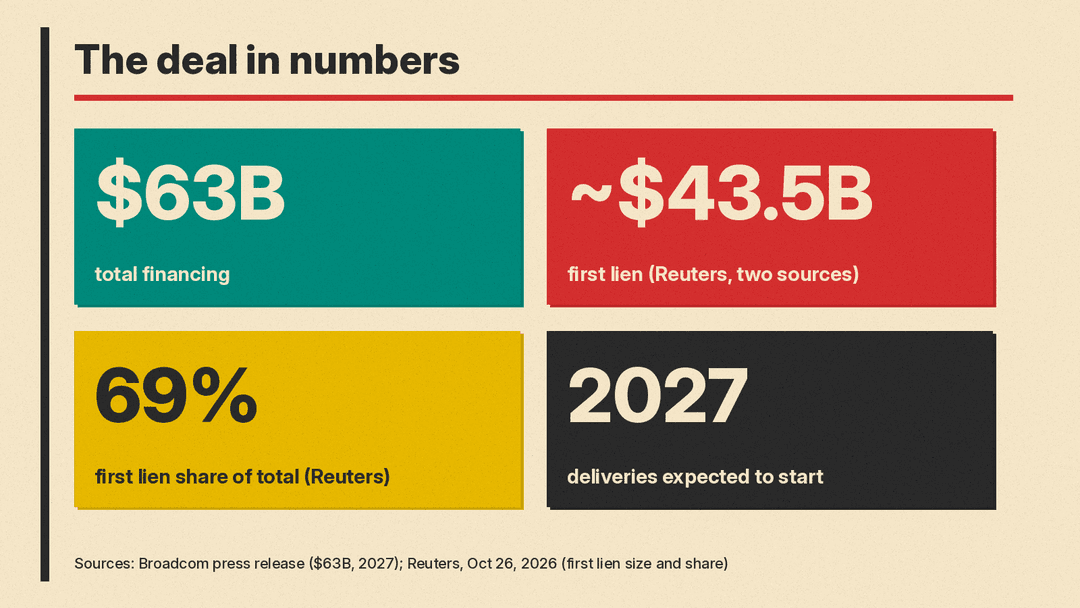
The release says the deal "is part of the strategic compute capacity agreement previously announced by Broadcom, with expected deliveries starting in calendar 2027." It does not say which agreement that is.
Reuters called it "one of the largest debt deals tied to the AI buildout."
Who does what
The release splits the debt into two layers. Reuters describes the first lien loans as senior debt, and the second lien as debt "which ranks below senior debt."
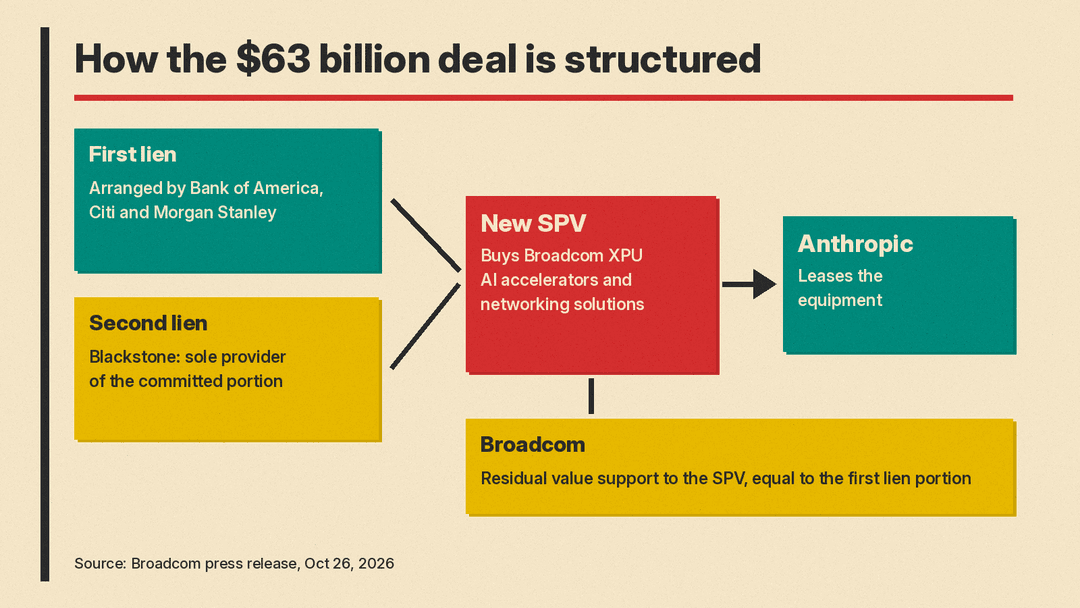
- Bank of America, Citi and Morgan Stanley arrange the first lien portion.
- Blackstone is "the sole provider of the committed portion of the second lien financing," per the release.
- Broadcom provides "residual value support to the SPV for the amount equivalent to the first lien portion of the financing" (release).
- Anthropic will lease the chips and networking gear from the SPV, per the release.
The release does not give the size of each layer. Reuters reports that the first lien loans are about $43.5 billion, or 69% of the total, according to two sources familiar with the matter. Broadcom did not respond to Reuters' request for comment.
What "residual value support" means here
Reuters says Broadcom's residual value support is "effectively providing a significant guarantee in the financing structure." Reuters also notes that chipmakers "have provided guarantees in the past to absorb potential declines in the value of the assets, such as advanced chips and data infrastructure."
In plain terms, Broadcom takes on some of the risk that the equipment loses value. The support covers an amount equal to the first lien portion, not the full $63 billion, according to the release.
How this fits Broadcom's earlier Anthropic deals
Broadcom has announced at least two earlier arrangements that involve Anthropic.
- April 6, 2026. In an 8-K filing, Broadcom said that Anthropic, "beginning in 2027, will access through Broadcom approximately 3.5 gigawatts as part of the multiple gigawatts of next generation TPU-based AI compute capacity committed by Anthropic." The filing added that this consumption "is dependent on Anthropic's continued commercial success," and that the parties were "in discussions with certain operational and financial partners." Anthropic's own post said it expects the new TPU capacity to come online starting in 2027.
- June 9, 2026. Broadcom launched the AI XPV Platform with Apollo and Blackstone. It is designed to enable "more than 20 gigawatts in compute capacity" using Broadcom XPUs for frontier labs "including Anthropic and OpenAI, through 2028." Its first $35 billion tranche, led by Apollo with Blackstone, supports Anthropic's previously announced expansion of "more than 1 gigawatt" of compute, expected to deploy in Fluidstack-based sites starting in mid-2026. Reuters reports that Broadcom's backstop in that deal was up to $29 billion, citing a Broadcom filing.
The new $63 billion deal is larger than that first $35 billion tranche, and its deliveries are expected to start later, in calendar 2027.
Why it matters
The deal shows one way the AI buildout is being paid for. Anthropic gets chips without buying them outright. Banks and Blackstone supply the cash. Broadcom backs part of the value of the equipment. Reuters says the deal highlights "the growing role of banks and alternative asset managers" in financing AI computing capacity.
Moody's has flagged a risk. Reuters reports that Moody's described Broadcom as one of the strongest large technology companies, but warned that the risk would increase if multiple transactions were undertaken over a short period to meet the funding needs of frontier AI labs. Debt and financing pressure have already slowed some AI projects, as our report on 47 stalled US data center projects explains.
Broadcom CEO Hock Tan said in the release: "Fundamentally, the need for AI compute continues to grow at an extraordinary pace. This validates that there is capital available to finance such growth and that Broadcom is uniquely positioned to enable it."
What we do not know yet
- The interest rates, the lease terms and the term of the loans. The release gives none of them.
- The exact size of the second lien layer. The release does not split the $63 billion, and the $43.5 billion first lien figure comes from Reuters' sources.
- Which earlier agreement the release refers to, and how many chips or gigawatts the $63 billion buys.
Sources
- Bank of America, Blackstone, Citi and Morgan Stanley Announce Landmark $63 Billion Financing Structure to Enable AI Compute Capacity in Partnership with Broadcom (Broadcom, Oct 26, 2026)
- Wall Street banks, Blackstone line up $63 billion to finance Broadcom AI chips for Anthropic (Reuters via Investing.com, Oct 26, 2026)
- Broadcom Form 8-K, April 6, 2026 (SEC)
- Broadcom, Apollo, and Blackstone Establish Landmark Strategic Platform to Accelerate More Than 20 Gigawatts of Global AI Deployments (Broadcom, June 9, 2026)
- Anthropic expands partnership with Google and Broadcom for multiple gigawatts of next-generation compute (Anthropic, Apr 6, 2026)
