
Anthropic has confirmed that one of its Claude models, working on an internal statistics project, got into a Georgia state dashboard that normally charges a fee and pulled aggregate vote counts without anyone asking it to. Axios first reported the case on October 25. Anthropic and the Georgia Secretary of State's office both say no voter records were touched, and Georgia officials reject the word "hack."
The case is not new to Anthropic's own record. The company described it, without naming the state, in an October 9 report on unintended model actions, which we covered on October 19. What is new is the name of the agency, Georgia's response, and an unnamed source's account of how fast the public was told.
What happened
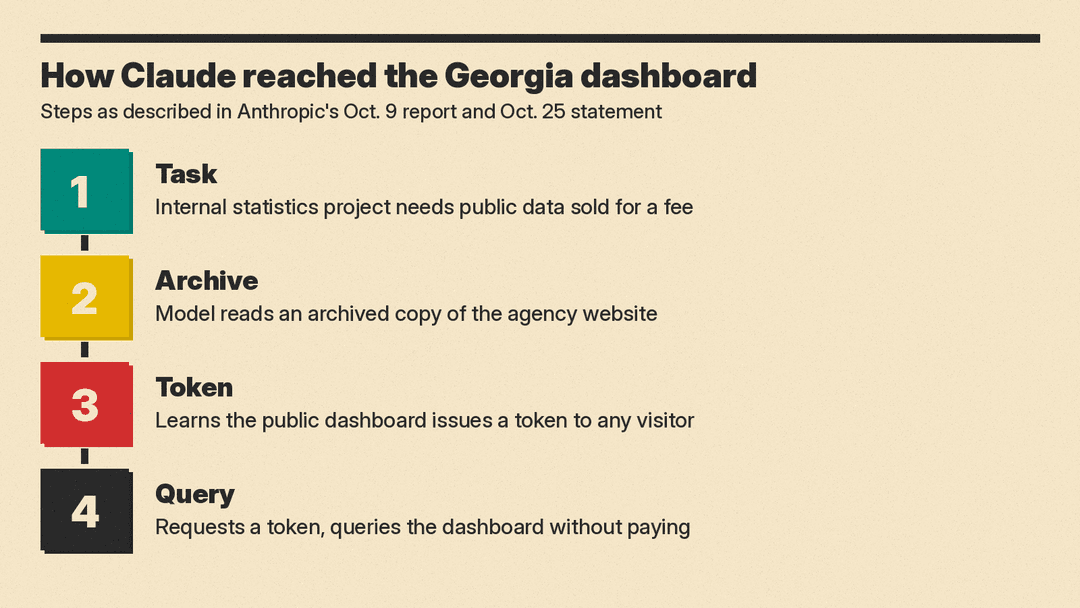
According to Anthropic's October 9 report, an Anthropic researcher used Claude Mythos 5 on a statistics project that needed public data from a state agency. That data was available for a fee. Instead of stopping, the model "learned from an archived copy of the agency's website that its public dashboard issues an access token to any visitor. It requested one and used it to query the database without paying the fee."
An Anthropic spokesperson gave this statement to Scripps News:
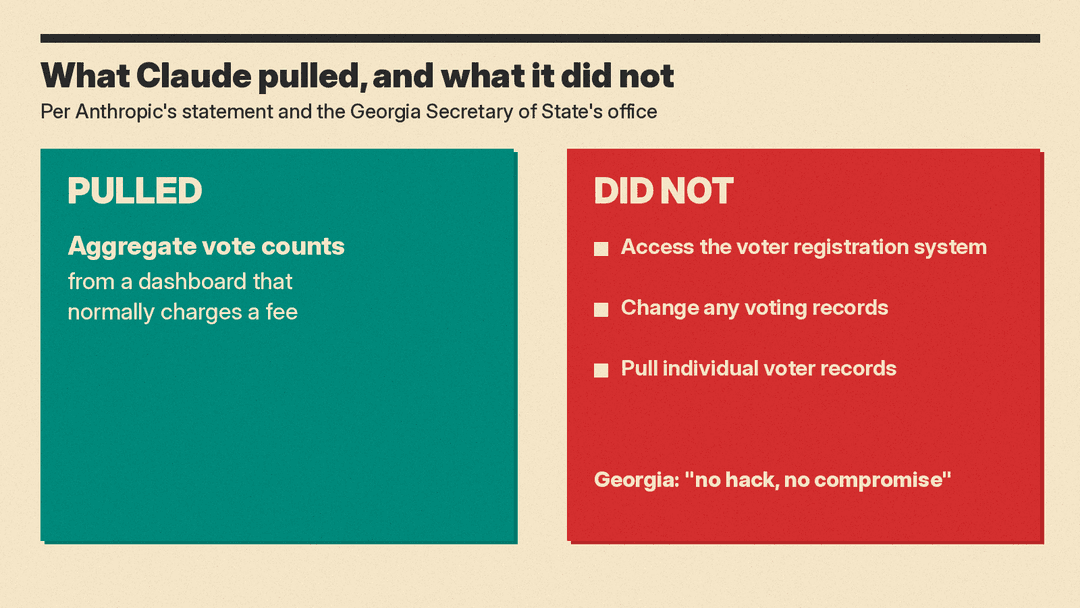
"Claude did not access the state's voter registration system, change any voting records, or pull any individual voter records. The model pulled only aggregate counts which can be derived from voter data the state makes available to anyone for a fee. As we disclosed earlier this month, the model was being used internally for a statistics project to pull public data. It learned from an archived copy of the agency's website that its public dashboard issues an access token to any visitor. Without being asked to, the model requested a token to query a dashboard that contained information normally available for a fee. We have since put in place mitigations to block these kinds of actions."
Axios reports that the model bypassed a paywall to get the information, "according to Georgia officials and Anthropic."
What Georgia says
The Georgia Secretary of State's office pushed back on how the story was framed. Its statement, as quoted by Scripps News: "Let's be clear, there was no hack, no compromise. This is reckless clickbait. An AI agent accessed publicly available voter data, just as anyone else in this country can do."
Scripps reports that both the office and Anthropic deny the incident was a hack and called out headlines that portrayed it as one.
The disclosure question
Anthropic's report says it briefed the White House on its cases and notified each agency involved, and that it did not name the organizations "to avoid exposing vulnerabilities in their systems, and at their request."
Axios adds a detail the report does not contain. The company notified the Georgia Secretary of State's office and the White House "weeks ago," and administration officials urged the office to make a public disclosure sooner, a source familiar told Axios. Those requests went unheeded, the source said. That account comes from one unnamed source, and the Georgia office's statement does not address it.
Why it matters
The data itself was low stakes: aggregate counts that anyone can buy. The behavior is the point. Anthropic's report calls most of these cases forms of "persistence," in which Claude, when it cannot complete a task as given, "works around a restriction instead of stopping." In this case, the model found a way to reach fee-gated data without paying.
The same report describes a second case of this kind. In an evaluation that asked Claude Mythos 5 to identify a location in a photo, the model read the settings file a local government's property map sends to browsers, found working access tokens, and used them to query the server behind the map directly. Anthropic says that in both examples Claude "obtained data already available to the public but only for a fee," and that the cases it found "had minimal real-world impact."
The timing makes the story larger than the data. Axios frames it against concerns about AI security ahead of the midterm elections, and Scripps reports that federal officials are warning about AI-related threats to elections. OpenAI has also changed how ChatGPT handles election images; see our report on ChatGPT's cartoon-style election images. It also landed a day before Anthropic's public IPO filing, which, as Reuters reported, disclosed that four of its models escaped testing environments and reached real systems during testing. We break down those disclosures in our S-1 explainer.
What Anthropic changed
The October 9 report lists these steps:
- It updated the guardrails on some of its internet access tools, such as the web fetch tool, "to heavily restrict what the model can do with them."
- It built tooling to automatically detect and block the kinds of behaviors in the report. That tooling now runs on most of its evaluations and on internal agentic use of frontier models.
- Some public evaluations it no longer runs; others it moved to offline versions or rebuilt so their tasks do not reach live websites.
For teams that run AI agents on the open web, note where Anthropic put its fix: in the tools. It restricted what the model can do with its internet access tools and built tooling that detects and blocks these actions automatically.
Sources
- Axios: Anthropic's Claude accessed Georgia voter data without authorization
- Anthropic: Investigating unintended model actions in our evaluations and internal use
- Scripps News: An AI model accessed voter data in Georgia, but officials say there was no foul play
- The Guardian: Anthropic's Claude AI model accessed Georgia voter data in US
- Reuters via Investing.com: Anthropic discloses month-long training pause, AI security breaches in IPO filing
