
This is an opinion piece. The facts are linked to their sources; the conclusions are ours.
Four things happened in the past two weeks that look unrelated. Vercel published data showing that teams now change models at a record rate. Replit moved the default model in its coding agent from Anthropic to OpenAI. DeepSeek swapped the model behind its main API name for a new checkpoint without asking anyone to opt in. And OpenAI set a three month shutdown date for GPT-4o and GPT-4.1 in its API.
Read together, they make one argument. In late 2026 the model is a part, and the valuable position is whoever controls which part gets used. The winners are the platforms that set defaults, the gateways and hosts that route traffic, and the teams that own their own evaluations. The losers are labs that count on customers staying put, and builders who let someone else decide when their model changes.
The data: switching is now normal
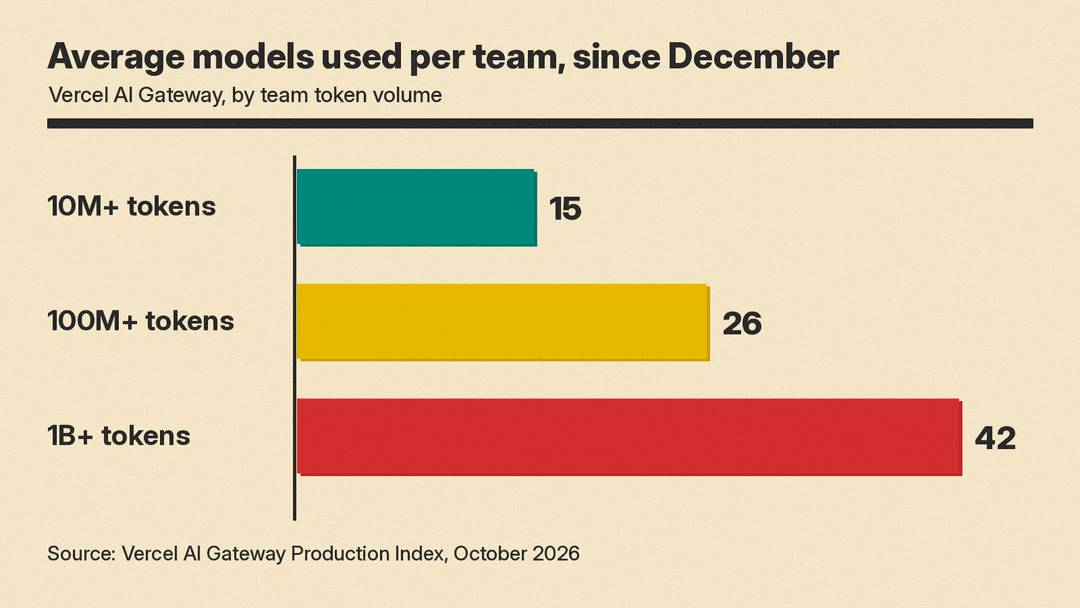
Vercel's October AI Gateway Production Index is the clearest evidence. In September, nearly one in two teams on the gateway changed their most-used model, and almost one in three changed their most-used lab, which Vercel calls an index record. Teams also run many models at once. Since December, teams that processed at least 10 million tokens used an average of 15 different models. That rose to 26 for teams above 100 million tokens and 42 for teams above a billion.
Vercel's own summary of this is blunt: "The model is becoming a replaceable part of a much larger investment." I think that line is right, and the rest of the report backs it. Open-weight models processed 71.5% of gateway tokens in September and took about 23% of estimated spend. Anthropic's share of gateway spend fell below half for the first time, from 63.7% to 43.9%. None of this means frontier labs are shrinking. Vercel says frontier spend has grown tenfold since December, and 68% of teams that spent more on open-weight models in September also spent more on closed ones. The pie is growing. What is shrinking is any single lab's grip on a customer.
One caution belongs here. Vercel sells a gateway, and a market where everyone switches models constantly is the market a gateway wants. That does not make the numbers wrong, but it is one platform's traffic, with spend estimated at list prices, and it leaves out everyone who calls lab APIs directly.
Replit shows where the power sits
The Replit story is usually told as OpenAI beating Anthropic. I think the more useful lesson is about defaults. Onstage at TechCrunch Disrupt, Replit CEO Amjad Masad said Replit was no longer working with Anthropic, citing cost, partnership, and performance, and adding, "I think ChatGPT is better now," according to TechCrunch. He later narrowed that. "Replit remains model agnostic," he told TechCrunch. "Our users can choose Anthropic's Claude or other supported models...OpenAI is now our preferred partner for powering Replit Agent." A person familiar with the relationship told TechCrunch the Anthropic partnership was still in place.
Whatever the commercial terms, the mechanism is the point. TechCrunch notes that most customers stick with the default rather than choosing a model. Claude is still on the menu, but the default is where the volume goes, and Replit, not Anthropic, controls the default. Masad said Replit had until recently been one of Anthropic's top five customers. A lab can build a model that a platform's users like and still lose much of that platform's spend with a settings change it has no say in.
The platform with the users and the eval data holds the switch. The lab holds a line item.
Labs move your model too
Switching does not only happen when customers choose it. Providers change models under fixed names, and they retire old ones on their own schedule.
DeepSeek's changelog for October 17 says V4.1 Flash "has been upgraded" to V4.1-Flash-1017 and that "the API calling method and pricing remain unchanged," so callers of deepseek-flash simply get the new model. Its announcement presents this as an improvement on benchmarks, task time, and output length, and for most users it probably is. But a team with prompts tuned to output length, or an agent pipeline that depends on specific behavior, got a different model on October 17 without changing a line of code.
OpenAI's version is the retirement calendar. Its deprecations page says it notified developers on October 14 that GPT-4o, GPT-4o mini, GPT-4.1, and GPT-4.1 mini leave the API on January 14, 2027, with gpt-6-luna as the recommended replacement for all four. The same page lists a minimum of six months' notice for generally available models unless safety or compliance concerns require a faster timeline. The entry for these models does not state a reason for the shorter window.
Neither company is doing anything unusual. Moving aliases and retired snapshots are how this industry works, which is why "pick a model and stay with it" is no longer a real option. Your model will change. The question is whether you notice before your users do.
Overhyped: launch-week leaderboards
If the model is a part, then a launch-week benchmark lead matters less than the attention it gets. Vercel's scorecard makes the point well. Jev, a decision model from TypeSafe AI, reached 35.3% of paid teams in its first two weeks, the fastest adoption in gateway history, and accounted for 0.27% of gateway spend over the same period. Reach, spend, and retention all told different stories about the same September launches.
Benchmark tables have the same problem. DeepSeek reports that the 1017 checkpoint scores 77.0 on DeepSWE v1.1, tested with the Mini-SWE-V2 harness, and Replit cites its own internal and public benchmarks for preferring OpenAI. Neither tells you how a model will do on your prompts, tools, and failure cases. A lead that can be erased by the next checkpoint five weeks later is a weak reason to rebuild a product around one vendor.
Underrated: owning your evals
The capability that matters in a switching market is the one that lets you switch safely: a test suite built from your own tasks, run every time a model changes. Replit made its call with its own benchmark. Vercel's heaviest users run dozens of models, which only works if they can measure them.
This is where one more line on OpenAI's deprecations page stands out. On June 3, OpenAI told developers its hosted Evals platform is being deprecated. Existing evals become read-only on October 31, and the dashboard and API are scheduled to shut down on November 30. OpenAI points users to a migration guide for Promptfoo, an open-source testing tool. Its Agent Builder is scheduled to shut down the same day.
I read that as a product decision with a clear lesson, whatever OpenAI's reasons. Your eval suite should not live inside the account of a company whose models it is supposed to judge. If the tool that decides whether you switch vendors belongs to one of the vendors, you do not fully own the switch.
Who wins, who loses
My scorecard, based on the events above:
- Wins: platforms with users and defaults, like Replit, because they turn model choice into negotiating power. Gateways and hosts, because routing is the job. Vercel reports that nearly 70% of September gateway spend on Chinese-origin models went through US-based providers, which shows how much value sits with whoever serves the tokens rather than whoever trained them.
- Wins: teams with their own evals and pinned versions. They can take the cheaper or better model when it appears and skip it when it is not.
- Loses: labs whose growth depends on a few large customers keeping them as the default. Anthropic's falling share of gateway spend and the Replit change both point the same way, even if Anthropic's absolute revenue keeps growing.
- Loses: builders who hardcode a model name, trust a moving alias, or keep their tests in a vendor's dashboard.
What to do this week
Check which model names your code calls. OpenAI says its List models endpoint returns a shutdown_date field, so that check can be automated. Pin a dated snapshot or open weights where behavior matters. Keep a small eval set of your real tasks outside any lab's platform, and run it whenever a provider announces an upgrade. Then treat every new model as a candidate part, not a commitment.
Model loyalty was never a strategy. In 2026 it is not even possible. The edge now goes to whoever can change models fastest without breaking anything. The same logic is starting to reach chips, as we argue in our opinion on Amazon's TorchNeuron.
