
There is no single best book for learning AI. The right pick depends on whether you want to understand what AI means for your work, learn the math, or build models and AI apps yourself. This list groups 12 books by that goal, from reads with no math to textbooks whose authors or publishers put the full text online.
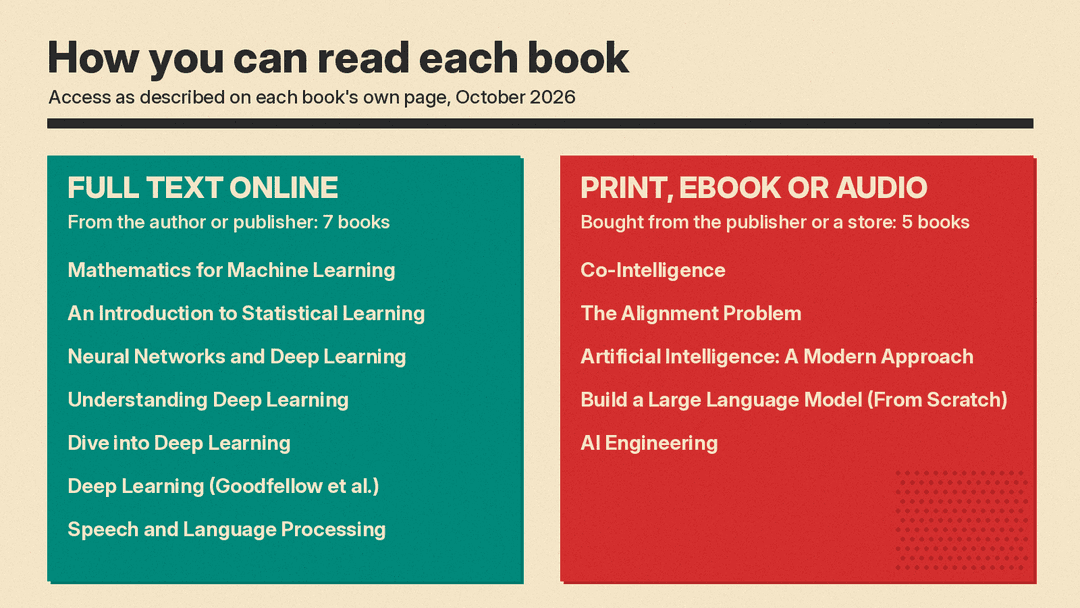
Every description below comes from the book's own page, linked inline. Where an author or publisher offers the full text online, we say so in their words. Formats and access were checked as of October 2026; prices are left out because they change.
If you would rather learn from videos and exercises, start with our list of the best free AI courses in 2026.
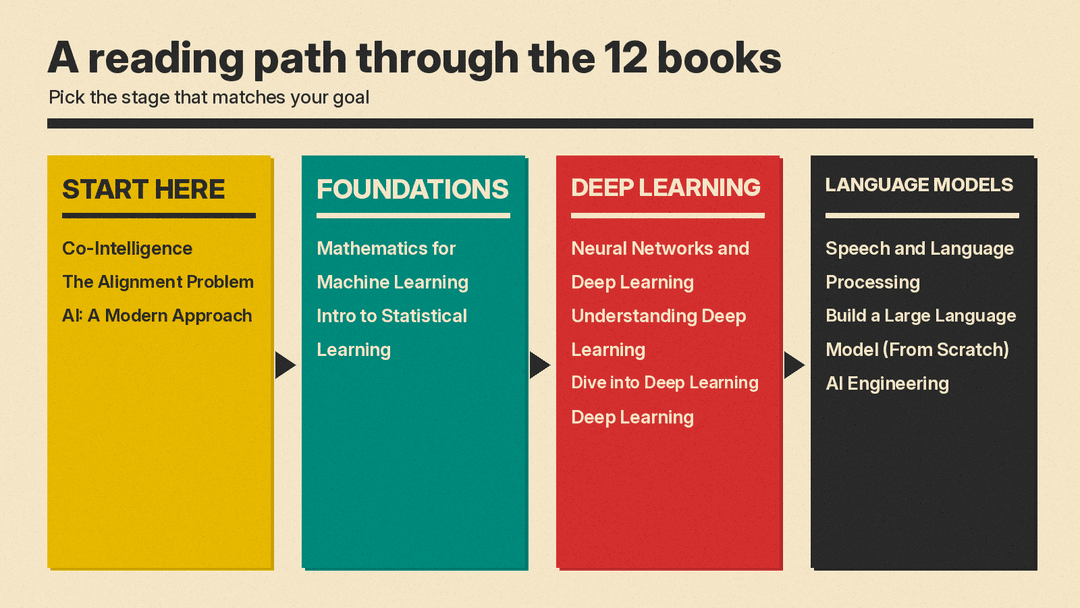
Start here: no math required
Co-Intelligence: Living and Working with AI, by Ethan Mollick
The publisher's page describes it as "the definitive playbook for working, learning, and living in the new age of AI" from a Wharton professor. It says Mollick "urges us to engage with AI as co-worker, co-teacher, and coach" and assesses AI's impact on business and education "using dozens of real-time examples of AI in action." It comes in hardcover, ebook and an audiobook read by the author.
Best for: professionals, managers and students who use AI tools at work or school and want a practical frame for it.
The Alignment Problem: Machine Learning and Human Values, by Brian Christian
The author's page calls it "A jaw-dropping exploration of everything that goes wrong when we build AI systems and the movement to fix them." The page lists a place on The New York Times list of "The Five Best Books About Artificial Intelligence" among its honors.
Best for: readers who want to understand what goes wrong when AI systems do not do what we want, and how researchers are trying to fix it.
The big-picture textbook
Artificial Intelligence: A Modern Approach, by Stuart Russell and Peter Norvig
The book's site calls it "The authoritative, most-used AI textbook." The table of contents on that page runs from intelligent agents and search through knowledge and reasoning, uncertainty, and machine learning. The site also links code, exercises and instructor material.
Best for: students who want the whole field of AI, not only machine learning, in one book.
Math and statistics foundations
Mathematics for Machine Learning, by Marc Peter Deisenroth, A. Aldo Faisal and Cheng Soon Ong
The companion site says the book "motivates people to learn mathematical concepts" and aims "to provide the necessary mathematical skills to read those other books." It is published by Cambridge University Press, and the authors write: "We will keep PDFs of this book freely available."
Best for: anyone whose math is rusty and who plans to read the deep learning books below.
An Introduction to Statistical Learning, by Gareth James, Daniela Witten, Trevor Hastie, Robert Tibshirani and Jonathan Taylor
The book's site says it "provides a broad and less technical treatment of key topics in statistical learning" and "is appropriate for anyone who wishes to use contemporary tools for data analysis." The site offers editions with R and with Python, with links to download the PDFs.
Best for: people coming from data analysis, spreadsheets or statistics who want classic machine learning before neural networks.
Deep learning
Neural Networks and Deep Learning, by Michael Nielsen
This one lives entirely on the book's website. Its chapters start with using neural nets to recognize handwritten digits, then cover how the backpropagation algorithm works, why deep neural networks are hard to train, and convolutional networks.
Best for: a first look at how neural networks learn, built around recognizing handwritten digits.
Understanding Deep Learning, by Simon J. D. Prince
The MIT Press page describes "a lucid, self-contained textbook suitable for anyone with a basic background in applied mathematics" that covers topics "such as transformers and diffusion models." The same page lists an "Open Access edition: PDF". The book's site adds "Python notebooks covering the whole text" plus figures and lecture slides.
Best for: readers who want a modern deep learning textbook with exercises, and who are comfortable with some math.
Dive into Deep Learning, by Aston Zhang, Zachary C. Lipton, Mu Li and Alexander J. Smola
d2l.ai calls it an "Interactive deep learning book with code, math, and discussions," implemented with PyTorch, NumPy/MXNet, JAX and TensorFlow. The site says it offers "an interactive learning experience with mathematics, figures, code, text, and discussions."
Best for: learners who want to run code alongside every chapter.
Deep Learning, by Ian Goodfellow, Yoshua Bengio and Aaron Courville
The book's site says it "is a resource intended to help students and practitioners enter the field of machine learning in general and deep learning in particular." It adds: "The online version of the book is now complete and will remain available online for free." The print edition is from MIT Press, dated 2016 in the site's citation entry.
Best for: a reference on the theory. It was published in 2016, so for newer topics read it alongside one of the newer books.
Language models and AI apps
Speech and Language Processing, by Dan Jurafsky and James H. Martin
The book's page hosts the draft third edition chapter by chapter. The authors write: "Feel free to use the draft chapters and slides in your classes, print it out, whatever." The latest release notes on that page describe a combined chapter that "covers transformers, pretraining, and decoding."
Best for: students who want the language side of AI, from classic NLP to how large language models work.
Build a Large Language Model (From Scratch), by Sebastian Raschka
Manning's page says Raschka "guides you step by step as you build a GPT-style LLM that you can run on your laptop," covering each stage "from planning and coding to training and fine-tuning." Raschka also writes the Ahead of AI newsletter.
Best for: programmers who learn by building.
AI Engineering, by Chip Huyen
O'Reilly's page describes AI engineering as "the process of building applications with readily available foundation models." The listed topics include evaluation, prompt engineering, RAG, fine-tuning, agents, dataset engineering and inference optimization. O'Reilly rates it "Intermediate to advanced."
For books that focus only on building AI agents, from a free primer to multi-agent systems, see our list of books on AI agents.
Best for: developers building products on top of existing models rather than training their own. It is a good companion to our guide on how to become an AI engineer.
How to pick your first book
- You use AI at work and want to understand it: start with Co-Intelligence, then The Alignment Problem.
- You want to study AI as a subject: Artificial Intelligence: A Modern Approach gives the whole map.
- You want to train models: brush up with Mathematics for Machine Learning, then pick Understanding Deep Learning or Dive into Deep Learning.
- You want to build apps with existing models: AI Engineering, with Speech and Language Processing for background on how language models work.
- You learn by coding: Dive into Deep Learning and Build a Large Language Model (From Scratch).
For vocabulary as you read, keep a glossary open. Google's Machine Learning Glossary defines many terms these books use. When you are ready for hands-on projects, our list of free datasets for machine learning projects has places to start.
Sources
- Co-Intelligence by Ethan Mollick, Penguin Random House
- The Alignment Problem, Brian Christian
- Artificial Intelligence: A Modern Approach, 4th US ed.
- Mathematics for Machine Learning, companion webpage
- An Introduction to Statistical Learning
- Neural Networks and Deep Learning, Michael Nielsen
- Understanding Deep Learning, The MIT Press
- Understanding Deep Learning, book site
- Dive into Deep Learning
- Deep Learning, Goodfellow, Bengio and Courville
- Speech and Language Processing (3rd ed. draft)
- Build a Large Language Model (From Scratch), Manning
- AI Engineering, O'Reilly
- Machine Learning Glossary, Google for Developers
