
For local AI, the number that matters most on Apple's new Mac Studio is memory, not speed. Apple says the M5 Ultra version will offer up to 512GB of unified memory, enough to load very large open-weight AI models on one desk. That option is not on sale yet: Apple's Mac Studio page says the "512GB memory option for M5 Ultra" is "coming late October."
Here is what Apple is actually shipping, what the memory and clustering claims mean for people who want to run AI on their own machine, and what it costs.
What ships today
Apple announced the new Mac Studio on August 25, and it began arriving on September 22. There are two chips. All specs below are from Apple's tech specs page.
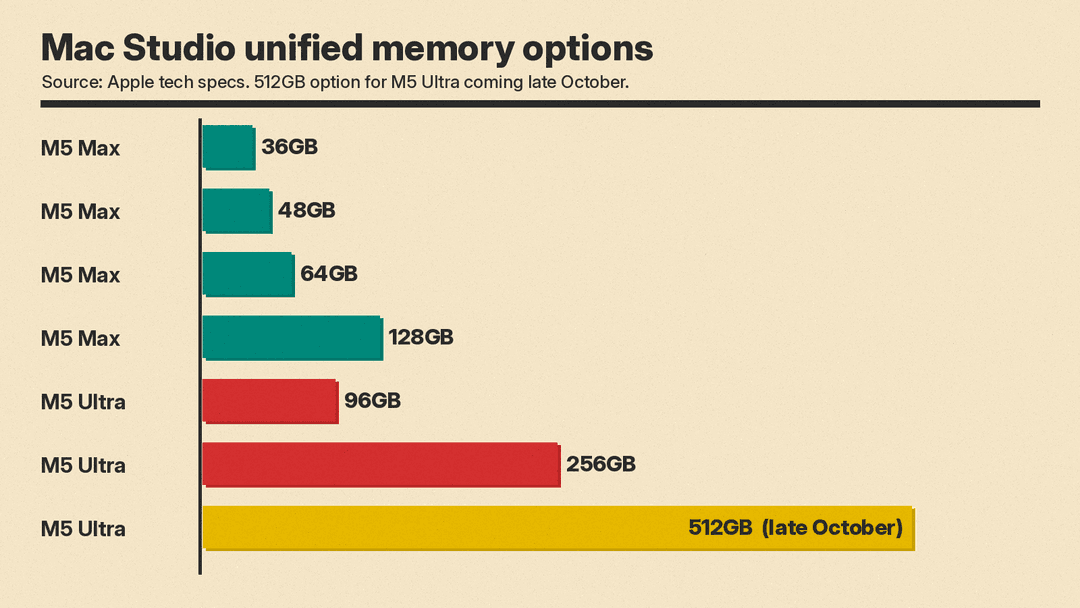
Mac Studio with M5 Max starts at $2,499 in the U.S. ($2,299 for education). The base model has an 18-core CPU, a 32-core GPU, 36GB of unified memory, and a 512GB SSD. You can configure it with a 40-core GPU and 48GB, 64GB, or 128GB of memory.
Mac Studio with M5 Ultra starts at $5,499 ($5,099 for education). The base model has a 30-core CPU, a 64-core GPU, 96GB of unified memory, and a 1TB SSD. It can be configured with a 36-core CPU and 80-core GPU, 256GB or 512GB of memory, and up to 16TB of storage. Apple's specs list the 512GB option with the 36-core CPU and 80-core GPU chip.
Both have Thunderbolt 5 at up to 120Gb/s, 10Gb Ethernet, HDMI, and, for the first time on Mac Studio, Wi-Fi 7 and Bluetooth 6. Apple says the Ultra model has up to six Thunderbolt 5 ports.
Why memory is the number that matters for local AI
On a Mac, the CPU and GPU share one pool of "unified" memory. For running a language model at home, that pool sets the ceiling: the model's weights have to fit in it, with room left for the conversation and your other apps. More memory means you can run bigger models, or keep more detail in each model instead of shrinking it.
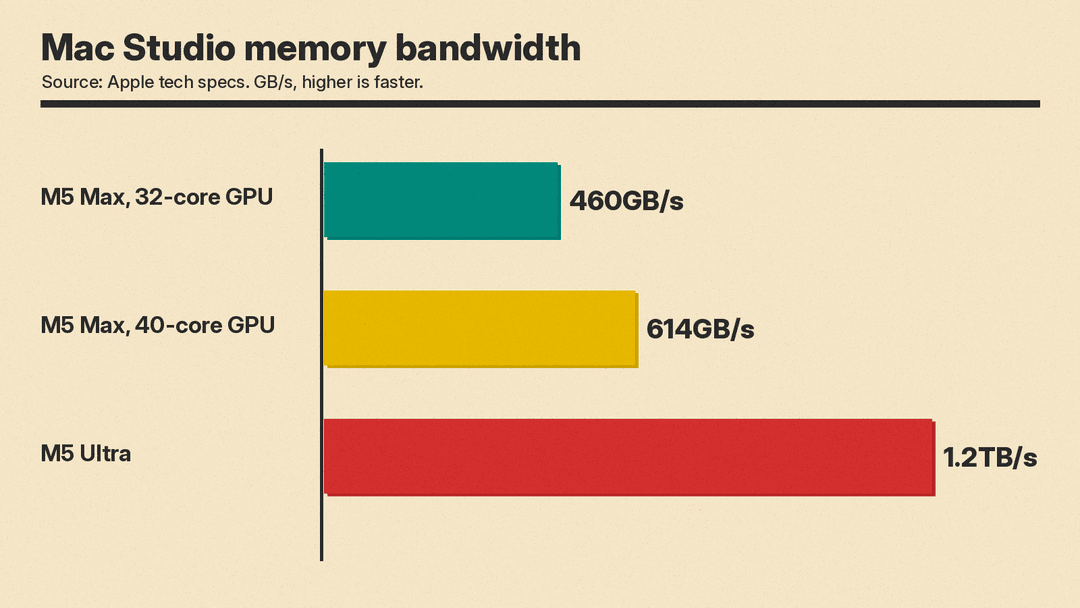
Speed of that memory matters too, because generating each word means reading through the model's weights. Apple lists memory bandwidth of 460GB/s for the base M5 Max, 614GB/s for the 40-core GPU M5 Max, and 1.2TB/s for M5 Ultra, which Apple says is "50 percent higher than before."
Apple's headline AI claim is that M5 Ultra reaches up to 4.3x the peak AI compute of M3 Ultra, the chip in the previous Mac Studio. Apple says it tested preproduction systems in July 2026. Independent tests may differ.
Apple names three AI apps on its product page: LM Studio Bionic for running language models locally, Draw Things for image generation, and exo for clustering several machines. If you are new to running models at home, our beginner's guide to running an AI model on your own laptop covers Ollama, LM Studio and llama.cpp.
Clustering: several Mac Studios as one
Apple says you can connect multiple Mac Studio systems with Thunderbolt 5 and RDMA (remote direct memory access), which lets one machine read another's memory directly. The goal, in Apple's words, is "a vast shared memory pool across systems" for loading "the largest and most demanding frontier-class open-weight models available today."
Apple's number: a cluster of four Mac Studio systems delivers up to 3x faster AI inference than one system. The footnote matters. Apple measured this with a 72-billion-parameter dense model summarizing a 32,000-token prompt, using mlx-lm on four M5 Ultra systems with 512GB each, wired as a full mesh so each Mac connected to the other three over Thunderbolt 5. That is four 512GB machines, a configuration not on sale yet, and a setup few home users will build.
Clustering also depends on software that can split a model across machines, such as the exo tool Apple mentions.
What the 512GB model will cost
Apple has not published a U.S. price for the 512GB option. MacRumors reported in August that U.S. pricing is "expected to start well above the $10,000 mark," and that Apple stopped selling the previous Mac Studio with 512GB in March because of the memory chip shortage. In Germany, MacGadget reported on October 19 that M5 Ultra orders currently top out at 256GB, that the 256GB upgrade costs 4,400 euros, and that it expects the 512GB upgrade to cost just under 9,000 euros. Treat those as reports until Apple's store lists the option.
Who it is for
For most people, a Mac Studio is not needed to use AI. Chatbots such as ChatGPT, Gemini, and Claude run in the cloud and work on any phone or laptop.
The Mac Studio makes sense for people who want models running entirely on their own hardware, for privacy, offline use, or to avoid per-token fees. Apple pitches it at "creatives, developers, AI researchers, data scientists, and more." The M5 Max model at $2,499 tops out at 128GB of memory. The M5 Ultra at $5,499 and up, and especially the coming 512GB version, is aimed at the very large open-weight models that Apple's release says users can run "entirely on device." One example is Meta's Muse Spark Open, which we covered earlier today. Our earlier explainer on local LLM inference on Apple Silicon covers how unified memory sets the size of model a Mac can run.
If you are waiting for 512GB, Apple's only commitment so far is "late October."
Sources
- Apple Newsroom: Apple introduces new Mac Studio with M5 Max and M5 Ultra (August 25, 2026)
- Apple: Mac Studio product page
- Apple Support: Mac Studio (M5 Max or M5 Ultra) tech specs
- MacRumors: Mac Studio with M5 Ultra and 512GB of RAM launching in October
- MacGadget: Mac Studio M5 Ultra 512GB configurations coming soon (German)
