
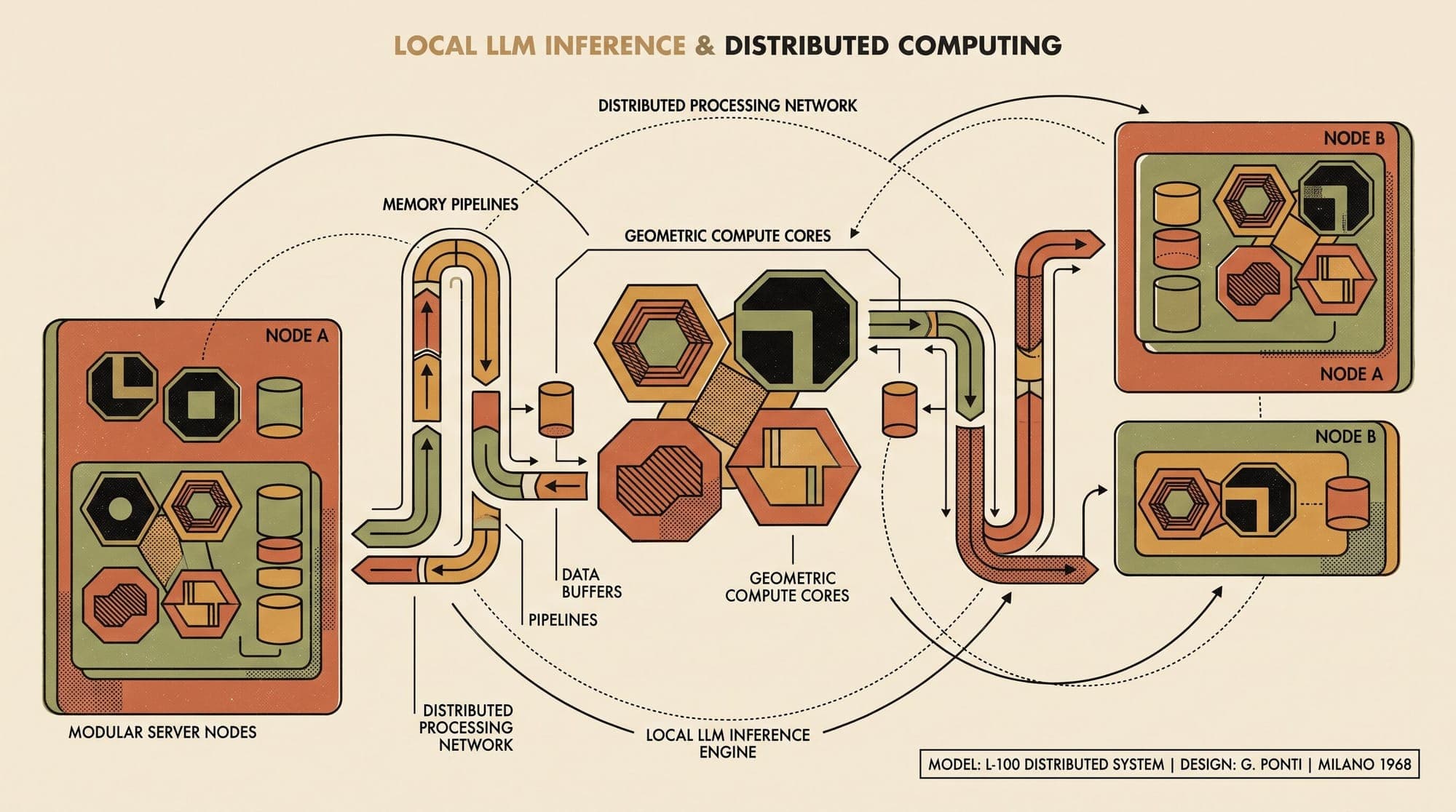
The deployment landscape for large language models is bifurcating. While datacenter workloads rely on high-throughput continuous batching engines such as vLLM and TensorRT-LLM, local and edge deployments operate under fundamentally different physical constraints. On developer workstations, embedded hardware, and private office clusters, inference is rarely bound by compute saturation across thousands of concurrent requests. Instead, it is constrained by memory bandwidth, local VRAM capacity, host-device transfer overhead, and runtime operational complexity.
Four primary open-source frameworks have emerged to address local LLM execution: llama.cpp, Ollama, Apple MLX via mlx-lm, and Exo. Each project targets a distinct tier of the local infrastructure stack, ranging from bare-metal C++ execution and container-style runtime management to Apple Silicon unified memory optimization and distributed peer-to-peer clustering.

Core Architectures and Runtime Paradigms
Understanding when to deploy each framework requires analyzing their foundational execution layers and architectural goals.
llama.cpp: Bare-Metal Portability and Minimal Overhead
Developed by Georgi Gerganov and the GGML open-source community, llama.cpp is written in pure C/C++ without third-party dependencies. It forms the foundational compute engine for much of the local AI ecosystem.
- Binary Format: Operates natively on the GGUF (GGML Universal Format) file specification, which encapsulates model architecture metadata, tensor shapes, and quantized weight arrays into a single self-contained binary file.
- Compute Backends: Implements customized hardware kernels across diverse backends, including Apple Metal (
ggml-metal), NVIDIA CUDA (ggml-cuda), Vulkan, Intel SYCL, and CPU SIMD extensions (ARM NEON, AVX-512). - Layer Offloading: Provides granular command-line control over layer placement (
-ngl/--n-gpu-layers), enabling hybrid execution where designated transformer layers run in GPU VRAM while remaining layers execute across host system RAM. - Memory Footprint: Operates with minimal resident runtime overhead (tens of megabytes at idle) and uses direct memory-mapped file access (
mmap) for instant weight loading without intermediate host memory allocations.
Ollama: Container-Style Abstraction and Local Daemon Management
Ollama packages local inference into a developer-friendly daemon written in Go, acting as an orchestration and serving wrapper around underlying C++ inference engines.
- Modelfile Paradigm: Introduces a declarative packaging format analogous to Dockerfiles, encapsulating base weights, prompt templates, system instructions, and inference hyperparameters (such as temperature and context window size) into reusable tags.
- Model Registry: Provides a centralized registry (ollama.com/library) that automates model discovery, download verification, and local layer caching.
- Automated Resource Sizing: Inspects available system memory and VRAM upon model invocation, dynamically calculating the optimal number of layers to offload to the GPU without manual tuning.
- Multi-Protocol Serving: Exposes a native REST API alongside a standard OpenAI-compatible
/v1/chat/completionsendpoint onlocalhost:11434, handling dynamic model loading, concurrent request queuing, and idle model eviction timeouts (OLLAMA_KEEP_ALIVE).
Apple MLX: Unified Memory Optimization for Apple Silicon
Created by Apple Machine Learning Research, MLX is an array framework designed specifically for Apple Silicon hardware, exposed through Python, C++, and Swift APIs. Its high-level package, mlx-lm, provides turnkey inference and fine-tuning.
- Unified Memory Native: Exploits Apple Silicon unified memory architecture (UMA), where the CPU, GPU, and Neural Accelerators share physical LPDDR5 memory on a common high-bandwidth bus (up to 800+ GB/s on Ultra chips).
- Execution Model: Implements dynamic graph construction with lazy evaluation, compiling compute graphs into optimized Metal shaders at runtime. This avoids the memory translation and format conversion overhead inherent in cross-platform abstraction layers.
- Direct Ecosystem Integration: Loads weights directly from Hugging Face Hub repositories in standard safetensors formats or native MLX 4-bit/8-bit quantized weights, bypassing the need for manual GGUF file conversion.
- Training and Fine-Tuning: Unlike pure inference runtimes, MLX includes complete backpropagation and optimizer modules, enabling local LoRA and QLoRA fine-tuning directly on macOS workstations.
Exo: Distributed Peer-to-Peer Cluster Inference
Exo addresses the physical memory ceiling of single machines by pooling consumer devices into a unified, decentralized inference cluster.
- Decentralized Mesh: Replaces traditional master-worker topologies with a peer-to-peer discovery protocol using UDP broadcast, manual peering, or Tailscale virtual networks.
- Dynamic Partitioning: Automatically inspects the available VRAM and compute capabilities of connected nodes (combining MacBooks, Mac Studios, and Linux GPU workstations) and shards models across the cluster using pipeline and tensor parallelism.
- Pluggable Backends: Leverages MLX on Apple Silicon nodes and tinygrad or llama.cpp on heterogeneous hardware, allowing users to run 70B, 120B, or 405B parameter models that cannot fit onto a single consumer device.
- Unified API Surface: Provides local ChatGPT- and Ollama-compatible API proxies that route distributed requests across the peer mesh seamlessly.
Performance Mechanics and Memory Bandwidth Limits
In autoregressive token generation, processing is almost entirely memory-bandwidth bound during the decoding phase. Because the model must stream its active parameter weights from memory into compute cores for every single token produced, generative throughput follows a strict physical relationship:
Generative Tokens Per Second ≈ Memory Bandwidth (GB/s) / Active Model Weights (GB)
+-------------------------------------------------------------------------------+
|                      Local Inference Execution Pipelines                      |
+-------------------------------------------------------------------------------+
|                                                                               |
|  [ llama.cpp / Ollama ]  --> GGUF File (Disk) --> mmap --> Host RAM / GPU VRAM|
|                              (Quantized: Q4_K_M, Q5_K_M, IQ-Quants)           |
|                                                                               |
|  [ Apple MLX / mlx-lm ]  --> Safetensors --> Unified Memory (Zero-Copy)       |
|                              (Metal Shaders, Lazy Evaluation, UMA Bus)        |
|                                                                               |
|  [ Exo Cluster Mesh ]    --> Dynamic Model Sharding (Pipeline/Tensor)         |
|                              --> Node 1 (GPU/Mac) <-> [P2P/RDMA] <-> Node 2   |
|                                                                               |
+-------------------------------------------------------------------------------+
Apple Silicon Bandwidth Utilization
On macOS devices, benchmarks published by Turing Pi and Apple Silicon research show that MLX achieves between 20% and 80% higher single-user token throughput compared to llama.cpp for models under 30B parameters. This advantage stems from MLX executing native Metal compute kernels directly against unified memory buffers without GGUF translation layers.
However, as model size approaches the physical memory bus ceiling (such as running 70B models at 4-bit quantization on an M2/M3 Max or Ultra), the performance gap between MLX and llama.cpp narrows significantly. At that scale, both runtimes fully saturate available hardware memory bandwidth.
Quantization Schemes
- GGUF k-quants: llama.cpp and Ollama support modern block-level quantization formats (including Q4_K_M, Q5_K_M, and importance-matrix IQ formats). These schemes apply non-uniform bit allocations across attention heads and feed-forward layers, preserving perplexity while reducing memory footprint to 3.5 to 5.5 bits per parameter.
- MLX Quantization: MLX utilizes grouped affine quantization (typically 4-bit and 8-bit formats with configurable group sizes) optimized directly for Apple GPU register layouts and Metal hardware matrix primitives.
Interconnect Latency in Distributed Meshes
While Exo allows users to run massive models across consumer hardware, distributed inference introduces a network communication tax:
- Pipeline Parallelism: Sequential layers are distributed across nodes. Inter-node bandwidth is required only when passing activation tensors between layer boundaries. Over standard Gigabit Ethernet or Wi-Fi, this creates pipeline bubbles and increases time-to-first-token (TTFT).
- Tensor Parallelism: Individual matrix multiplications are split across nodes, requiring all-reduce synchronization across every layer. To achieve acceptable interactive token rates with tensor parallelism, Exo requires high-speed interconnects such as RDMA over Thunderbolt or 10GbE networking.
Concurrency and Serving Dynamics
A critical distinction between local runtimes and datacenter inference servers lies in how they handle concurrent requests.
Independent benchmarks published by Red Hat evaluating llama.cpp against datacenter engines show that llama.cpp and Ollama maintain flat throughput curves as concurrent client requests increase. Because local runtimes process requests sequentially or through fixed slot allocations without continuous token-level batching or paged KV-cache management, total throughput does not scale linearly with load.
- llama-server Slot Management: llama.cpp includes an integrated HTTP server (
llama-server) that supports basic parallel slots (-np / --parallel). It processes incoming prompts concurrently by subdividing context memory, but overall throughput remains constrained by single-node compute limits. - Ollama Daemon Pool: Ollama manages multiple model instances and queues requests in software. While effective for developer environments and local agent tooling, it is not engineered for high-concurrency multi-tenant production traffic.
Architectural Decision Framework
Selecting the appropriate runtime depends on hardware topography, deployment architecture, and workflow requirements:
+-------------------------------------------------------------------------------+
|                       Local Inference Selection Matrix                        |
+-------------------------------------------------------------------------------+
|  Requirement                       | Recommended Framework                   |
+------------------------------------+------------------------------------------+
|  Frictionless Local Setup & DX     | Ollama                                   |
|  Embedded / Cross-Platform Edge    | llama.cpp                                |
|  Maximum Speed on Apple Silicon    | Apple MLX (mlx-lm)                       |
|  Local Fine-Tuning (LoRA/QLoRA)    | Apple MLX                                |
|  Clustered Multi-Device Pooling    | Exo                                      |
|  Zero-Dependency Minimal Footprint | llama.cpp                                |
+-------------------------------------------------------------------------------+- Deploy llama.cpp when: You need a single, portable binary with zero external dependencies for embedded Linux devices, edge gateways, or cross-platform environments requiring granular control over GPU/CPU layer offloading.
- Deploy Ollama when: You need rapid developer onboarding, standard OpenAI-compatible endpoints for local tools (such as OpenWebUI, Cursor, or Continue), and automated model lifecycle management.
- Deploy Apple MLX when: You are operating on Apple Silicon workstations and prioritize raw generation speed, native Python workflows, or on-device fine-tuning without container abstractions.
- Deploy Exo when: You have multiple idle consumer machines (such as MacBooks, Mac Studios, or desktop GPUs) and need to pool their combined memory to run frontier open-weight models locally without purchasing enterprise cloud GPUs.
Sources
- llama.cpp Repository and Documentation (GitHub)
- Ollama Official Repository and Model Registry (GitHub)
- Apple MLX Framework Documentation (GitHub)
- MLX-LM Model Serving and Generation Package (GitHub)
- Exo Distributed Inference Cluster Repository (GitHub)
- Exploring LLMs with MLX on Apple Silicon (Apple Machine Learning Research)
- vLLM or llama.cpp: Choosing the Right Engine (Red Hat Developer)
- Running Local LLMs on ARM Hardware (Turing Pi)



