
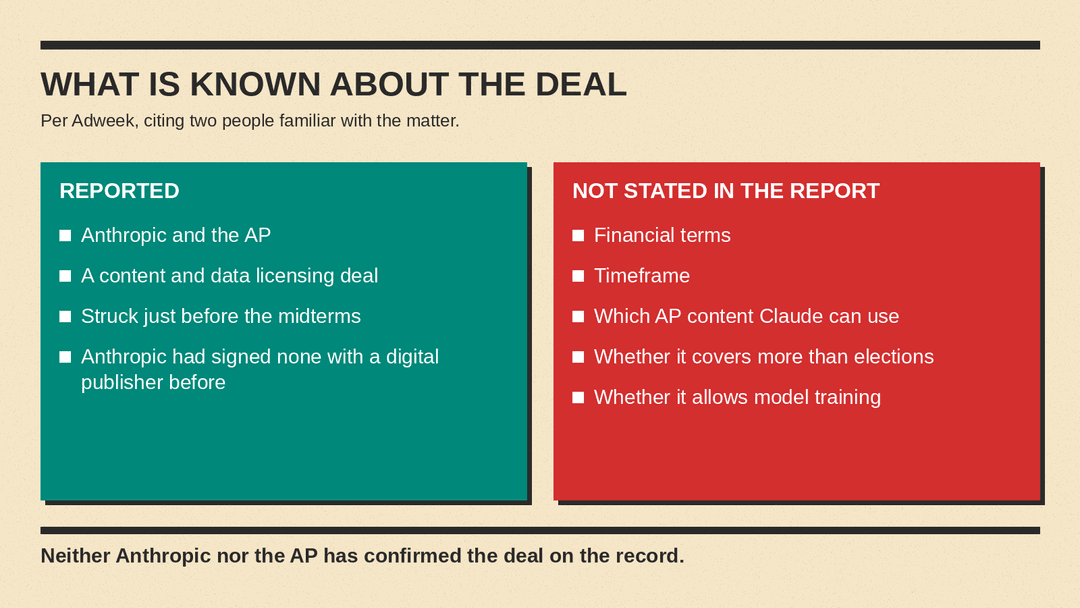
Anthropic has reportedly signed its first paid content licensing deal with a news publisher, and the publisher is the Associated Press. Adweek reported the arrangement on November 4, citing two people familiar with the matter. Neither company has confirmed it on the record, and the price, length and full scope are not public.
The reported deal fits what readers could see on election night: Claude showed vote counts inside the chat, and the results cards carried an AP credit.
What Adweek reported
Adweek's Mark Stenberg wrote in his On Background newsletter that Anthropic and the AP struck a "content and data licensing deal" just before the midterm elections. According to the report, Anthropic had not signed a content licensing deal with any digital publisher before Tuesday, November 3.
Adweek says Anthropic did not respond to a request for comment, and the AP did not comment on the record. The financial terms and the timeframe "were not disclosed by either party," the report says.
For context, Adweek notes that OpenAI has negotiated more than a dozen content licensing deals with publishers, including Axel Springer, News Corp. and The Atlantic. In an August piece, Adweek had reported that media executives said Anthropic believed its use of publisher content is legally permissible under fair use, so it had not pursued such partnerships.
Treat the deal itself as reported, not confirmed. Everything below about what Claude displayed comes from a separate test, described next.
What Claude showed on election night
Anthropic's October 14 post on the midterms said Claude would "begin showing up-to-date results on election night and in the days that follow." It said people who ask for current vote counts would see "the latest official numbers directly in their conversation." That post names Democracy Works as the source for voting information, and it does not name a source for the results.
Ulrike Langer, a media innovation journalist who writes the News Machines newsletter, tested six AI tools on election night with the same 84 questions between 1:30 p.m. and 10 p.m. Pacific Time. She reports that the results cards in Claude and in Google's Gemini credited the AP. She notes that OpenAI said ChatGPT would show "live vote counts from The Associated Press," and that the cards in ChatGPT and Claude were fed by AP.
Her timing results for Claude were mixed:
- At 5:09 p.m., nine minutes after polls closed in Maine, Claude showed an AP card with the first 22 votes, timestamped to the minute. ChatGPT's card still showed zero votes.
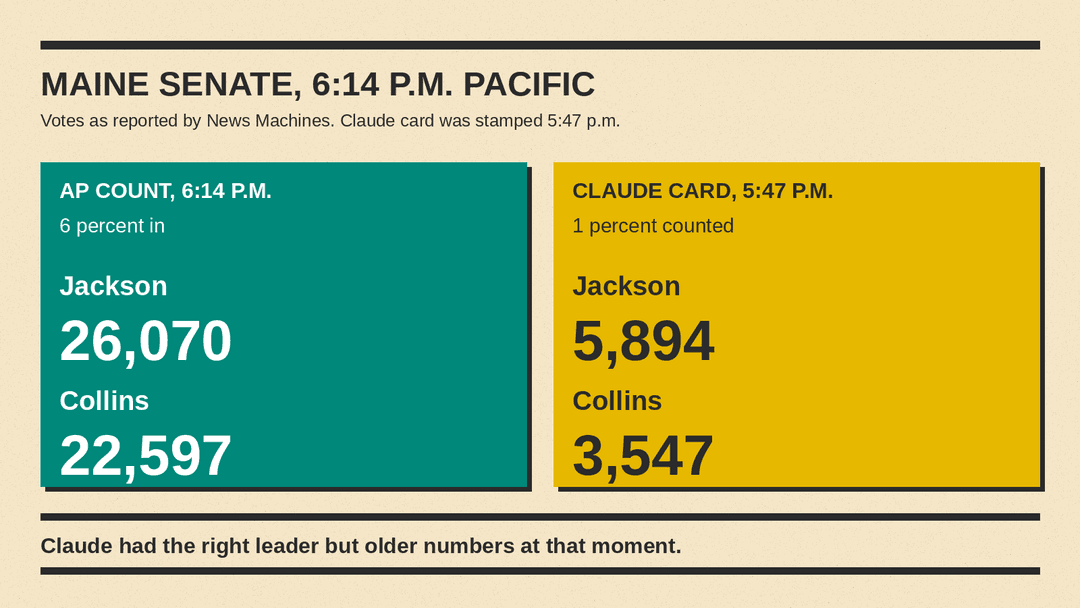
- At 6:14 p.m., the AP counted 26,070 votes for Troy Jackson and 22,597 for Susan Collins with 6 percent in. Claude's card was stamped 5:47 p.m. and showed 5,894 to 3,547 with 1 percent counted. It had the right leader but old numbers.
- At about 8:35 p.m. in Washington's 3rd district, Claude's card from 8:30 had current numbers. ChatGPT and Google AI Mode showed AP cards from 8:07 and 8:11, and they showed a different leader.
Langer calls her work a field test rather than a study: one AI-assisted human tester, one night, and no usage data. Her five takeaways for newsrooms include that "the count belongs to whoever licenses it." She also found that the AI tools often pointed readers to local outlets for races with no results yet.
How this compares with OpenAI's AP deal
OpenAI's arrangement with the AP is public and narrower in what it names. On May 27, the AP announced it would provide OpenAI with "vote count results data for national, state and local races in major American cities" through the 2028 general election, as reported by Editor & Publisher and Variety. Langer says the financial terms weren't disclosed. Variety also noted that OpenAI and the AP had earlier struck a content-licensing deal for AP stories.
The Anthropic arrangement, as Adweek describes it, covers "content and data." The report does not say which parts of the AP's output Claude can use, whether the deal covers anything beyond election coverage, or whether it allows model training. Adweek's own reading is that this is a limited first step, and it expects Anthropic to use the results to decide whether to go further. That is the reporter's interpretation, not something either company said.
Why it matters
Adweek describes publishers' crawler blocking as a digital embargo meant to bring AI companies to the table. It argues that on election night, an answer engine limited to freely accessible pages cannot say who won a Senate seat ten minutes earlier, and that this gap is the likely reason for the deal. That reasoning is Adweek's, and Anthropic has not given its own.
The AP is also an unusual first partner. Adweek says it earns most of its revenue from licensing and wire deals, and that it was the first publisher to sign with both Google and OpenAI. The AP says it counted the vote and declared winners in nearly 7,000 races in the 2024 general election, with a 99.9% accuracy rate, in its OpenAI announcement.
Adweek also notes that Anthropic is preparing to go public in a matter of weeks. The report does not tie the deal to the offering, so that link should not be assumed. For more on the company's ownership, see Who Owns Anthropic?. For how rivals handled the same election, see how OpenAI's midterm safeguard works and how AI stocks moved after the midterms.
What to watch
- Whether Anthropic or the AP confirms the deal and its terms.
- Whether Claude keeps showing AP content outside elections.
- Whether Anthropic signs licensing deals with other publishers, since Adweek says it had signed none before this one.
Sources
- Adweek: Anthropic Strikes Its First Licensing Deal, With the AP, for Election Coverage
- Anthropic: Preparing for the 2026 US midterms
- News Machines: What six AI tools showed readers on election night
- Editor & Publisher: The Associated Press adds OpenAI as elections customer
- Variety: AP, OpenAI Strike Deal for Election Data
