
Anthropic's biology research lab has published a structure for a vault particle from a bacteriophage, and it says Claude took part in every step of the work. Vaults are large, hollow protein barrels that sit in cells across most of the tree of life, and nobody knows what they do. The result does not answer that question. What it does give is a faster way to make and study vaults, and a detailed account of where an AI model helped and where it needed correcting.
Everything below comes from Anthropic's Nov 4 write-up. The page says a preprint has been submitted to bioRxiv and that the link will be added once it is live, so the findings have not been through outside review yet.
What a vault particle is
According to Anthropic, a vault is a hollow protein shell found in nearly all cells in the human body. Leonard Rome and Nancy Kedersha discovered it in 1986. It has roughly three times the mass of a ribosome, which makes it one of the largest known molecular complexes in eukaryotes. In mammals the shell is built from 78 copies of the major vault protein, arranged as two identical halves joined in the middle.
Researchers have proposed several jobs for vaults, including moving molecules between the nucleus and the rest of the cell, protecting cells from toxic compounds such as cancer drugs, and supporting innate immunity. Anthropic notes that none of these has been conclusively confirmed. Mice bred without a vault partner protein or the vault RNA develop normally, which suggests vaults may matter only under specific conditions.
What the team found
Anthropic says its team showed that many more vault proteins, including ones from prokaryotes (simple cells such as bacteria) and from bacteriophages (viruses that infect bacteria), can assemble into complete vault-like particles. Related proteins had already been spotted in genomes, but the company says that to its knowledge no one had shown that they assemble into vaults.
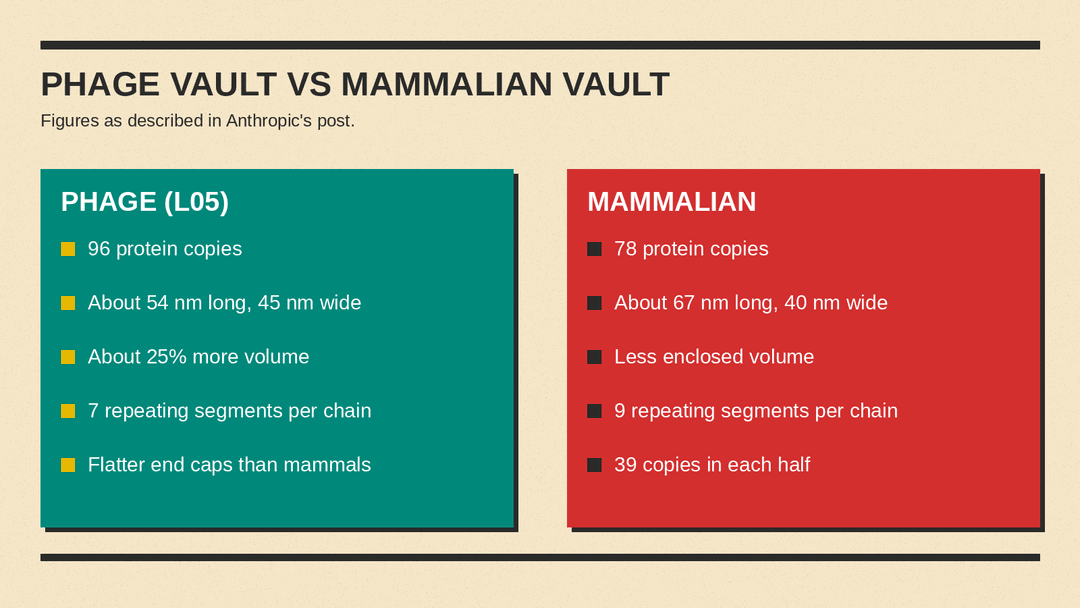
The detailed structure covers a phage vault built from 96 copies of one protein the team calls L05, with a combined mass of about 9.5 megadaltons. Here is how it compares with the mammalian version, as Anthropic describes it:
- Copies: 96 in the phage vault, against 78 in the mammalian one.
- Size: about 54 nanometers long and 45 wide, against 67 by 40 in mammals.
- Volume: about 25% more enclosed volume, because the phage vault is more spherical.
- Wall design: seven repeating segments per protein chain, against nine in mammals, with flatter end caps.
The team also made 15 altered versions of the protein. Some single changes near the cap kept the shell from closing and produced open, rosette-like particles, which shows that region is needed to seal it. When the team copied two wall segments to reach nine, the same count as in the human vault, the particles grew and enclosed roughly 20% more volume. Anthropic says this hints at how vaults could have changed size over evolutionary time. It also suggests they could be adapted as nanocapsules for delivering enzymes.
Where Claude fit in
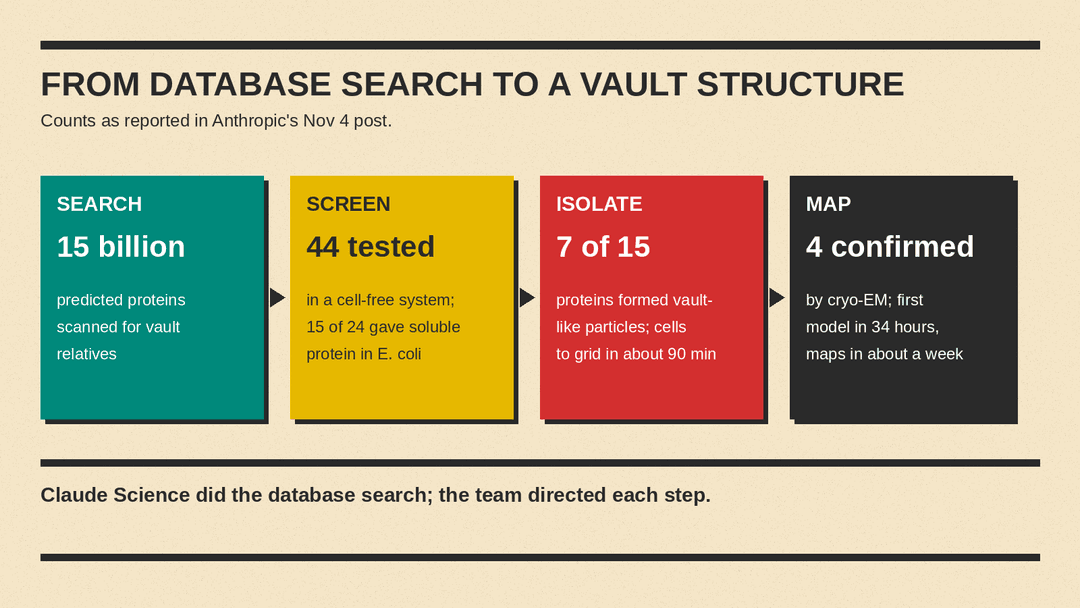
The post describes four stages, with these numbers:
- Search. Using Claude Science, the team searched a database of about 15 billion predicted proteins for relatives of the vault protein. They were rare but widely spread: present in 29 major groups of bacteria and four of archaea, yet in less than 1% of species with a sequenced genome.
- Screening. The team chose 44 candidates and tested them in a cell-free system. Claude turned each protein sequence into DNA tailored to the host cell. In living E. coli, 15 of 24 candidates produced soluble protein.
- Isolation. The usual method for eukaryotic vaults takes about three days. The team switched to size-exclusion chromatography, which takes about 90 minutes from cells to microscope grid. Claude first argued against the approach, because clumps of misfolded protein come out in the same fraction. It then recommended a specific column and proposed loading ruptured cell contents straight onto it. Under an electron microscope, seven of the 15 proteins had assembled into vault-like particles.
- Structure. Cryo-electron microscopy confirmed the vault shape for four of the seven, two from phages and two from bacteria. In an internal multi-agent setup with access to internal compute, Claude ran the open-source RELION software while the team advised on analysis choices. A first model was ready in 34 hours, and final maps came about a week after processing began.
Claude also noticed a pocket in each of the 96 protein copies that holds a small molecule the team has not identified. Claude found that its shape resembles coenzyme A, a common helper molecule in cells. Anthropic says that if it is coenzyme A or something similar, it would be an early hint of a possible function.
What went wrong
The write-up is open about the errors. A protocol Claude wrote called for a growth medium with an additive that interferes with getting DNA into cells, which set the project back two weeks. Early in the cryo-EM processing, Claude skipped a standard step and produced a flawed map blended with its mirror image. Anthropic quotes the team telling it: "Please let's do normal things unless they don't work."
The team says it shared its lab notes with the researchers who train Claude, and that Claude made fewer DNA design errors as newer models arrived. It adds that in areas the team knew well, mistakes were caught quickly, while in unfamiliar areas they cost time.
Why it matters, and what is still open
The team says none of its members had worked with a protein assembly this large and that they had limited structural biology experience. The project took under four months. Anthropic says most of the work could be done by a typical lab using existing Claude products. Only the cryo-EM analysis, which used hundreds of GPUs in parallel, needed more compute than an academic group might have.
The limits are plain. The vaults have so far been made only in E. coli, and the team has not tested whether they form in the bacteria and phages where they occur naturally. The function is still unknown. Dr. Rome advises the team, and Anthropic discloses that he was a paid consultant who gave feedback on the manuscript. He is quoted in the post: "Figuring out the function of vaults is still enormously challenging."
We have covered Anthropic's biology work before, including an autonomous protein binder design campaign and its own drug programs. For readers following AI in research, the useful part is the level of detail. It is a company's own account of a project, so it shows what Claude did and where the team stepped in, but it is not an independent assessment. For comparison, see our explainer on DeepMind's AlphaFold, and our earlier coverage of Claude building multi-step exploit chains for another case of Claude working through long technical tasks.
Sources
- Investigating vault particles with Claude, Anthropic, Nov 4, 2026
